This episode is a conversation and was not read from a written script, so there is no cited text for it. The automated transcript below is searchable.
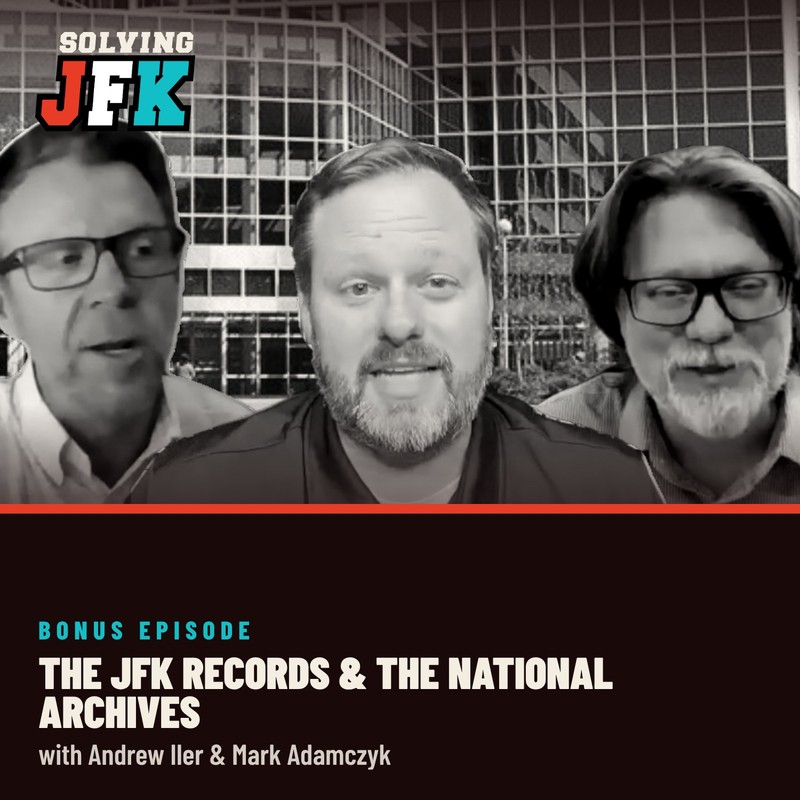
Bonus episode
The JFK Records & The National Archives
Mark Adamczyk and Andrew Iler are back on the show — two lawyers who are both co-authors with me on The JFK Assassination Chokeholds , and two of the very few people who've read the 1992 JFK Records Act as closely as it deserves. Their new three-part article, "The War on Oliver Stone's JFK Records Act," traces a line from the media pile-on against Stone's film, through two secret CIA memos written months before the law even passed, all the way to a problem nobody in the mainstream press wants to touch: more than 27,000 binding legal orders issued by the Assassination Records Review Board appear to have gone missing at the National Archives. If those orders are gone, so is the only real mechanism Congress built to hold the government to its word.
We get into all of it: the Board's fights with the CIA and FBI in the '90s, the congressional records still sealed in 2026, and the "blank piece of paper" determinations that should set off alarm bells. Then Mark and Andrew tell us about their recent trip to the National Archives in College Park, what they were allowed to see, and what they weren't. It's a long one, and as always on this show, we cite our sources and show our work.
Automated transcript
Machine-generated from the audio and unedited, so names and spellings may be wrong. Tap a timestamp to play from that point.
Speaker 3Since the inception of the congressional task force on declassification of federal secrets, the JFK Records Act has been top of mind. Given that the Act has essentially been disregarded and not followed, it was a seeming victory for truth when President Trump declassified many of the remaining with held documents in 2025. However, the exact status of the JFK records remains murky. In this episode, I'm joined once again by two of my co-authors on the JFK assassination chokeholds, attorneys, market damsick, and Andrew Eiler. But first, I want to make a quick program announcement about solving JFK. I started this podcast out of an honest desire to find out what happened in the JFK assassination. That's the same reason we've all read the books and looked at the documents and watched and listened to the podcasts. We all want to know what happened. While there's still work to do on that question, I wanted to take a moment to step back and say thank you to anyone who listens to the podcast
Speaker 3When I started solving JFK in 2022, I never imagined how successful it could possibly be. I wouldn't have believed you if you were to tell me that I would soon have the opportunity to be in a major documentary film, JFK with a doctor saw, write a book with Jim D. Eugenio Paul Blow and today's two guests. appear on CNN and other news channels and be invited to Congress for the first JFK assassination hearings since the 1990s. Also, thanks to listeners like you, episodes of Solving JFK have now been downloaded over 4 million times. I'm very appreciative for this journey and I realize that all the work I'm doing is built on the efforts of serious researchers who have made all the points that I'm making and we're making now many years before me. Having said that, this episode will be the last one for a few months. I've been doing a lot of analyzing, writing, and speaking recently, but now it's time for me to do some reading, learning, and outlining.
Speaker 3For this last run of season three episodes, I've got to cover some of the most important topics in the case. As we look at the potential roles of Cuba, Fidel Castro, the CIA, and the generals. Over the next four months or so, I'll be on a research hiatus so that I can do justice to those important topics. Beyond the lookout for new episodes of Solving JFK to come back in November. Okay, back to today's episode. Mark and Andrew are lawyers who spent years analyzing the 1992 JFK Records Act and the binding legal orders that it created. In April, Mark and Andrew published a sweeping three-part article called The War on Oliver Stone's JFK Records Act. In this episode, we're going to walk through that whole story, including two secret CIA memos written eight months before the Records Act became law, the congressional records that are still sealed today, and the central mystery, what happened to those 27,000 final determinations?
Speaker 3And then, because Mark and Andrew just got back from the National Archives at College Park, Maryland, they're going to tell us what they actually found at the archives. Coming up next on Solving JFK.
Speaker 1In Dallas, Texas, three shots were fired at President Kennedy's motorcade in downtown Dallas. The first reports say that President Kennedy has been seriously wounded by this shooting. The flash, apparently official, this is kind of the die, and come to see out. And Drew Mark will come back to solving JFK.
Speaker 3Thanks Matt, you're to see you great to have both of you guys and we've been on a lot of zooms in our lives together and it's good to be talking about something where you guys are the clear experts and I'm just going to ask you questions. I like that a lot. It's good. Three attorneys here, two experts in the JFK Records Act. Two attorneys, one Canadian lawyer. Oh, that's right. Canadian, Canadian, well, I assure you, could you guys quickly just for listeners who maybe the first time of them hearing you just kind of share your background and sort of what got you into the JFK Records Act, Andrew and the Mark.
Speaker 0Yeah, sure. I've been interested in the case, but really over the last five or six years, I really focused in on the JFK records act, the law and how the act was complied with. I. I do a lot of administrative law, and so it's an area that I'm quite familiar with on the Canadian side of the border. A lot of the principles are similar, and so it really interested me, and I really dug in quite deep into the act and working with Mark as being fantastic over the years. I'm with you, Matt. I mean, we've had so many conversations about this over the last few years, especially with chokeholds. But yeah, my my area really is the JFK Records Act and and what's happened to those records.
Speaker 3Yeah, we're going to we're going to go deep on that for sure. What about you?
Speaker 2Yeah, similar. I mean, my interest in the case peaked, I think like many of us with Oliver Stone's movie JFK in 1991, and we'll talk today about the relevance of the movie to the records and what we've seen over the last 30 years. I remember in the fall of 2016, the night that Trump somehow won that election, one of the, you know, regardless of your politics aside, I was, I was really thinking he was going to do something about the, I just had a feeling he would do something different. about the status of the JFK records, knowing vaguely that the 2017 deadline was the following year. I didn't really had drilled down on the statute yet. Then when that year went by on October 25th on the evening of the 2017, after Trump had tweeted about being excited about the finally releasing all the JFK records he didn't about face. and issued wide sweeping delays, which continued into the Biden administration, and when Trump did that, it really sparked my interest as an attorney to figure out what the heck happened, and what the statute really does say, and what it doesn't say.
Speaker 2So that just led to all kinds of work and avenues and eventually meeting Andrew, it was just kind of meant to be that we would get together and start looking at it in a different light. I don't know why it took until, five years ago for for two lawyers that have day jobs you and something else to really get into it as much as we have, but we did and here we are talking about 2026 and still a lot of problems that we have. you know, really started to understand more than ever and, you know, fortunately we were able to break it down to a lengthy article and several before that. And in a way that just basically shows, here's the problems, it's not in compliance and here's what we think can be done about it.
Speaker 3Yeah, I wanted before we get into the weeds here just to zoom out big picture, you know, you talk about the JFK assassination of people and you talk about JFK records and what a lot of people will say is what what are you even doing who even cares those those have been destroyed right they're they're not going to be around we don't even know. or they'll go, hey, there's no conspiracy, right? Those are two very common answers that you'll hear. There's not a whole lot of people who say, let's look at the actual process and see what's there and what actually happened. And what's what I love about what you guys are doing is that you're tethered to the, you're literally looking at the emails from ARB, you know, officials back and forth to one another and you interviewed some people who were on the ARB. So what I always find to be interesting is, you know, when you, when you're tied to the documents in this case and you zoom in close.
Speaker 3A lot of times, you'll find that the official story sort of supports the critic side. And that's kind of one more time. This whole conversation we're having. I view as just an extension, Andrew, of your obstruction chapter that you wrote for ShowColds.
Speaker 0But yeah, you know what chapter 10 of our book is is pretty special in my view. And I got a credit call below for doing the lion chair of work on that. But, uh, The assassinations fascinating, because from day one, anyone who criticized or thought differently than the findings of the willing report was chastised. They were marginalized by the media and over the years, whether it's the release of the or a lot of the records that the ARB released in the mid-1990s. I mean, up until that point, the going story was that the Parkland doctors didn't look at JFK's body in trauma room 1, and that they weren't qualified to render any opinions on the nature of the president's wounds. And it was the Bethesda top sea staff that knew the real truth about the nature of his ruins. And then come 1997, 1998. The ARB released all of the records from the autopsy staff and a large majority of them concurred their views and their depositions and their notes concurred with the parkland doctors.
Speaker 0The media has ignored that but every step of the way over the last 60 to 63 years. new pieces of information have come out. And our focus on the JFK records collection and the law that governs it, it's a current case of non-compliance. And people go, well, you know, all the records, there's no smoking gun, everything's nothing burger. Well, no, the non-compliance with the act is not a nothing burger. The way the record's have been handled in the 30-year since the Arab issue almost 30,000 legal orders that have disappeared is not a nothing burger. If an America's is gonna do a better job saying this part, but each record had a little court file It became a little court file based on each individual assassination record. And the fact that they have lost legal orders issued by the ARB or they're buried somewhere at the National Archives and the public haven't seen legal orders in 30 years should be a deeply problematic problem for the American public and for Congress who has oversight over these decisions that the ARB made.
Speaker 0current issue and and the records are really at the center of it.
Speaker 3Yeah, Mark, do you want to add anything to that?
Speaker 2I mean, that's well said, I mean, we take the approach that, well, some might consider one document to be a smoking gun more than the other, we decided and looking at this subject that it really comes down to all the records, those are going to live forever, whereas the more time that that goes on, and we can talk about, you know what differences could have been made if the review boards orders had been followed 15, 20 years ago instead of last year or not at all, but that being said that they're, you know, it's when you see when you go to the National Archives and You see in front of you that the still non-digitized records, I mean we only three percent of the review boards, actual records that we could find at Nera have been digitized but when you get your hands on the working files and the memorandum. Remember, and a between the review board and the agencies, the review board and different attorneys representing those agencies fighting to the nail to get every last assassination record up until September 30, 1998 when all the agencies knew the review board's lights would turn off.
Speaker 2When you see that real struggle up till the 11th hour, you just know, like Andrew said, that that's the problem in front of us and whatever records come of it, come of it. But until there's a full inventory of all of them in an accounting and just locating of the review board's actual work, as Andrew mentioned, we don't know truly what the true records collection is.
Speaker 3Okay, so we're going to zoom into a lot of the granular detail here, but just keeping it high level. So if you're someone who's, you know, you're coming to this, you're going, what are you talking about Trump released everything there's like a handful of things left, but it's pretty much all released is I mean, let's just talk for a little bit about the state of the records generally and kind of what what we have. because there are documents that there are still some that are redacted that have been released. There are others that don't have rift numbers as a whole issue of ones that we're never even looked at by the ARB, which is a much, much bigger. problem. But and then there's the timing of when the documents were all handed over. And then there's the question of this 27,000 documents, the final determination forms. And those tell us when exactly the classification should be should be removed right when the items should be declassified and what the basis is for it.
Speaker 3But basically. Those documents are not readily available. You guys found some like an archaeologist finding finding a dinosaur egg, okay? Um, but nobody knows where the rest of them are, and we have proof that they're not being followed. And so people may say, so what who cares, I see how that would have been a problem before, but now that everything's been released, why does anyone care? So if you guys kind of helped to answer those two things really quick, uh, just why should we care we don't have a smoking gun necessarily that there's a final determination for them that that there's a specific document for although it's library likely given just as numbers game and then yeah that just the state of where we are subsequently for documents.
Speaker 0You know maybe Mark maybe you should start off with covering Trump's executive order from January of last year because I think there's bit of a misunderstanding in the public about what that order actually says.
Speaker 2Yeah. Yeah. And then if you want to get into, you know, the the tronches if you will and you know one one thing I was thinking of what is it matters is well let's let's get into that um because we can answer Matt's question on the the current state of things and what the confusion is but um right so in January 2025 You know, put his best foot forward, apparently, and did what he said he was going to do in 2017 and issued an executive order. Now, an executive order is not a statute. It's not the JFK Act. It's the president using his office saying, you know, agencies, you need to do this. And the wording of the order is important to look at because the perception that it was an order for the release and that's been done is just not the case. If you look at it, it says it's time. It's in the public interest for everything to be released. I am here by ordering the Director of National Intelligence, the Attorney General, and White House legal counsel to come up with the plan and presented to me within 15 days as to how the records of the JFNNNNNNNNNNNNNNNNNNNNNNNNNNNNNNNNNNNNNNNNNNNNNNNNNNNNNNNNNNNNNNNNNNNNNNNNNNNNNNNNNNNNNNNNNNNNNNNNNNNNNNNNNNNNNNNNNNNNNNNNNNNNNNNNNNNNNNNNNNNNNNNNNNNNNNNNNNNNNNNNNNNNNNNNNNNNNNNNNNNNNNNNNNN
Speaker 2matter for which there's a public statute, a federal statute that was unanimously passed that outlines the framework of how to get it done so clearly that you really couldn't ask for it to be better. But the problem is that we no one seen that plan. And that's something that should be produced because all we've seen, we can only speculate as to what it says, because we saw a little over 2,500 records released on NARA's website shortly after Trump's order and no organized fashion, not tied to any index. And it was fascinating, right, because it made a lot of news and there were some things such as the Sessions or memo that were fully declassified. uh... it's it's it's not released it's not resulted in a final release of all of the assassinations records at the national archives because there's still no inventory and index of all of them the tie it back to just as we saw in twenty centers really know
Speaker 2I don't think any meaningful difference between releases from 2017 up until March, 2025, following Trump's order. Trump's order just said it's time to get it done, come up with the plan. But all we've seen from the National Archives is a random number of records. Some of them re-released with the same or maybe a few were set of reductions. But it's just... mainly made headlines. Fortunately, the representative Luna's task force took it forward and had some hearings and more records were obtained, but it's not what it's made out to be.
Speaker 3Right. Yeah. No. That's that's certainly true. Um, I remember, uh, it was, uh, Tulsi Gabbard was supposed to provide the, uh, a report and, and recommendations. And we still don't know what report was provided. And oh, by the way, there was the recent, I'm going to use a of controversial word curfuffle. There was a recent curve fuffle with whether or not the CIA rated Tulsi Gabbard's office that that language was later sort of walks back. But the question, it sounds like the office had some boxes of JFK records and then they didn't have the records. So I don't really know what happened exactly, but Andrew.
Speaker 0Yeah, you know, I talked in about Carfuffles, shortly on the heels of that announcement that the CIA, quote, rated Tulsi Gabbard's office, Senator Ram Paul, who I believe is to chair the Senate Oversight Committee, or no, is he's chair of the Senate Select Committee on Intelligence. One of the two, he stated on the record that he has been seeking church committee files and he says he can't even get church committee files. Church committee was a precursor to the Senate Select Committee on Intelligence. So it's his committee. He can't even get records out of the legislative archive, supposedly, or out of the CIA, regarding the church committees, notes, records, findings, it to show is the intransigence of the intelligence agencies to continue despite this powerful law the JFK Records Act to really stymie any effort for the full documented and inventory release of records. So I don't know what to say we're up against a wall.
Speaker 3So in other words, there was a thoughtful process that process was usurped at every possible turn. And it's just like everything else in the whole case. Everything that you would expect if there was a conspiracy is there. And then so it's like, well, that doesn't mean there definitely was. It's just that literally all the boxes are checked.
Speaker 0If you wanted a plan, you couldn't get a better plan than the JFK records act it laid out an iron-clad process for the collection, review, and release of all JFK records. So the concept that they had to come up with a new plan when a federal agency spent four years. tirelessly attacking this problem with legislation behind it. And Mark will get into some of Judge Tune Himes testimony on May 20th. We both think that was probably the most powerful testimony that there's been in the last 30, 40, 50 years with regard to the JFK records. And I don't know. Mark once we get into the nuts and bolts of the article, I hope you
Speaker 2Yeah.
Speaker 3Yeah. Well, let's let's, let's, let's, well, come right back to that. I want to, let's get into the article. So you guys kind of, you start out, and this is a three-part series, but one of the things you do is sort of talk about how, um, you know, Oliver Stone's film was was so important. And then it's immediately attacked by critics without ever, really, you know, without them, without them even seeing it. For example, the Chicago They just generally didn't give it a fair shake at all, but similar to the chokeholds chapter of obstruction, you know, the whole notion of how the story is playing in the media is uh... consistent throughout consistent with the nineteen sixty seven countering criticism of the war and report document where they they talked about uh... you know conspiracy theories and and how they're going to employ their propaganda assets and then of course there's the november that you know last year abc prime time to the special truth and lies who killed jfk and they give three minutes
Speaker 3to Jim D. Eugenio and Oliver Stone and then the whole rest of the two hours is all official story folk. So I guess you'll be understand the context of why that whole thing is important. The media, a mockingbird, side of things, vis-a-vis the record's act, I guess.
Speaker 0So. You know, when the film, even before the film came out, this is a singularly unique reaction, pre-emptive attack on a film. I don't think any other film has received this kind of reception by the mainstream media in the history of film, and before the film was even released, a copy of all the was obtained, some may say it was stolen, but it was obtained and it was leaked to the press. And even before the film came out, there were numerous editorial pieces that were put out by George Will, George Largner, And when the Academy Awards came out, Jack Valenti, who was the president and the motion picture association, he took out a two-page ad attacking all of her stone's film, and really they were visceral attacks. They weren't substantive attacks on the film. They might pick a tiny piece, but they were attacking all of her stone's character, his intentions, his loyalties, they were going after him in the film so hard, and then once the film was released.
Speaker 0There were even more attacks in the mainstream media, but the American public showed up for that film. I think they're all as researchers, we're all children of all of our stones film, JFK. Most of the current crop of assassination researchers are doing it because they saw all of her stones film. And then they started reading books because it was, it was so magnetic and electrifying that film that it galvanized the public. And The big thing that came out of the film was the public reaction to the content in that film. And Americans wrote and phoned their senators and Congress people. And it was such an uproar, Congress passed the JFK Records Act in record time, unanimously passing every member of the Senate and every congressman and woman voted in favor of the JFK Records Act. And that act again, it required every agency in the government to transmit all of their assassination related records to the National Archives so that they could go to the assassination records review board, which was an agency established by the act, to then review.
Speaker 0and issue orders to either release or re-review it if a part of a record or a whole record warranted postponement for release under the strict standards of the act. And you know, what we can see and Matt, you've mentioned the February 10, 1992 memo, what Mark and I found over the last year were so finely tuned and nervous about the reaction to Oliver Stone's film, they were meeting in the days and weeks after that film was released. They established a task force on how to contend with all the records that they had. What could they do? How could they maintain They knew that legislation was coming as of February 10, 1992. The film was released in late December 1991, but by February 1992, they had already done an inventory at the CIA of all of their records. And this guy Ken McDonald, CIA official, he was tasked with coming up with strategies on how to deal with their records. How can we avoid pending litigation?
Speaker 0How can we maintain security classification over our records? And he came up with, I think it's like a 13 or 14 page memo. and he laid out a bunch of different contingencies on how they could maintain classification over those records. And one of them was, Somehow they must have had ESP or something. They, you know, eight months before the JFK Records Act was passed, they said, hey, maybe if we transfer these records to the national archives under their current classification, somehow we could avoid it. We can put it in a special secure segregated collection at national archives. The CIA will even pay to staff the national archives to review these records and to make sure that they're handled properly. And there were other suggestions, but the very same day that Ken McDonald's memo came out, a second CIA memo came out from the director of operations, And it's, you don't know who the author of that memo is, but they said to hell no, hell no, we are never going to give the third party agency access to our operational files, and that's a hill that we're prepared to die on.
Speaker 0And so it's amazing to see the CIA really ramping up its concern and its strategies on how to deal with the coming JFK Records Act.
Speaker 3So where they ultimately successful in sequestering documents to give to Nera prior to the act being in place? Did that strategy ultimately work out?
Speaker 0You don't want to end it up happening. Is the act had a very tiny section in it? Is it Section 5D3 Mark? Yeah. Yeah. any record that was transferred to the National Archives prior to the passage of the act did not need to go through the assassination records review board for review and it didn't need to receive a RIF number and what the RIF numbers do for your viewers map the RIF numbers are so that each record can be individually tracked We don't know the volume, pretty sure that fairly large numbers of records were transferred to the National Archives before the act was passed. That Section 53 also says, but those records should all be released, basically. So, you know, we can't tell for sure how many records were transferred beforehand, but I think what the CIA did, they then saw the act forming up and as at past through the different stages of the legislative process. Um, they knew that there was going to be an appeal process for the agencies to contest ARR bead decisions and at that time, um, the president was George H. W. Bush, um, in his first term.
Speaker 0and he had a fairly strong history with the CIA. He was director of the CIA back when the church committee was going. And I imagine that they thought that the president would be a bit of a to ARRB orders to release records. And as we know in 1992, there was an election, George H. W. Bush contested the election against Bill Clinton and Bill Clinton won. And so I think the CIA had an evolving strategy on how to deal with the records. And that kept going. want to address kind of what happened a little bit with Clinton if if that's okay, Matt.
Speaker 2Yeah. Yeah, just real quick, the collection we're talking about at the moment, and this also applies in a similar fashion to the church committee records. But the memos that Andrew mentioned are fascinating. They're linked in our article. I would highly recommend reading the February 10th memo. It actually lays out the inventory. of what is called the HSCA sequestered collection, this group of records from the 1978 investigation at the congressional level into the case, which resulted in an entire report saying there was a probable conspiracy. So it's 64 boxes of highly sensitive CIA records, including a lot of records on Oswald and Mexico City. So, this what happened was at the conclusion of the HSEA investigation, the Congress reached an agreement with the CIA to have everything locked away for 50 years. And that that was announced or the public was reminded of that or learned of that at the end of Oliver Stone's film, right?
Speaker 2The HSC records would be locked, so people were freaked out by that and like, what in the world why do we have to wait, you know, to twenty twenty nine to learn more. So the JFK Records Act as Andrew's already stated, well, a destroyed that whole plan that they had to keep everything secret till 2020-29. It certainly expedited the process and almost immediately after the film there is this law in place. So that just want to give a little context. You can actually see the inventory, if you will, if records were talking about and speaking of inventories, kind of answers, one of your questions in a sense, Matt, how do we know what number of records made it into the archives early to be especially protected, not until there's an inventory of the sequestered collection as turned over to the National Archives and when. And in an index showing the class if it's been released now or not, so that's the only way to truly know.
Speaker 2But yeah, what happened with Bill Clinton, as Andrew mentioned, he took a pretty pro-ARB stance. I mean, not just, I mean, he did. So the agencies we think and I agree with Andrew, they went into the JFK Records Act world and the review board, knowing they were going to be independent, knowing that they would have to provide as many records as they could tolerate for independent review. And they didn't know yet what the review board was going to do if they were going to play along with the agencies and let them defer records until 2017 or maybe longer if they could get away with that the review board said hell no. We're going to hold you to the standards of the JFK Records Act unless you give us a heck of a reason that's supported by the law to not release this now. We're going to release it. So agencies were like, oh, this is they're going to actually do their job. Now I got a appeal to President Clinton to overturn the review board.
Speaker 2President Clinton didn't overturn a single review board declassification decision. If the review board said this comes out now, or in 2006 or in 2017, Clinton said that's fine with me in every case. And so that was another indication to the agencies that the JFK Records Act was going to be a problem. The review board was doing its job. They fought the agency on every single appeal. And so then it turned into what we feel and we've seen living and breathing records at the archive. It's recently as two weeks ago awaiting out strategy. They literally waited out the review board until they were out of money in time.
Speaker 3Yeah. I'm reminded of something that Alan Dullis said during one of the Warren Commission meetings when someone's asking about what, you know, will Hoover be honest about whether or not Oswald was an informant. And then Dullis, without, of course, ever mentioning the CIA role for Oswald, Dullis comes out and says, well, even if he was, I'm sure Hoover would just lie about. So, there's this memo that you've uncovered from 1992 after the movies out, but before the act is live and they see it coming down the pie and they're like, we're not going to let this happen and then they're like, oh, maybe we can sort of defang it and they're like, oh, it's happening and they're like, oh, it's happening and they're talking so seriously and these silly little citizens think that their law is going to be a thing and then they're like, and then so then they And then at that point, what it becomes just a waiting game and even Tanheim himself said that he knew they were waiting him out.
Speaker 3So what does that look like for, let's the CIA, let's just say, to wait someone out. I mean, would the documents have already been, does that mean that they just didn't provide the documents on the front end? Or like, what does that mean? There's just all these outstanding requests that they never responded to? Like, would the rubber meets the road? What does
Speaker 2Yeah, I mean, I'm glad you mentioned Judge Tuneheim from his May 20th testimony before Luna's committee last year, one of his other statements, and I listened to it again earlier this week, because it's that good. He said, many of our specific requests for records they wanted to see went unanswered and I actually found an example of that that I linked in the article. Judge Tuneheim was asking the CIA for assessed assistance with their Mexican government liaison for access to the telltap operational records that would have recorded the phone calls of Oswald and Mexico City at the embassies or alleged calls. And they wanted to complete the story on Mexico City, that the HSEA did a heck of a job trying to do it in hard way and at Lopez wrote a 400 page report. And the review board knew that there were still significant questions on that. In fact, the Lopez report, as I just mentioned, wasn't even publicly available when the review board started.
Speaker 2They got it declassified. And, but Judge U9 was looking for more of the records to supplement the Lopez report. Those operational files on the telltap operations that were run out of the Mexico city station and couldn't get them. I saw a memo that, you know, were the CIA got the priority request from U9 and they went back to their office and said, we're going to have to figure out how to respond to this. So that, yes, that we know that the waiting out involved, you know, heavy contested hearings with the board, at least on the records they were willing to provide, and then we've also seen a lot of activity in the internal review board records as recently as two weeks ago where they were fighting tooth and nail, I saw a church committee. Um, you know, an inventory A to Z. You name any intelligence officer of interest at the time of the church committee. Uh, they were investigating the intelligence abuses all the way going back to the Warren Commission.
Speaker 2And, uh, they had all these kind of all transcripts of all their testimony and executive session given to the church committee. Four or five pages an inventory and handwritten notes of the ARB staffers saying we got this. still following up on this haven't heard back on this and this went all the way up until the review board was done in September 1998.
Speaker 0Yeah, you know, Matt, our last visit on May 18 to 20 to the archives. We just really focused in on ARRB internal records, which are not digitized. And the whole pause for me, my area, I was looking for policies and procedures of the board for the review process and for issuing their final determinations and that kind of information. Mark was there really focusing in on congressional records, how the arm handle congressional records and throughout like all the records that I reviewed of Jeremy Gun and Mark reviewed Ron Heron who was a senior legal counsel for the The are really only functionally operated between April 95 and the end of September 1998. 94, they were established and they got appointed, but they were really getting like their office building in place and staffing up a brand new agency. and developing their policies and procedures. They really started to get into the records only in the late spring of 1995, when their actual review process started.
Speaker 0And even back into 1995, they had identified the church committee, the HSEA records as being kind of a hot zone for interest, and we need all of those records. And so you can see, starting in 1995, they start to make requests. And again, a lot of this documentation isn't publicly available. It's not digitized, so Mark and I are reading correspondence after correspondence. from 1995, 1996, but in 1997 as they know their mandate is going to come to an end within a year, 1997 and 1998, they're sending like bi-monthly memos. We still haven't received this. We're following up. This is essential information. You need to give us a response on this. You need give us a timetable when you're expecting these things. They don't meet their timetables, another memo immediately follows. The Arb staff were tenaciously diligent trying to get these records with the force of the law out of the agencies and you can just see roadblock after roadblock delay after delay.
Speaker 0It really games that are playing and it got to the point where Judge Tuneheim And Jeremy Gunn started to send threat letters to the agencies. If you don't do this, we're just going to release all the records that we have. And they literally would say, and that kind of blunt language, do it, or there's going to be serious consequences. And they were also writing to Congress to complain about the rate of release. And so, When we talk about a evolving strategy, CIA didn't really know how the act was going to be passed in its final form. But once they saw it, you know, counsel for the CIA, I think his name is John Edensher. He wrote a 1992 memo and he's like, Holy G's, guys, they're going to allow for the public to have judicial review of the arms final determinations. And he's writing this in a memo to the to the director of the CIA. This act has real teeth. We're going to be in court. This isn't FOIA.
Speaker 0This is like the JFK Records Act. We're going to be judiciously reviewed on the arms final determinations. So this is a whole different animal than we're used to.
Speaker 3Yeah. And so just real quick, back to the the church committee and how that you're talking about how the ARB was really making a push for the church committee. I read in your article and I suppose I knew this, but I never, I didn't connect these things together. Arlin Spectre was there of the Senate, the select committee on intelligence at the time when the ARB was trying to get the documents. So he's once again in a position to to affect the case. That's
Speaker 2Yeah, I am in finalizing the article and looking into that committee more, it's called the SSCI that the ARB was dealing with, I'm the church committee records and I wanted to see who they were dealing with, Malcolm Blunt had told me that the review board was struggling with a guy named Charles Bataglia who was a staffer on the Senate Select Committee on Intelligence and I looked him up and he worked for none other than Ireland Spectre. Yeah, he was the liaison, if you will, and I found a couple memos in Ron here in Spiles that Andrew mentioned. He was working for Jeremy Gunn, and his soul job was to dig down to inventory and get as many church committee records as he could. And even right to Charles Bataglia saying, you know, here's our latest inventory. You know, you still owe us XYZ 123. And then, they would have a call like a member random of the phone call and but tagly would say okay I gotta go talk to senator specter about this you know I saw you with those um... you know i got to say if jim were here what would he say you would go you can make this stuff on make it up
Speaker 2And I tell you, you know, in all seriousness, the part, the part of the church committee holdings that the review board was bound in terming to get what they struggled with the most was the swiker heart files, the subcommittee of the church, which, you know, the church committee looked at a lot of different intelligence abuses, but swiker and heart specifically focused on nothing else but the JFK case. There was not a single trace of the swiker heart working files and records. at NARA. And I know Malcolm has gone to narrow at least three times asking for assistance with the legislative archives. The review board sent staffers over there for three working days towards the end of their term to get, you know, to get the records in the church committee holdings and it's that was definitely lingering as of the closing of the review board and until there's a We mentioned the HSEA 50 year rule that the Senate select committee on intelligence has the same thing.
Speaker 2They have a resolution where they re-review their classified documents every 50 years. That could be what Senator Rand Paul is up against right now. They are treating their records under special rules that are inconsistent with the JFK Act.
Speaker 0That's a great point, Mark.
Speaker 3Yeah, good. That's a good point. Something. So not not to be a conspiracy theorist here guys, but I just wanted to throw out something that came to mind as we're talking about this. So Jeremy gun, all right, he's sort of got a very important role, right? And this, of course, A lot of people have important roles in the ARB who would be in a position to influence. I want to be very clear. I'm not saying that any specific person was a CIA asset in any way whatsoever. Here's what I am saying. After having recently studied, you know, KGB spy games, et cetera, it would be really surprising to me if there was something so high stakes. and that that covered that was going to impact intelligence agencies so much and then they would to for them to not have any assets on the inside would be would be surprising would it not I'm just speculating I'm not saying we've seen I was saying isn't that what they do wouldn't we expect them to have someone there and if so that would be hard to to combat I guess I don't know if you guys ever thought of that
Speaker 3Like, oh my gosh, CIA is so powerful. Why didn't they just put someone on the inside and take it down from the inside? That would probably make me think well.
Speaker 0I think it's pretty well known. There were at least two CIA officials on staff at the ARB. I was surprised to learn that who knows if there were more, but I think it's pretty widely known that two staff people were one was just secunded right out of the CIA. Um, and apparently in your position on the arp. Yeah, I believe it was open. Yeah.
Speaker 3I don't want to name any names or I'm just saying I would expect them to like the amount of effort like the CIA has a document about Mark Lane going to a conference in Brazil one time and then like in the 90s like you know So for them to be something this high stakes and then to not weasel their way on doing I would just I'd be disappointed in them honestly Um Anyway, just kidding CIA. Thank you for being us a for all friends. Um, we're good. Uh, so let's talk about final determinations and these final determinations forms. That's sort of that sort of zooming super tight in and the reason to final determination matters is that there are still some records out there that are withheld that should be released and these forms may tell us exactly When they should be released, and if we can get our hands on a form of one that hasn't been released, that sort of our golden ticket to to get in order to get that released.
Speaker 3Is that the significance of the final determinations? Or am I probably over some of you?
Speaker 0Yeah, you know, I mean, it may be, it may not be. We don't know. We've only seen probably 900 to 1000 ARRB final determinations. Now, when I was at the archives in November 2024, I search tons of boxes, I found a box and a half containing about 450 final determinations. Again, these are the legal orders by law. The ARRB was mandated to issue for each record. that it reviewed and granted a postponement of disclosure to an agency requested that a record or a part of a record not be publicly disclosed. So for each of those, it's standardized form. And in the form, it has the RIF number, the originating agency, the data, the document, the number of pages of the document. And then if Let's say there's a three-page document and there's eight sections of the dot, separate sections of the document that they want to remain classified. They'll basically redact those sections. The first redaction on page one will be post-pulment number one.
Speaker 0For that post-pulment, the arb was required to give a specified reason under section six, why that post-pulment was justified under the law. same thing, postponement number two on page one. That's postponement two. There had to be a written reason to not disclose that particular section of the document. And so they did that for almost 30,000 documents. So In total, the ARRB issued 27,000 separate legal orders. Some of those legal orders were 15 pages long because something like the Lopez report had almost 400 reductions in it on its first run through. So it was almost a book, the first order, final determination for the Lopez report. But again, we don't know what happened to these legal orders. They were supposed to be published in annual reports every year by the Arab between 1994 and 1998. The Arab only ended up publishing one annual report. And again, this was mandated by law that the Arab had to issue annual reports.
Speaker 0and they didn't, and part of those reports had to be all of the final determinations issued that year.
Speaker 3and that and what you found when you went in 2024 or the last time you went was a box of what like a 900 final determinations.
Speaker 0450 yeah and I took a fairly well circulated photo now they were all in a box that was labeled press and public contacts. which really had nothing to do with the contents of that box, so even if you were searching and you can only search by archival boxes at the archives, there's no possible way you would have found those if you were looking specifically for final determinations. what period of time were they for from yet i that's yeah that's a great question the the only determinations i've been able to get all the determinations from nineteen ninety five ninety percent of those were consent consent post-polliments because they had social security numbers in them so they couldn't release government employees social security numbers So the 1995 final determinations are kind of a relevant, but I got 450 from 1996 and that's when they were starting to get into some slightly sensitive documents.
Speaker 0It was pretty clear. And in those 450, I would probably suggest 70 to 80% of those required that the associated records be released in January of 2006. So, the R-Bissued in order for each record and 78% of those orders issued in 1996 required that the record be released in 2006. By, yeah, Nera had to comply with these orders under the law. So there's just sort of automatically being released in 1996 because they were legal orders ordering them released. And when I pull blow and I created a database and And when we reconciled the order with the actual related record, we found that most of them didn't comply with the order. And the records remained withheld into the 2020s, instead of being released in 2006. So I mean, it's demonstrable, non-compliance with the R borders that we found.
Speaker 3So, okay, and the whole question is, where are all the rest of these final determination notices? And what's really interesting about your article here or the work that you've done and the original research that you've done is you have, I think, laid out a definitive case that those final determination forms should exist. They should have existed, right? So you talked to Jeremy Gunn, who was the Chief Council, talked to Judge John Tahnheim. It's a Tahnheim or Tahnheim. I wanna get it right. I think he says Tahnheim. All right, tune high. And when you talk to them, gun told you be email that a hundred percent of the final determination forums should be housed in NARA and available for inspection. And Judge Tsunheim told you that all the boards determinations were final determinations. And he said that if date specific releases didn't happen, this was to the that someone hasn't pulled out the record.
Speaker 3Well, G, maybe the record wasn't there. It turns out. And he confirmed the 27,000 individual releases number. Good.
Speaker 0Yeah. Yeah. He has several times on numerous podcasts. And I think he even said it in his under oath testimony that they issued 27,000 final orders with regard to postponements. Now, you know, one of the, for me anyway, I think Mark would probably agree. One of the most interesting sections of the art over the interviews that I did with the senior Arab staff. And, you know, I got to say they probably thought I was a little bit crazy, because like, I drilled down on into the weeds and great detail, you know, did you staples or to use paper clips? Yeah. What color were the file folders, right? And people just it seems insignificant, right? But what I really wanted to establish. Like, just, so it's un-debatable, is that for every record, they created a file folder. And again, I'll go back to what the way Mark describes it. For every individual assassination record, the ARRB had a file folder.
Speaker 0It was like a court-doc-doc at for a specific file. their policies mandated that they handle and create each file and that your lawyer, you know, how law firms filing systems work. You know, you got Jeremy Gunn, a whole team of lawyers that are creating a process for declassification. You've got to do things systematically. So, each file folder started with a rift sheet or an identification aid. It had an unredacted copy of an assassination record. Then it had the redacted copy. Then it had the agencies request for, like their justification for the postponements. It had all of the Arab staff notes in these file folders. And once the review process and recommendations for each record, everything was put in this file folder and it was put in a box to go to a board meeting so the board could vote on those records. Once the board voted on the record, Everything was typed into their lotus note system that also tracked everything and at the end of the meeting they would print off all the final determination forms and it was the staff's responsibility to take a printed copy of the final determination form.
Speaker 0Find the folder for the related file and that final determination form would be literally attached with a clip to the, as the covered new cover sheet of the inside of that file, and everything would be clips or nothing could fall out of the file. And then it would be put in another archival box based on the meeting date in the agency, put back in the arbskiff so that it could be transmitted to Nera and entered back into the system with the final determination supposed to have governed. I don't know Mark, I've spoken too much on this. Our last trip to Nera on May 18th, the 20th, Mark, you take it away on one of our main goals was to get these file folders. So I'm going to mark take it from here because it's a nice story.
Speaker 2Perfect segue into Matt's question, like where else do you look for these right and not any mislabel box I mean you could get lucky again. So we we One of the chief goals on the recent visit was yes to Locate the remaining file determination at final determination orders where they got to be there. We just heard their review board is on record that they were created and that they were filed away and transferred to Nera very systematically. So, you know, Andrew came up with a really good idea that I quickly bought into about a month before we went to the National Archives. He's like, we... We need those, those review boards, file folders that that would have all of the work of the review board that led up to a final determination order. They were all physically attached together, just like Andrew said, and we're going to specifically ask for those. I mean, they have to be there, right? We know they were following attached to the record.
Speaker 2So we did an advanced pull request which is your way to get organized before you go. They will pull up to 16 archival boxes for you and put them on a cart and if you get through all your 16, somehow you can get 16 more. We were only there. I was there two full days and you were three. But we were targeting the review. So I did a bunch of advanced pull requests for the review boards meetings. as Andrew just indicated they had meetings where they issued these orders and the file folders could be there. Or more final determinations. There is nothing in the review board's meeting files that are then other than minutes. Like I do association loss. So when a board meeting happens, there's some basic minutes who attended and they had breakfast. They had a lunch break and they And then Jeremy Gunwood put in a with they called a sunshine law memo. So when they had closed meetings, right, when they would actually make these decisions, there was no information at all.
Speaker 2But there, there, there was no trace of any of the file folders. And so when we asked for six examples, some Ruben Fron referred records, the Lopez report and some David Phillips. HSEA testimony. We know that records that the board saw, and we have Andrew can talk about the final determinations we do have on the Rubin F. Ron records, but we wanted to see the file folders, and all the work that the board did, and we talked to two of the most senior members at the National Archives you can talk to who actually saw us out to make sure we were comfortable in getting what we needed. After a good amount of discussion on it and laying it out exactly as hands your put it five minutes ago After three days of being there we came away empty handed So they they were not able to locate these these little I call them many court files because The example mat is going down to your clerk of court in the county where you live in Ohio and saying, you know, there was this lawsuit last year.
Speaker 2I want to see all the the findings by the lawyers, all the briefs, all of the motions. And I want to see the final judgment. What did the court rule? I want to read it all. And you go to your clerk of court and ask for it. And they send you away, empty handed and say, but we don't have that. Here's the case number or here's the rift number in the case of the JFK records. We gave them the rift numbers and we want the review boards folder on that and they looked at us like we had three heads.
Speaker 3What did you get the rift number from? How did you know the rift number in the first place?
Speaker 0Yeah, for those, we asked for six original Arab file folders for six specific RIF numbers. I think for them had to do with Ruben Fron. So we have the Ruben Fron assassination file and it has a RIF number. associated with it. And so we just asked for the original our file folder for those four Ruben Afrons and then the Lopez report our file folder for that record. And that's why I again going back to the article in the interviews. I was so meticulous in interviewing, like Doug Horne and chat roads, Peter Voth, David Marwell about how they created these files for this exact reason, right? Because I wanted to understand their granular process of putting together the file folder, what was inside the files. So we know they exist and under the act, those file folders themselves and their contents, are all assassination records under the law and by law they're not allowed to be destroyed or compromise they need to be preserved so in the arbor made sure of that they they wrote that in and it's in the law all our records are assassination records so the fact that the national archives can't find them as deeply problematic yeah yes for sure uh... you interviewed a guy named chet roads
Speaker 3Right. He was one of the, an ARB staffer, a computer specialist. And he's kind of the guy that was running the Lotus Notes programs. All right. Yeah. I was going to happen to the actual computer software. Does that still even exist? Like does the National Archives have it? The Lotus or what?
Speaker 0Yeah, I chat roads was great. I talked to him for maybe an hour on the telephone. And He was one of the first employees hired by David Marwall when he became executive director. And, chat and David Marwall really conceptualized how they wanted the system to run to track at electronically on a computer system. So they used low-to-snotes, which is an email-based program calendars all all collaborating with each other on the software. And so he was there from the very beginning to the very end chat roads. And at the end he went into significant detail with me during the interview. He packaged up three full computer systems. He everything was on CD-ROM and they packed up the servers, hard drives, copies of everything, and then he took it over to the National Archives along with a memo on how the National Archives could keep the lotus note system working. So God forbid the National Archives decided to
Speaker 0do their job under the act and comply with the R borders. And you know what I've asked for information on the Lotus Note system. It's funny, the Friday before we arrived at the Archives on Monday. I got a bit of a dump by the National Archives at 9, 830 and 9 o'clock at night on a Friday night in anticipation of our visit. They were expecting us, it's pretty clear. And they gave me a bunch of raw data that it appears to have come from the Lotus Note system. So maybe they found some of the CD ROMs that the stuff was on.
Speaker 3Yeah, they're probably just a box of floppy's and it's like labeled org and trail, but that's actually all the lowest notes, that's the cool thing. All right, I want to talk about something that's potentially uncomfortable. But, but maybe I'm just misunderstanding it too, and this is just me. Maybe I'm putting the other things that shouldn't be put together, but this was my takeaway from the article. We talked about how the final determination forms, the version from 1996, was very detailed, and it followed the statutory letter of the law. In your article, you do a really good job citing, you do a good job in many respects, Mark and Ann Taylor. But you do a good job demonstrating what it actually looks like, and you break down all the little, you know, you sort of diagram But then, so 96 worth thorough, everything is following the statue, it's all good. But then you have one from 1998, and it's essentially, you say, it's like a blank document, and it's not totally blank, but there's bare bones, and they're clearly not compliant with the statue in the 1998 version.
Speaker 3So the question is, what happened? between 1996 and 1998, and then a related possible answer for that is this conversation going on between Barry Harrelson of the CIA and David Marwell, when we see these emails back and forth, and these sort of grappling with like, Hey, this is going to take forever if we do it the way that the law requires. Maybe we ought to, maybe instead of working on classification by individual section and part, we should just do it whole documents. And we see that conversation, we don't see where that conversation ended. right so we don't know what actually happened but around the same time is when they're having that conversation in fact they stop following the final determination form so maybe those two things aren't related but it almost feels like man is now that the way it always goes like the bad guys get away because like pragmatically like that was the easiest what like route like it's like not conspiratorial it is but it's like it's like you know
Speaker 0You know, it's kind of sad. I'm so deep into the Art Final determinations that last year, I mean, I kind of noticed that there was an absence of any final determinations that I could find for 1997 in 1998. I've written about that in previous articles. And sometime last year, I had a sneaking feeling that they must have changed their policy, just because I haven't seen a 97 or 98 final determination. So I wrote Jeremy Gun and Judge Tuneheim. I don't know, maybe two or three times. And my question always was, did you guys change your policies in the spring of 1997 with regard to the final determinations and this is before I saw the March 7 1997 memo between David Marble and Barry Harrelson that you're talking about. I just something must have changed in the spring of 1997 and when I found that March 1997 memo I'm going holy crap, this is clearly they changed their policies and so once I found that memo the first thing I did is I copied it, I scanned it and I sent it off to David Marble and judge two and a time and chair me gun and I'm like what happened right?
Speaker 0And I haven't heard from them since so I don't know what happened. And I think I've mailed the email them in May or June of 2025. That's the last time I've tried corresponding. I haven't heard back from any of them. I don't know what happened to the 97 and 98 final determinations. If they were all issued like blank pieces of paper like that example, I found four or five from 98 and they're all like that one. They're all virtually blank pieces of paper. No orders, no release dates, no periodic review dates, no section six justification for reasons. It's kind of disturbing. It's disappointing, in fact, if the Arab did change their policies and stopped following what we think the law required, which was a section six justification and a date for release or periodic review, then that's a real problem with the way the Arab finished their job. We know that they were seriously under the clock to get a massive amount of records that were being stalled by several agencies in in terms of the agencies reviews, but
Speaker 0I do have a sneaking feeling that they stopped issuing substantive final determinations in the spring of 1997. That's my main reason for going to the National Archives this time to see if I could find any internal documentation to show that there was a board meeting where they made that decision to streamline the final determination process.
Speaker 3But if they made that decision doing so would be a, just a blatant violation of the statute, or did not.
Speaker 0I would have to see the policy change to see what it's at, but the final determinations that I've seen are problematic in my view, because they don't, like just by administrative law principles, you have to give adequate reasons to justify your final agency action on an issue. And without any meaningful section six justification, and no release or review dates, it would kind of fail on that fundamental requirement for issuing an agency final action. You guys are American attorneys. I'm just a lowly Canadian in-house council, but I think it's the same principles.
Speaker 2The bright side, let's just assume that a huge portion of the later issued 97 and 98 final determination. Let's just say they did have that different and less than sufficient format. They still have to be located because they would identify the record that the board made a decision on and let's face it. The last the end date was 2017 anyways. for a mandated release under the JFK and less the president, you know, said otherwise, so they still need to be located so that they are accounted for. And those record and the status of the assassination records that were attached to them are accounted for.
Speaker 0Let's say we've only found and located less than 2% of the final determinations, we're just shooting in the dark here. I mean, we have to find copies of those legal orders and then we can see what the status of the records are.
Speaker 3Yeah, so just a couple more things here and then we'll wrap up, I guess one big question is, obviously the very feral litigation is wrapped up. Where do you see the future of the JFK Records Act in court if at all? I mean, because there's really there's two issues. There's can we get the law to do the thing it's supposed to do that's issue number one issue number two is if we can wears the stuff and if we get the judgment will we be able to go find it or will it just become the administrative error you know what i mean like that doesn't really the two different issues as i see it but you guys know way more than me about it would what do you view view how do you view that
Speaker 0Yeah, I mean, I certainly see the issue of the final determinations as being like a viable legal issue to resolve a getting them and be if they haven't being complied with having them in force. So I think that's fair game, but as for other litigation, I don't know. My focus is being on the final the terminations, and I don't know whether Mark has any comment about potential litigation.
Speaker 2Yeah. I mean, we've we've kicked it around for sure. Other claims that could be brought. But we started shifting our recent focus to oversight as the most practical solution at this point in time. And we in our article, we write, you know, about an alternate universe. If the first thing that the task force had taken on after Trump's order came out, uh... would have been uh... calling the archivists and starting the oversight process on all of the assassination records yes it's been awesome that some additional records have been located by the task force the hearings were fantastic they got a lot of things on the record that uh... folks that are just learning about this case had never heard before a damn hard way and dug horn and judge tune highman Jeff Morley and Jim and Oliver you guys were at the pleasure of seeing the first one was awesome. So, but if oversight takes it on, they have never ending jurisdiction under the JFK Act over all the issues we're talking about here today.
Speaker 2And if that ball can get rolling, the final report of the task force will be issued by November. And we're sincerely hoping that the oversight pieces that both the Senate and the House can can, you know, rightfully take control of. And so, you know, it would be more effective than litigation. The statute's still on the books. The archive is the United States cannot certify as required by the act that everything has been made public until there's a true inventory of the entire collection, both with the review board. uh... did and that ties into the final determinations and everything that that circumvented the the review board as we talked about at the beginning of the of the show here so that that's what i'd like to see well speaking of the uh... the congressional task force uh... i'd understand you guys do you have some some news regarding regarding that yet go ahead mark though Yeah, so, you know, we hope that in work, we're trusting that a good results of writing this article and really drilling down on this issues, we've recently been invited to meet with Representative Luna in Washington on June 10th.
Speaker 2We'll be going up there in a little over a week and presenting some of these issues and findings and the oversight pieces that I just mentioned.
Speaker 3So, so by the time that you guys will have have met with Congresswoman Luna, all right.
Speaker 0Yeah, we're hoping the meeting goes well. We're going in trying to put a strong case forward for there to be actual oversight of the JFK Records collection. I mean, we're focused on really not the final determination. It's a small piece of what we think is important. And we keep hammering home the need for there to be a, for there to be a full inventory and index of all of the records in the collection. All three tranches, the PreJFK Act records that were sent to NARA, like all the warm commission and HSEA and church committee records that were sent over there. And then all of the records that are covered by the final determinations onto the R review, But really, the black hole of all black holes is what was shipped over to Naira after the Arab wrapped up its operations in September of 1998. We don't know what was put in when it was put in, how much was put in of these records. And that to us, there has to be a full inventory and a status report on each record.
Speaker 0Each one of those requires a riff number. So we need to know what's there before we can even start to think any certification by the archivist that the act is being fulfilled and all the records being released. We need an inventory. It's like a simple accounting and that's where Jeff Crudell really comes in. He has a background on auditing and accounting, a institutions, and that was the first thing he identified. He said, we need to do an inventory, and it needs to be done thoroughly. And so we really kind of hopped on that train and looked specifically at what the act requires. So when we go and speak with Representative Luna, that's really going to be our focus.
Speaker 3Good. Well, I know in your article, you laid out 10 points that you thought were vital, your 10-point road map. So it was funny. I was excited reading your road. I'm going to read it right now because it got me so fired up. But I got so fired up reading your roadmap and I felt like I was like reading like some sort of like motivational speech now. It was almost it brought to me like going too far I can tell. No, it brought the energy of like when LBJ was talking to Richard Russell trying to tell him to be on the, you know, to convince him to be on the Warren Commission. And he was like, well, you know, you fought in the military, you put your, you put your, you're uniform on and you fight for your country bad as you are, I was like, you know what, this makes me want to put my uniform on and fight for the JFK assassination research community fat as I am. And, uh, and anyway, here's the top 10.
Speaker 3Number one, release the ARB final determination orders to the extent they exist or tell us what the hell happened to them. Number two, release all ARB records, including the Lotus Notes database, three published a full subject guide book and index to the entire collection for remove special sealing rules for the church, Records number five pursue the missing Bethesda autopsy records kind of important number six require the Department of Defense and military intelligence to release all assassination records 7 and 8 question passed in present archivists in national archives JFK staff under oath on non-compliance with release orders and post-1998 transfers. That would be awesome too. There's still a little bit of the whole Allen Delus. Well, do you think they're going to tell the truth? It's type situation, but maybe they will, I don't know. Number nine, release all internal near our records, including legal opinions on the JFK Records Act, and number 10, a point a new ARB for final decisions on post-poned unreviewed records.
Speaker 3i.e. pretend that you care about the law. That's what we want. We want a law with teeth, right? If we're going to have a law, then let's have a law, right? So there you go. I think that's a great list of things to get. And you know, I understand that the task force is a people have a lot of different opinions, but I still view it as something's better than nothing and man, I'll tell you what, if you guys can get some of the things on your list, that would be awesome and I think it's great that they're talking to you guys, that's certainly a positive sign. And then in terms of people finding your work, your three-part series is available at Kennedysandking.com. And it's we've only touched on parts of it today, but I mean, for anybody who wants to see the inner workings of the RB, the, you know, the third part of your article, I think really showed sort of. the real possibility of like, innocent shenanigans.
Speaker 3In other words, like, what I mean by that is somebody trying to help, you know, maybe not trying to have a nefarious ends, but it does seem like they're just like, oh, we can't process all this information at one time. Let's just, let's just not follow the thing. But maybe that's not what happened. I don't know. Anyway, it's fascinating. You guys have done an amazing work on this, and there's nobody else this as deep in the case, as deep on on the JFK Records Act as you too. So, I'm honored to know you and appreciate you coming on and blessing us with your knowledge. Mark anything else you want to add?
Speaker 2No, Matt, this was awesome. I mean, we've all done great work together in the past. And, you know, your show is just the cold standard. And I know you're going to come back, guns of blazing in November with those very important topics you mentioned at the beginning and just to have us on to share the latest on the records. And hopefully, keep people interested in that. Everything helps that we're all doing.
Speaker 3Thank you. When I come back, I'm going to wear a size medium uniform with the button and that'll be, that'll be my end side joke. That's all I know. I have a lot of people still in with the joke. But anyway, thanks guys. And Somjave Kaylisters, appreciate the opportunity you've given me to do this. And I'm going to keep going and we'll be back in November, ready to roll.
Listen without commercials, and get the bonus episodes
Supporters get every episode ad-free at listen.solvingjfkpodcast.com, the bonus interviews, and the community.
$3a month
- Commercial-free versions of all 139 episodes
- Bonus episodes and interviews
- Supporter community