This episode is a conversation and was not read from a written script, so there is no cited text for it. The automated transcript below is searchable.
Recap & Rebuttals
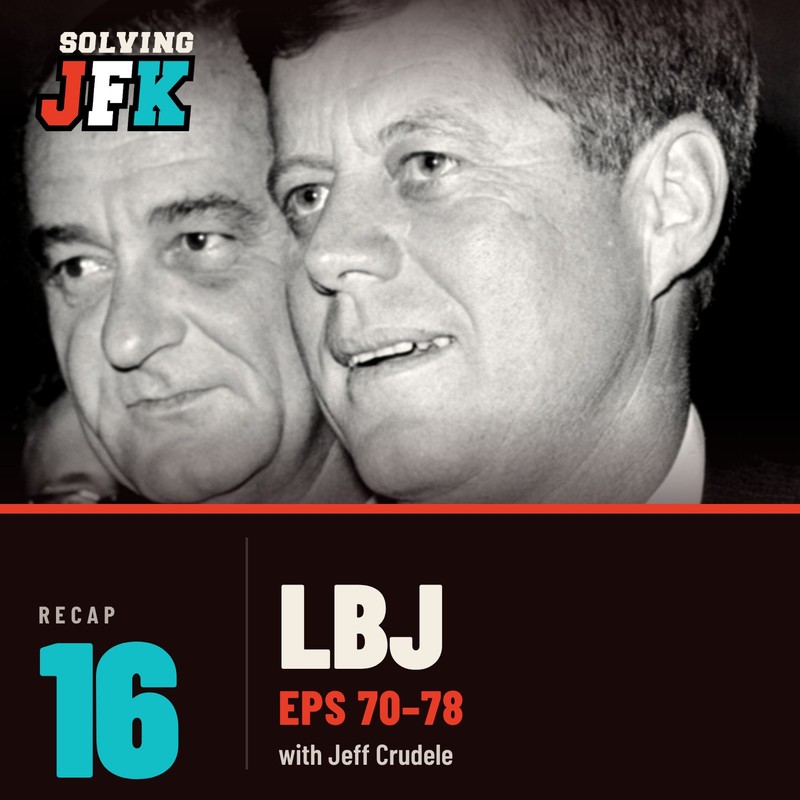
Part 16 (Ep 70-78) with Jeff Crudele
We are joined by Jeff Crudele to talk through the various controversies within the study of Lyndon B. Johnson as related to the assassination of President John F. Kennedy, including LBJ's start in politics, the stolen 1948 election, Bobby Baker, Billie Sol Estes, Henry Marshall, Mac Wallace, Cliff Carter, and many more. We try to answer the big question: Was LBJ involved in the assassination of President Kennedy?
Automated transcript
Machine-generated from the audio and unedited, so names and spellings may be wrong. Tap a timestamp to play from that point.
Speaker 3We just finished a nine-part series on Lyndon Johnson as a potential platter against President Kennedy. Where I ultimately landed at the end of part nine was that Johnson was involved in a cover-up as we already discussed during the series on the FBI. It's not clear whether Johnson had for knowledge, but I would air on the side of him knowing about the assassination and advance if I had to pick aside. And it's also not clear whether Johnson participated in the plot to kill Kennedy, but he did have the means, the motive, and probably the opportunity to do it. We just don't have any proof that he actually did. Now, we'll see if my guest today agrees with those assessments, and then we'll get into the nitty gritty of all the details when it comes to Lyndon Johnson and the assassination of President John F. Kennedy. So in this episode, I'm joined by fellow deep dive podcaster Jeff Crudell from JFK the enduring secret will revisit the key questions about Lyndon Johnson as related to the JFK assassination coming up next on solving JFK.
Speaker 1In Dallas, Texas, three shots were fired at President Kennedy's motorcade in downtown Dallas. The first reports say that President Kennedy has been seriously wounded by this shooting. The final, apparently official, this is a kind of the dive and come to see out.
Speaker 2The man lay a formally jump to the assassination question. I get the hat of the magazine. Man is me on board. It's all going back to the phone. I wasn't even up for a big conspiracy. Mission answers. Activate a lock-up, a lock-up, a lock-up, a lock-up, a lock-up, a lock-up, a lock-up, a lock-up, a lock-up, a lock-up, a lock-up, a lock-up, a lock-up, a lock-up, a lock-up, a lock-up, a lock-up, a lock-up, a lock-up, a lock-up, a lock-up, a lock-up, a lock-up, a lock-up, a lock-up, a lock-up, a lock-up, a lock-up, a lock-up, a lock-up, a lock-up, a lock-up, a lock-up, a lock-up, a lock-up,
Speaker 3Yeah, yeah, and I was just talking before like every time you and I talk to each other, it gets too interesting to not recall. I'm like, man, hold on. We got a show. What time I was talking to you and you called me and I was in a home depot. And I just went to the outdoor section and talked to you for like forty minutes about something.
Speaker 0It's great, right? You know, it's it's a fun fast when we do it for sure.
Speaker 3that for a man for sure. Well, uh, I know that you have on on your podcast, JFK, the enduring secret, which uh, it's a nice background, you got there. Um, so everyone to see. Uh, but I know on your show, you've, you've gone very, very, very deep on Bobby Baker, Billy Solesta's Don Reynolds. So, and I know that you and, and Mac Wallace and the fingerprint, et cetera, which is an offshoot of, of Billy Solesta's. So that'll be really good to talk about all that stuff, and we can, we can, we can, We'll put most of our focus on the end part of the series. We won't go too deep on like what grades did London Johnson get in elementary school.
Speaker 0That's good because I can't tell you.
Speaker 3All right, good. Well, anything, any preliminary thoughts before we, before we dive in?
Speaker 0Yeah, I just say one thing. First of all, I'm just really glad that you made a pivot into this topic. It's not necessarily the one that's explored more deeply by, you know, many of the folks who want to talk about this. And I think it's an area of the assassination research that's, there are several people who have gone very deep, but they're not, they're not very well known in the, in the more broader public mind of the research around this topic. And as an investigator, this is sort of the first place you would go aside from the political ramifications to it. So I'm glad you're there, and I'm glad we haven't a chance to talk about it. I hope it spurs more in this area.
Speaker 3Definitely, and you know, there's a lot of stuff that I think is speculative about Lyndon Johnson that's sort of in the conspiracy lore, but there's also a lot of stuff that's like, wow, this keeps coming up. So it's just kind of sorting out the, you know, what's real and what's not real or which ones are maybe on the fence. So all right, let's go ahead and jump into it. So the first issue, and again, we're not going to cover everything, but just touching based on Lyndon Johnson's early career. So a few highlights. He rigged his college student council election and student council president. So very good early on. He's a winner. He hired, so as a twenty two year old. He was hired to be a congressional aide by Dick Kleberg of the King Rans family and he basically ran Kleberg's congressional office while Kleberg was out playing golf. He became tight with FDR when he was you know, basically serving as a congressional aide.
Speaker 3even though his congressman did not support FDR so he was an opportunist and you know an opportunist from the beginning and he eventually led the national youth administration for Texas, which was a new deal program that House Speaker Sam Rayburn recommended him for, so again, he's become friends with the president of the United States, United States, and iconic president, FDR, and he also is friends with the Speaker of the House as a congressional aide. So that's Linda Johnson for you. And he then goes back to Texas. He's elected to Congress as a twenty nine year old. I don't think I didn't appreciate the Lyndon Johnson got involved so early, but he was really a political creature from the get-go. And then my other favorite little story from the first episode, it was Johnson in the Navy. He hated having to salute his superiors, and he hated that no one knew he was a congressman when he was in uniform.
Speaker 3And then he went to Northern Australia. He was sent there during World War II as an observer of a bombing raid that was in New Guinea of Japanese bases. And the bombers on his mission came under fire, but Lyndon Johnson's bomber did not. Nevertheless, General Douglas MacArthur awarded LBGA a silver star. And Johnson came back to Congress wearing his metal and referring to himself as Raider Johnson. So there's a landing Johnson early on. Thoughts on what that tells us Jeff about him. I don't know, it's just kind of like psychoanalyzing. We really can't read too much into it, but interesting and nonetheless.
Speaker 0Yeah, I mean, he was. He was a complex character. He was born in the Hill Country. That pretty Texas, it was dirt poor. I don't think people realize the context of it. The Texas was not electrified until the forties, the thirties and the forties. He was obviously significantly involved in that. You talk about getting involved in politics early at his father. uh... was involved in politics dabble in politics and i think you got in early uh... exposure to it's actually through his father but you know look at you know i'm not you know i'm not robber care i'm not i wouldn't attempt i don't think any of his should to try to unravel the the total complexity of his character but he uh... is a guy who demonstrated very early based you know on many things many of which you've just mentioned His capacity to demonstrate really significant character flaws. And they grew in size and complexity as time went on.
Speaker 0And those are just early indications of things to come because the scale of what happened later on was pretty significant. Some of the things that you just talked about, for instance, his naval experience was brought up in the forty-eight election I don't know if you recall that maybe I can't remember if you mentioned that in your your pod series or not but you know he was he was taken on obviously by the coax Stevenson group in the primary in the runoff they really got after him about that and made some very serious allegations you know in the beginning the story on that was He thought that you could be a congressman and be in the military at the same time. And then there was a decision, maybe you can't choose one of the other, and you know what he chose. He chose to come back and be a congressman. And he got, they used that very pointedly in the runoff at our political campaign. And they were obviously, they were obviously poking at his, you know, the fact that he let other men go off to war and fight it.
Speaker 0And he went back to his, as they, as I believe they described it, his cushy, fifteen thousand dollar job in the marble capital of Washington. So it was an interesting thing. I mean, he's just, he's a, he's a real study. I mean, I know, you know, as we get into this, you're going to see that he's, he's been involved in some of the most momentously good things. that have happened for this country and at the same time, he has an incredibly dark side that has come out at times like an iceberg.
Speaker 3Sure, yeah. So on that point, just on the, this is from episode one, I do have a rebuttal real quick. And it's really just sort of a correction clarification. I had said in the recorded podcast, I referred to the Democratic Party as the Democrat Party. And I didn't realize that that was a pejorative. I was not aware of the history of the usage and I corrected it going forward. You know, as anybody who knows my politics knows, I pretty much hate everybody. And trying a politics free space, which is very difficult to do, given what we're talking about. But yeah, so I'm not trying to put my hand on one side of the scales there.
Speaker 0If it makes you feel better, I just got slapped about that. in a recent episode myself. So I think that may be more prevalent than you think.
Speaker 3All right, good. Let's move on to the second thing. The nineteen forty-eight stolen Senate primary election, which you just alluded to. So just very quickly, Johnson initially lost the Democratic party primary election against former Governor Koch Stevenson by a hundred and thirteen votes. But then after George Parr's political machine added a two hundred one vote margin for Johnson in precincts thirteen, he won the election. And the judge, Louis Solis, who actually added the votes, admitted to it. So this is definitively proven. It was fraud. LBJ's lawyer who handled the appeals against the Stevenson campaign took it all the way to the Supreme Court. And that was Abe Fortis, who Johnson would later put on the Supreme Court. Now for the lawyers, there's a whole We can do a whole episode on the litigation around the nineteen forty eight election but I think that would pretty much bore everyone else in nineteen fifty two prisoner Sam Smithwick who is in jail for killing somebody contacted coke Stevenson the guy who lost the johnson in nineteen forty eight with info about the forty eight election fraud Stevenson immediately went to go visit him and as soon as as he as soon as he got the letter from Smith from Smithwick about this fraud
Speaker 3And when he got there, the prison told him that Smithwick had hung himself and Allen Shivers, who was the governor of Texas at the time, later said that he thought LBJ was behind the Smithwick death suicide murder, whatever you want to call it.
Speaker 0You know, you talk about your lawyer, so you appreciate this, and I'm sure you already know it. But one of the key things about that litigation was it really wasn't at least my understanding of it. You can correct me if I'm wrong. It really wasn't covered under federal election laws, per se, because it was actually a, it was a primary process to determine who would be the Democratic nominee. And so, you know, they weren't breaking federal election laws, per se, I don't think in that regard. And there was a, there actually wasn't a investigation of it. I mean, a sham investigation, obviously. You know, as a result of that, they concluded that it was, it was appropriate to move forward with Johnson's victory. But, you know, there, there was some mechanics to that that were more, more technical and nature than you think. I mean, under today's laws, I'm sure there would have been more, you know, there would have been a real scrutiny of it.
Speaker 3Right. I mean, this, you know, a lot of things that I think, you know, like in the whatever conspiracy law, they're just taking for granted to be true. And this is one of the things that, oh, hey, the nineteen forty eight Senate election. Well, it turns out that everybody, everybody agrees about this.
Speaker 0Well, it was a classic, it was a classic voter fraud case that, you know, over time and especially after LBJ's passing, you know, became, you know, sort of a classic discussion, and you know, if you think about the way events tumble into place, what, what an event that made a real pivot. Had he not been elected to the Senate, he wouldn't have progressed in the Senate become one of the most amazing majority leaders of all time, and he also wouldn't have been in a position to be president of the United States. And it's, you know, so obviously this was really a pivotal moment in history. A hundred, you know, two hundred and two votes in total, depending upon how you count sometimes to a one or somewhere in that neighborhood. But I, two hundred and one votes, all in alphabetical order, all in the same penmanship. all probably done by the same person, written in on those ballots were the difference.
Speaker 0And that's what really caused them in the end to be president of the United States.
Speaker 3Right. It's the whole strategy of waiting until the last minute to turn in the votes of the precinct that you control or precincts, once you know what the number to beat is. That's the pretty strategy.
Speaker 0So, well, you know what happened there. Actually, the reason that happened is they got done prematurely.
Speaker 3Right.
Speaker 0And they got to, and got to vote, vote count wrong. And when it came up that they were still short, they had to figure it out. And Johnson frantically called par. And par said you can get it in precincts, thirteen. And that's how they did it.
Speaker 3Yeah, Park gave him the old Billy Mays, but wait, there's more. You know what I mean?
Speaker 0So a lot of back scratching there too. You know that at the time there was some suggestion that Park had a brother who was in trouble, who needed some help. That was part of it. You know, there had been a lot of back scratching before the election in terms of their relationships.
Speaker 3Yeah, let's let's talk about how Johnson became the most effective Senate Majority Leader of all time, Pearl Robert Kero and Robert Dalek. My quick notes on this is that he served on the Armed Services Committee and the Joint Committee on Foreign Intelligence. And also, he just, he was like a master networker, just he knew what everybody needed, what everybody wanted, he had the dirt on everyone. And I got a quick thing, just to read that I didn't cover before that someone sent me if it's applicable here. So when Frank Church was elected to the Senate, he came to DC looking for a house, looking for somewhere to live. Bobby Baker ends up taking church around showing church all the church in his wife all the houses of the senators who are going to be who just lost who are going to be leaving. And the point is, Bobby Baker was trying to have something on church for the future. I'll remember when I got you this deal, you shouldn't have got.
Speaker 3And having realized that, he said, no, thank you. I don't want that. But that's the kind of thing Lyndon Johnson did. Bobby Baker reminds me of Doug from House of Cards. He's like, go to assistant.
Speaker 0Yeah, he was a fixture. I mean, he was an absolute constant fixture. You know, he was really already there. And in the Senate, obviously, before Johnson got there, when he was one of the first people that Johnson saw it. And he already had a baker, already had a reputation as being a guy who actually was one of his skills, which was really amazing, was absolutely understood. And any given moment, what the vote count was. on a piece of legislation, and he had a pulse on that, like, probably nobody else. And, you know, the money free float back then, I think one thing Johnson did was, you know, consolidate how both, you know, proper and improper campaign contributions came in and they came in centrally then they were they were dealt out centrally and so you know the the economics of that are you know you couldn't do that in today's environment under let you know current election rules and so on and so forth but that was how it was done and it gave
Speaker 0them a unique people in those roles, particularly him in that role in that time frame, a unique amount of power through the economics of contributions, which actually ultimately led to some extent to his downfall. Some of the things that happened in the Baker case ran directly to that.
Speaker 3I want to talk quickly about how LBJ got on the ticket and then we'll come back to Bobby Baker. So the official story is that, and this is what Kennedy said to Kenny O'Donnell, LBJ was so terrible to deal with as Senate Majority Leader that he wanted to make him vice president so that he could instead deal with Mike Mansfield. and he's, you know, LBJ told, uh, told O'Donnell, look, I'm forty three, I'm not going to die. It's a nice president, meaningless. Uh, and, and so that's the official story. And the, the other official story is, well, he, he offered it to Johnson as a courtesy because he came in second with, you know, thinking there's no way Johnson would ever take it because the majority leaders are better jobs. So there's a few different lenses with which you can look at this. It's still good to the official story answer. The insider story is that JFK offered the VP slot to Senator Stewart Simington, but then he pulled it back at the last minute.
Speaker 3And that's according to JFK advisor HiRaskin and Simington advisor who also happened to be JFK's personal lawyer. And that's Clark Clifford. Raskin says that JFK told him that LBJ and Sam Rayburn threatened to frame him if he didn't put LBJ on the ticket. And Evelyn Lincoln, JFK's personal secretary, who had been for some years, says that Johnson used dirt that Hoover got about JFK and his mistresses and threatened to use it. So to me, I would say it appears that, you know, LBJ and Rayburn, strong armed JFK into this decision, if we're to believe Eve Evelyn Lincoln and high-raskin and Cliff, you know, Clark Clifford. So, you know, you'd have to think all those people were wrong to not believe that's true, I suppose. Your thoughts, Jeff?
Speaker 0Well, I think there's a little bit of truth in all of those. I mean, if you think about it, there are all very rational reasons to believe that in the end, a very complicated calculus that could have gone a couple of different ways went that way. I think, in the end, you have to get elected. And I think the most important thing that anybody was thinking about at that moment was, how do you carry this South? And no Dow Johnson, it was already cracks in the Democratic Party. I mean, the clear distinctions between the portion of the party in the south that was going more, was staying more conservative in the part that was pivoting to a more progressive agenda that had already been introduced as a result of the new deal. There was some real concerns about how to carry. And so I think that was legitimate. I also think that they got on. The other part of this, which I think is true, is that Johnson was somewhat ambivalent about the presidency.
Speaker 0He had a lot of ambition. I think he wanted to be president. But he had multiple heart attacks. I think he was unsure what the path was going to be. If Kennedy wanted sixty, what he went in sixty four, would he be too old by the time he got a chance to up for it. And a lot of people, the theory is really not an inconceivable one that he's even made. He made the comment at one point that certain number of presidents die in office. Statistically, that's true. He knew of Kennedy's health frail teas and he thought maybe maybe there was a chance that that would happen. I mean, I don't think that's far, far, far, far. The other thing, there's a lot of different stories on this, right? Everybody's got their take. If you read Bobby Baker's book, which is one of the funniest books of all time, wheeling and dealing. he tells his story that he was the one who talked linden into that and i'm sure he had nobody talked linden into anything i think linden did what he wanted to do there but he said look it's the you know best job you'll get your you've had several heart attacks it's the easiest job your that you're that much closer to the presidency take it and uh... you know so i think there were a lot of people
Speaker 0with whatever their, you know, perry and interest for self-interest were, there were, you're suggesting things to him. You know, in the end, I think he made that calculus. I do think he was blackmail. I think there's no doubt he was, he was blackmail, but I, you know, I don't think that was the only reason he said yes.
Speaker 3To your point about, you know, they needed to win the election, you can There's no better example of the split within the Democratic Party at the time than there is of Lyndon Johnson and Senator Yarbro. I mean, they're in the same state and their politics, you know, they'd be in different parties today.
Speaker 0Texas was a quintessential divergence between the original hard-line conservative Democrats that had been around since the Civil War and Reconstruction. And then obviously, we're really in a tizzy beginning in the early thirties with the Roosevelt administration. I mean, I don't know if you've read the book. It's a great book. In fact, I have it here. If you're a Johnson fan, you can't, you cannot go through this process without reading this. I'm going to hold it up because it's an amazing book. I don't know if I can, you can see it or not. Yeah, exactly. So, Texan looks at Lyndon. This was a tiny little book and it was written back in sixty-four and it's a guy, Jay Evans Hayley, who was quite a man and quite a man and quite a historian as well. He wrote about Johnson contemporaneously, but he talks about that split. And it's, you know, it really is a big part of the history of the Democratic Party.
Speaker 3And let me guess, Jay, have a daily diet of carbon monoxide and protein.
Speaker 0Yeah, like the like the like the rest of them in the in the in the esters crowd.
Speaker 3Yeah. All right, let's pivot over to Bobby Baker, who is someone you know a lot about. And I'm just gonna, I mean, you know so much, you would, how many episodes did you do on Bobby Baker?
Speaker 0Uh, fifteen.
Speaker 3Fifteen. There you go. So it's amazing. Um, because I had written my section. I'd read a bunch of books. I read some documents and I'm making outline. And I listened to yours and I had a lot of stuff that was already in there. And then stuff just some of you added so much more color. So there were a couple of things that I got from yours. I forget what the exact details were. But, uh, yeah, you really, really went, went deep on this. You know, I'll just go high level and then you fill in anything else you won't talk about. I'm Bobby Baker. So Baker is Johnson's assistant from early on. As soon as he gets in the Senate, he knew where the bodies were buried. He had been a Senate page for a while. Long story short, he perlazed this role as was the secretary to the majority leaders.
Speaker 0Well, technically, it was the secretary to the majority, not the majority leader. So technically, he was working for the party inside the Senate. He's technically.
Speaker 3Yeah. Or if Johnson would later say when Baker came under fire, he's just an employee around here.
Speaker 0Exactly. Exactly.
Speaker 3So anyway, so he In that role as secretary to the majority, he was able to, you know, make decisions about things like vending machines and government property. So he started his own vending machine company, which was very profitable at the time. There's the carousel motel that he develops in Ocean City, Maryland. Shout out to my producer and my business partner on some other things, Jerry Depiso, who runs a major, I think the biggest music festival in North America in Ocean City, Maryland is called. Really? Go check it out. Anyway, so he goes and develops a motel in Ocean City, Maryland. He does a fixing of Haitian meat inspection.
Speaker 0That's a crazy story actually.
Speaker 3Plent Merchison was had this Haitian meat plant basically and they weren't meeting health standards so they couldn't export it to the United States and Bobby Baker came in and basically made it be okay for for everyone and then finally there's the quorum club Bobby Baker starts a club that's was in a nearby hotel you can fill in all the details basically it's a place for you know senators congressman lobbyists to go and hang out with with without their mistresses and uh... not worry about the press uh... pounding them and that eventually leads to ln row mesh who worked at the quorum club and he introduces her to jfk and then there's a big fallout from that this whole It crazy web, but at the end of the day, why Baker matters for Johnson is that he was a massive liability for Johnson. And that was really coming to a head as things progress. So you want to fill everyone in on anything else you want to say on Bobby Baker?
Speaker 0Just like the title of his book, he was the ultimate wheeler dealer. I mean, he was a guy who could cut a deal in this, you know, between senators. This was back when, you know, They all practiced a modest level. I would suggest a chicanery about the way they traded votes and helped each other and did a lot. And he was the master of that. And he was known as Little Linden. I mean, he got so attached to Johnson. And Johnson would suggest that Baker was the first person that he saw when he woke up in the morning. It was the last person he talked to when he went to bed. And of course, he distanced himself as soon as the is the investigation started. And the problem with him is he's a young kid that went to Washington as a teenager, essentially, from Pickens area, South Carolina, and came from Little, and all of a sudden, had, as you know, a net worth of over two million dollars. And it was basically learned behavior.
Speaker 0And you know, he went, it first, I think he was a patron of a Senator Cure. And I don't know if you, I mean, you know that story, but you know, in the end, ironically, it was the, that relationship and things that happened toward the end that actually put him in jail. after the senator's passing actually. And so that's the irony of that story. But he parlaid everything into a financial transaction. And he learned that from Lyndon. You know, Lyndon didn't do, he used to say, Lyndon wouldn't do anything for free. And he did the same thing. But the problem, if this is sort of an Icarus story for Lyndon Johnson, Much of the Baker story is not really that interesting when it comes to inditing Lyndon Johnson per se. I mean, again, there's lots of stuff he did that they were connected to that would have taken him out. The, the asked his story is significantly more nefarious and on an order of financial magnitude much bigger.
Speaker 0But the Baker piece took place in Washington. and it got all the attention. And I think that that's where you, you know, that's where you, you know, sort of the casual observer of all this, you know, really gets connected to the whole story, the care cell, the care cell. Actually, sadly enough, The carousel motel, and I'll just say one thing about that transaction, that probably was his downfall. He always wanted to be a real estate guy, and he had a couple of other things. He owned a Howard Johnson's outside of Charlotte, North Carolina. He didn't much of stuff, but at the end of the day, he got involved with some friends, some family friends, the Novak's, and no, no, Fred Novak was a builder. And what happened actually to begin with was they all made a lot of stock through a process that was really started by Senator Kerr. Senator Kerr gave him sort of his first tips on buying into what was known as magic or mortgage guarantee investment court.
Speaker 0And when I get into the details of that, it was a good stock transaction. He made a lot of money on it. He let his friends in on it. In fact, what he would do, what he'd do with the Novax, actually. You may know this, but it's an interesting sort of start to their financial connection. He said, look, I know a great company you should invest in. I don't really have a cash right now. So if you have some cash, you put it up. And we'll split both the, either the gain or the loss on it. Which is kind of funny because he didn't have the money to invest in it, but he was going to actually subsidize the loss on that's your how. But they trusted him. And in that transaction, which was in the early stages of the growth of magic, they made a lot of money, both of them. And I think it really embolded them. They thought, you know what, this guy's just, he's got a magic touch. Everything that he does turns to gold.
Speaker 0And so they got involved with him and they were kind of perfect because, you know, he was a constructionite. But it was over his head. You know, he'd never done anything that big. And Baker, you know, Baker had scope creep. You know, it started out as a motel and then all of a sudden it became, you know, the kind of the nightclub scene that he thought would entice all the uh... the washingtonians to come and probably a big part of that was a fact that i think you realized at some point that whatever was a hundred eighty some miles from dc was going to be hard to get people to go there is often as he thought they might so anyway at the end of the day they got into real trouble with that there was a and then before they got it done just before they got it done uh... an orthoester hit and uh... right and uh... and they didn't have any insurance And it really created a terrible circumstance.
Speaker 0So he was cash strapped in a big way. And it really, it prompted some radical moves related to serve you. And probably the You know, the litigation that was the lynch pen that started it all was a function. I think of him attempting to consolidate and, you know, make one money through the serve you corporation. And that's what, and that's where kind of all started. I think had they not, you know, later, what he did, and the Novax, you know, feel like he's sort of got, you know, they got their portions of that deal stolen from them. You know, he merged the care sum motel into serve you. and a really interesting way, you know, and with all of this is mafia friends, you know, and Fred Levinson and, you know, the rest of that crew. But, you know, so, but there's no doubt that that was really the anchor around his neck. And I think it prompted a lot of transactions that at the end of the day were more dubious because he really needed the cash.
Speaker 0He was terribly under capitalized on the motel.
Speaker 3you just mentioned mafia connections. And when I found out that Fred Black Jr., that's Baker's business partner for servue, not only did it was he one of those neighbors who also lived near Johnson, but he was a defense contractor lobbyist. And also, he's the guy who called Johnny Ricelli the night before he was killed and told him to watch out. So I mean, That tells you the proximity LBJ has to people who are rather high up in the know in the mafia, you know, to the extent the mafia was a player, which spoiler alert, that's the next series I'm going to be jumping into. But you know, to the extent that was the case, they're right there with Johnson and the relationships are there. In addition to, you know, Carlos Marcello, bribing Johnson half a million dollars throughout the nineteen fifties per Jack Halfin. Similar to Bobby Baker, we also just equipped a little detour before we go to Billy Solesta's.
Speaker 3Don Reynolds, somebody else you want really deep on. And this is the guy who's testifying against LBJ. On a rather minor matter kind of seems like actually, but the timing of it, and the certainty of it is really something. So do you want to quickly talk about Don Reynolds and what you found it? Yeah.
Speaker 0Yeah. Yeah. Well, so Don Reynolds was an insurance agent who actually befriended Baker many years before. And Baker struck a deal basically with him. And it was basically to get a part of his insurance agency. But then it was really to be able to funnel through referrals. you know, transactions from wealthy people into the insurance agency whereby Reynolds benefited and he being a new partner would benefit as well too. So that grew into more than just that. They had a personal relationship. Reynolds was a partier and so he got involved in a big way and sort of, you know, all the, all the trips, all the junkets, whether they were into Yorker, you know, Puerto Rico or other places with girls and things like that, there was a lot of that going on. And entertaining, you know, as part of it, but it was pretty, it was pretty debauched. And he, he also, I think, grew into essentially being a cutout or a bag man in various ways.
Speaker 0And he ended up, the two of the more famous transactions are the, you know, the ones that we probably all talk about. And as you suggest, one of them was really not that big of a deal. After LBJ had his heart attacks, he was having a hard time getting life insurance. You know, back then, key man life insurance was a big deal. And you know, being part of the radio stations, he wanted life insurance. And he couldn't get it. Baker said, I know where you can get it. And he referred him into dot rentals. And rentals got it. And but it was expensive. And you know, an LBJ's sort of standard MO was that anybody that made a dollar off a him had to let him make a dollar off of them. And so sort of the quid pro quo was you got to, you know, you got to rebate something back or you got to give me money, you got to do something. And there's a couple of different stories on it. I won't go into the details of it.
Speaker 0But the bottom line was that Walter Jenkins, who was basically LBJ's closest sort of personal adhesiase secretary type, made a demand of Reynolds to provide a stereo. You know, because they wanted one at the house and so rentals did that. It was basically a kickback from the premium that he had earned on the insurance policy that he had paid. It's like it's rounding in this entire world of politics that we were talking about. But the Senate rules and administration committee that was investigating the baker if you ever got a hold of it. John Williams, who really is a really an American Patriot. He was, he actually wasn't on the committee, but he was the guy who spearheaded the investigation through a series of communications. He was able to come into contact with Reynolds and Reynolds told him the whole story. And that became front and center. He was actually being interrogated, Reynolds was.
Speaker 0on November twenty second almost, you know, at the moment, as you know, the assassination, when, you know, by actually by the Senate's Republican investigators, Burkett was his name. I don't know if you remember that, but, and in fact, they were, he was spilling his guts basically and he was providing documents and he was doing all sorts of stuff. And Burkett actually in the middle of all that found out that the president had died. He went back in the room and he finished the discussion without telling. uh... you know without telling down rentals what happened because he knew the moment that he told him that the vice president had become the president uh... that there would be a problem in fact at the end of the session it was revealed and uh... uh... rentals was just trembling he said you know i'd like to take the documents back and you know it's okay if you know if you want to see it ever had this conversation you know he was really scared and uh... on the events that went on after that were really unbelievable forced him out of the country
Speaker 0he lived in the Bahamas for a period of about from about nineteen sixty five to the time that the LBJ left office in sixty eight and coming back a few times but the stories are just amazing bobby baker after he got indicted called rentals about two o'clock in the morning, one or two o'clock in the morning, in the Bahamas. I think that was sixty-seven. I think was the year he got indicted. And he said, look, you've really, you've disturbed some pretty powerful men. And they've gotten through it, okay. But if you come back and you decide to testify now in his trial and Baker's trial was what he was applying. He goes, these men will take you out. And it was, I mean, it was a very explicit discussion whether it was true or not. I think probably it was Baker was probably up late drinking bourbon and, you know, contemplating life after being indicted. And, you know, it was one of those, and he named, you know,
Speaker 0very high, you know, very high up men in the mafia and very high, and you know, people like Fred Black and others, okay, who, you know, were quite, you know, in that group. And so it was, I mean, this was a really intertwined group of people, Reynolds at the end of the day was also involved in the, uh... seeking they saw a bond they were you know they were doing the Washington stadium at the time and that was another big one and without going into a lot of the details of the bottom line was that they wanted The individual who actually was the head of the construction company was actually also head of the Democratic National Committee, I think at the time, as a fundraiser. And what they wanted to do was to send more money over to Reynolds and Reynolds insurance agency, then was the cost of the bond, and then have him then move the money, and access money back over into Johnson's coffers. and lent him use it for purposes of the nineteen sixty election.
Speaker 0And you know in the end, you know, it was a suicide squeeze on him because obviously he didn't consider it to be income and he didn't report it is income and they used the old the good old IRS rules to to get him and indict him or get him and Baker and others involved in a process that involved a lot of IRS complex IRS questions. But at the end of the day, he was a bag man. And he even made a representation that he was at a party at one point and saw a bag that had a hundred or a suitcase that had a hundred thousand dollars worth of cash in it. It was bound for Lyndon Johnson as part of the TFX deal. You know, I mean, he said a lot of things. I mean, but he was a guy who I had his moments, you know, there were, I mean, he had some character flaws and there were some things about his, his, some things that happened in life that you can take a pause on. But I think most people believe that as far as the stereo set was concerned and some of those key things, like that, he was telling the truth.
Speaker 0And people believe that that minor thing would have taken Johnson off the ticket.
Speaker 3Yeah, well, especially because the RFK was looking for for anything. I mean, you know, as we'll talk about here in Billy Solesta's RFK called the judge on the Henry Marshall, the Henry Marshall Judge Barry and I believe his name was that over saw the initial trial to determine whether or not it was a suicide. He called what twelve times in eight or nine days and JFK called once so they were they were very invested at seams and trying to get dirt on Johnson. We'll come back to that again here a little bit, but let's let's pivot on to Billy Sol Estes. the man. This is a lot of abilities to list this. And I know this is another one that you went super duper deep on, but just out of the gate. So one one thing I learned, this is actually something I learned from your podcast that I was not privy to, Jeff. And I believe I've foot noted your podcast.
Speaker 0Wow.
Speaker 3The parts about Billy Celesta's childhood, like I didn't realize that he was actually a really good farmer. He won, you know, with a four age club farmer of the year award and he's given that by FDR presented to him and just, you know, the whole thing of parlaying a sheep into, you know, having a bunch of them and then You know, the thing where he volunteered to go take advantage of this government program to remove some sort of weeds or something I forget it was from land and then paid people less.
Speaker 0I've contracted it out.
Speaker 3Yeah, I'm sorry. Like what's funny is You know, I think we look at Baker and Billy Solesta says these, whatever, Wheeler dealers has got a negative connotation. And certainly there were times when they were outside of the law and they're doubt about it. But just the volume of the deals they did and the way that they approached life, I got to tell you, like, as I was studying them, it made me go, I'm like, I got to get an L.O.I. and on something. Well, how come I don't have any deals pending right now? I need to go to anybody who can sell me something somewhere. I can sell somebody something. Like what were we doing?
Speaker 0I think, you know, I grew up in business, I was in business my whole life as you know, and I can tell you that they are classic examples of people who are highly driven, really smart, highly successful, well-connected, and they taste as success, and they were also in circumstances where they were able to You know, do things that were so aggressive and not have any consequences to them. And I think it ended bolded them as it does a lot of people who gain power to cross the line. And then, and then I, and as this case, it was, it was worse. I mean, you know, a baker's case, Maybe more just more classic, classically, you know, politically incorrect things that go on in Washington than I did. You know, some illegal, some not but mostly, certainly morally wrong. But at Estus was just pure, most of it was pure financial fraud.
Speaker 3I was I was with us this on the cotton a lot in the part of it so so we'll talk about that real quick um with that was but to me where we're as just lost me where I go I don't know if that is is when he started just making up fake fertilizer tanks Yeah, that that just blatant straight up fraud. The cotton allotment thing you could you could make a legal argument that it was like to me that seemed like like potential legal cleverness, but but yeah, I mean the had there not been intent to why from the very beginning to actually default on the
Speaker 0on the property loans. It actually was technically an appropriate transaction, but there was, there was intent. And I think that's the problem. In fact, on that, the reality is that the government did not want a lot, a lot, meant themselves to be traded in essence like in an active market. That was a real no-no. And so they actually, when a transaction did occur, there were actually forms. that you had to sign in those circumstances indicating that there were no side deals. I mean, that's how much they knew that this could be potentially circumvented. So the farmers themselves were actually committing some level of fraud by, you know, in many cases by entering into these transactions themselves.
Speaker 3But it's super high level on what this whole cotton allotment thing is because it ends up mattering a ton. Okay, so farmers got paid a minimum guaranteed amount by the government if they only produced a certain amount of cotton and they had to have a cotton allotment to do that and that would determine how much they could produce. The land was required to have this this kind of lot meant to get paid and Estus acquired unused cotton allotments on behalf of farmers who were not going to use them because they they still had the cotton allotments because they lost their land to eminent domain most typically and then Estus paid them money upfront and then he kept the land with the cotton allotments after the farmers didn't follow through on the loan which was the plan the whole time as you just noted and this was going well for us this until Henry Marshall stepped in and shut it down and uh... you know as to sense at Clark to go talk to him to know a veil they try to get Henry Marshall a promotion to dc he doesn't want to take it
Speaker 3And this sort of tease up the fact of Henry Marshall being a huge problem for Billy Solesta's.
Speaker 0I mean, the technicalities of that transaction are slightly different, but they're, but they're, but they're substantively what you just discussed. And the, the reality is that Marshall, and I don't think a lot of people know this, but, you know, Marshall had previous relationships with those guys. I don't know if you know this, but Marshall used to play cards with Cliff Carter.
Speaker 3and Brian.
Speaker 0Yeah, I mean, a Brian Texas, you know, Brian, you know, Cliff Carter owned a seven-up bottling plant there I believe and he liked to play cards and actually cards with money were a big thing in Texas probably still are, you know, illegal card games or illegal card games and they knew each other. And so it was a little bit ticklish, I think, you know, in the beginning and I think suggestively You know, like most of these things, you know, probably back in the day, if you were bending the rules a little bit on stuff like that, probably the regulators didn't get too upset about it. But I think it became so blatant and in such proportion that, you know, Marshall, you know, really realized. And you have to remember that he had, Estus had his, Nemesis, you know, I mean, there were people in town there in Pekus that caught on to him and, you know, and, you know, the local, the local paper, you know, and through information that was provided to them right through the doctor and, you know, ruined his career.
Speaker 0They came back and ruined his career actually. I mean, obviously, Marshall wouldn't let it go. And there was a series of processes that Estus went through and that he engaged Johnson in. And they really thought they had the whole thing under control. And then they didn't. And you know, without going into a lot of detail on all this, that really was the beginning of a terrible circumstance for Estus. And let me tell you, when people don't, I guess I love to, this was so enthralling to me because it was a financial crime. And you know, my background is, you know, in the financial piece of things. And so I found this whole thing very interesting. When he re-acquired the rights to all those continents through the leases, and he was immediately actually in a position where he had to put a lot of money into that. He had to plant the crops. He had to buy the fertilizer, he had to water, and he had to do all that.
Speaker 0And there was a period of time where the allotments themselves hung in balance. But the politics of it got so heavy as they finally ruled that they were going to reverse his allotments. And this was after he had made huge investments. And he was already making, he already needed a lot of capital to fund the predatory pricing that was going on with the ammonia deal. He was selling an hydrous ammonia fertilizer all over Texas at lower than market rates in a predatory pricing model that was going to basically drive everybody out of the market. and would probably leave him to be the only major supplier in Texas of fertilizer. But those things cost a lot of money. I was clearly illegal. It was predatory pricing as we know it today. And it was still illegal in that moment in time. And those two were sucking up so much money that the only way that he could move forward was to accelerate, particularly all of the fake transactions around the fake fertilizer tanks and the grain storage tanks.
Speaker 0And the other thing, which Johnson surely came through on, was to make sure that he got the grain storage contracts. which he did. And that kind of saved him. I mean, he would have probably been bankrupt prior to, but he got the transaction and the money started flowing. And that was the cash flow, the positive cash flow element of the model that kept the whole Ponzi scheme going. When everything broke, And you mentioned a lot in your podcast as well, especially when you made that stupid remark within the department that one person's already died. I mean, that was the beginning of the end, I think, for the thing really started unravel at that moment. And I have to tell you, there is so much money. involved in this set of transactions that it makes the whole, the things that Johnson was worried about in the Baker case, look like Tinker Toys. You know, he was he was secretly funding or he was secretly taking if you believe the comments made by Estus ten percent of everything right off the top and on one particular transaction the larger grain storage Elevator the location that Coleman Wade was so involved with it was a sort of a state of the art
Speaker 0centralized location of warehouse that they had really invested a lot of money in. He got twenty, he basically funded some of that because S. is now the capital of the time and he got twenty percent off that deal. And it was all cash, right? It was all cash. And there was never any, it was signature Johnson. There was never a receipt or a, you know, or a, or a trace that he was involved in any of it.
Speaker 3Yeah, yeah, immediately it was thinking was getting twenty percent, but is he getting a K one? How is it? They're giving him twenty percent and then the owner of the business has to claim all of his income on the front of the fact that they just don't count the income or what I was curious about that. So Henry Marshall, so he comes out and tries to shut everything down and it turns out that he ends up being killed. Initially it was ruled a suicide. Of course there's you know carbon monoxide found that as lungs and there's five gunshots and blunt force trauma to the head. Pretty clear that it was not a suicide. That's really not disputed anymore. It was proven in nineteen eighty four by a court in Texas that it was not a suicide. The sheriff that tried to shut down the the initial investigation. To me, it's just like, why would the sheriff want to do that unless someone is trying to get him to do that?
Speaker 3And you've got, you know, what, three or four of the sheriff's family, you know, family members on the jury. And most importantly, the sheriff's son and law was the jury format. And then the sheriff's cousin worked for Johnson at the executive office building at the same time. So it's like if you want to talk means mode of an opportunity, the connections are all there. You just don't know for sure that he did the things.
Speaker 0I mean, I mean, it's almost inconceivable that, yeah, I mean, it's common sense that would tell you that there were five shots. I mean, what if I do shoot himself once and realize he hadn't killed himself and, you know, shoot himself some more? I mean, both action, both action. Yeah, and then trying to kill them, then try to pull a bag or something over his head and I kill himself using carbon monoxide. I mean, the whole thing was a ridiculous premise from the very beginning. But sadly, I mean, there was a lot of, you know, I keystone cop elements to it. I mean, actually mistakenly, and I think this was very, I mean, there wasn't any nefariousness to this, but the brother-in-law took the, took the truck the next day and washed it. So there was no, there was no change. I mean, first of all, they didn't collect any, hardly any evidence that the scene, including latent. uh... fingerprints but you know they still probably had a chance and that was that was dashed by some you know stupidity on that uh... but i'm sure they would have anyway you know i mean at the end of the day but the family family got involved with people's got involved you know clinton this was something that really stirred the marshal murder really really i think uh... catapulted clinton people's into the picture
Speaker 0you know, who's a famous, you know, as you know, Texas, highwaymen and, and, uh, doggyly pursued this case. And, uh, and Lyndon Johnson's exploits, you know, really to the end of his life. And, uh, this case, you know, he's largely responsible, I think, for assisting the family. And, you know, at the end of the day, it took a long time. But, uh, as you said in nineteen eighty four, there was finally another grand jury, uh, that was convened that, uh, determined that he was, it wasn't a suicide, it wasn't a murder. And really, that was the precursor I think for, you know, for Estus deciding to work with Douglas Caddy. You know, and sort of the next series of things that happened, because Cattie then wrote the, as you recall, on SSB half, he wrote the letter to Stephen Trot at the Justice Department. Trot was at the time the assistant U.S. U.S. attorney in the criminal division in Washington.
Speaker 0And he wrote the letter suggesting that Lyndon Johnson had ordered, you know, had been involved in a criminal enterprise that, you know, had included all of them, and had ordered, You know, the killings of, you know, that whole group of people that were listed in that letter. And that's an amazing story. Obviously, you know, at the end, he didn't follow through on it, but it was a, that to me is, and that's where the, that's mostly the source, and I know you're gonna go there, because you know, I know you wanna talk about this, but that's mostly the source of where people go and they say, well, Johnson's connected to it.
Speaker 3Or a thousand percent, yes, you're right. Usually when people say that, you know, Johnson's involved, they point to Mac Wallace, referencing Billy Solastus, they point to the fingerprint, and they point to the metal and brown merkson party. And I think it's possible to not be super persuaded by those things and still think Lyndon Johnson could be involved. But let's go one at a time. So here's the question. Did Mack Wallace kill Henry Marshall? I want to get your take on that first. So let me just lay out sort of the overview and then I'd love for you to jump in, but I'll let you jump in before I make any conclusions.
Speaker 0Yeah, I mean, look, at the end of the day, the only real evidence that there is that he killed he, somebody killed Henry Marshall. Whether he killed Henry Marshall or not, it's not clear because all of the forensic evidence was wiped away. So I don't know how somebody, when you're, when you're using a reasonable standard, I mean, certainly there were people, I mean, the gas station story and the resemblance, you know, of Mac Wallace to the person identified in that is, is, is helpful. But I don't think there is a, in a court of law, I don't think you could convict him on what, you know, what we know today. But okay, if you believe, that, uh, as this is telling the truth about these murders, but it seems, it certainly seems conceivable, then there's strong, you know, the strong evidence that he likely was involved in that. But I don't think, you couldn't convict him in a court of law. I think that's the bottom line on this.
Speaker 3because really all you have. And the reason it matters is people go, oh, oh, oh, oh, oh, oh, oh, oh, oh, oh, oh, oh, oh, oh, oh, oh, oh, oh, oh, oh, oh, oh, oh, oh, oh, oh, oh, oh, oh, oh, oh, oh, oh, oh, oh, oh, oh, oh, oh, oh, oh, oh, oh, oh, oh, oh, oh, oh, oh, oh, oh, oh, oh, oh, oh, oh, oh, oh, oh, oh, oh, oh, oh, oh, oh, oh, oh, oh, oh, oh, oh, oh, oh, oh, oh, oh, oh, oh, oh, oh, oh, oh, oh, oh, oh, oh, oh, oh, oh, oh, oh, oh, oh, oh, oh, oh, oh, oh, oh, oh, oh, oh, oh, oh, oh
Speaker 0But he was being blackmailed by the way. I mean, the reason he was involved in that case, I think, is because he was being blackmailed by cancer through, you know, through Josefa. And, you know, so he had more of a connection. You know, Johnson wasn't there just to help, you know, just for any reason whatsoever. I mean, he had legitimate concerns about what was going to come out during that trial.
Speaker 3Can you unpack the part you're saying about him being blackmailed by just the foe?
Speaker 0Yeah, well, so this was early on, you know, for for Johnson, and there were one of the things that he had in his, his quiver of quid pro quo's was the handing out of small business administration loans. And, you know, and as I said, you know, Johnson never got anything for nothing. And what transpired was that kids are really was dating Joseph, but probably was an ulterior motive. And the ulterior motive was to actually get to Johnson and get a small business loss so that he could right advanced the pitch and put and and recapitalize it and and that tangled web which included you know obviously uh... mac walls is wife cancer jocifa and then johnson okay and indirectly because of what would might have come out uh... He wanted no part of Joseph, being mentioned in the middle of this trial, because if it had led then to conversations about why kids are wanted to be with Joseph in this whole of Triangle, it would have led to the whole discussion around
Speaker 0You know, the improprieties that he was already engaged in related to those small business administration loans. So, you know, he had a technical interest and that's beyond just, you know, what is in the obvious. And so there was a reason for him, you know, to Quellit at the end of the day.
Speaker 3Right. And so if Mac Quellit killed Henry Marshall, Then so okay, he did kill cancer. We know that for sure. And there's really no dispute about that. There's no debate about that. But on the Henry Marshall case, if he killed Henry Marshall, then I think that's a different level than cancer because I think it's a little bit disputed on cancer because there's the argument of like the love triangle quadrangle. And then there's also what you're saying, oh, maybe which I read and I want to say maybe Nelson's book that what you're laying out that you know really it was LBJ told him to to to silence cancer but that seemed a I didn't see great source for that I see well well maybe it but I have another alternative is it may not be the he he had him silence
Speaker 0but that in what happened he had a great deal of interest in the trial so he supported Wallace and the reason Wallace didn't go to jail for the rest of his life was because of what Johnson did and so you know Wallace by that very nature that of that whole series of events became pretty pretty beholden to Lyndon Johnson. And so I think from there there may have been a match that was made in heaven. And I think he used him. I mean, he was a killer. He knew he had a reason to be loyal to Lyndon Johnson. And I think things started from there.
Speaker 3Okay, so when you say that, that makes it sound like you think he, Mac well as did kill other people. I think you did.
Speaker 0I think I think he had the capacity to kill other people as funny. I have a person who is from the UK who is a really fervent follower of our podcast and he's a former major investigator in the UK. And after he listened to the Mac Wallace episode, he was one hundred percent convinced he said, look, if you listen to that gentleman's M.O., including his, you know, the way he treated women, the way he dealt with this, his other problems, his dashed hopes, he was a brilliant guy. whose careers were really quite limited. And he said he's a very typical ML of somebody who would have killed and killed again. And I think that, I'm not a criminalologist, but it seems to me that is the key question. And that's what we said in the podcast. You know, was that a crime, was that a crime, a passion that happened once in Mac Wallace's life and was he, you know, intellectually and emotionally and behaviorally equipped enough to get on with his life after that or not, or you know, really was this part of his DNA.
Speaker 3I, that makes sense and, you know, I agree that that's a reasonable point when looking at, you know, what type of person, what was he, what kind of things could he be capable of. But I'm just saying, looking at the evidence that we have, the only thing that puts back, the, you know, the drawing, that's, you know, who knows how reliable that is. And depends on what glasses he's wearing to be honest with you.
Speaker 0I agree, you know, I agree, I agree with you Matt. I mean, I listen. You know, if you were a prosecutor locally, you wouldn't, you wouldn't take this case to the, but, but you had, but this is the same thing that repeats as a pattern over and over in these, in these circumstances. All of the forensic evidence was wiped out. There's no possible way to time to the crime that he was there. And that doesn't mean he was. OK, I'm not suggesting that that's. But the point is that it was a period of time in life where it was so easy. There was no cell phone, there was no GPS paying on the tower. There was nothing that they couldn't wipe out. And those shares and those little towns, places like Texas, were owned. They were owned. okay by the by the by the political machines from which they were surrounded.
Speaker 3Yeah, I'm I'm like the so so I I land sort of open on the the the Mac wall is kill Henry Marshall. I'm not saying he definitively did not. I'm just saying there's no evidence that he did other than really the best evidence I heard which I could not find a site for was in Philip Nelson's book where he says that the gas station attendant said that the man had the same type of car. The Mac wall is had.
Speaker 4Yeah.
Speaker 3But I couldn't find any sourcing for that other than just Nelson saying it. But I didn't include it. So I don't know. I mean, to me, if we don't know for sure that he killed Henry Marshall, then everything else kind of is open and comes into question. But the main thing here is the Billy Solesta's tape brings it back into play.
Speaker 0Well, let me say one thing about the gas station attendant. He was pressured. I think there is some evidence, and I have to go back and look at that. I think he, like most people, you know, when the sheriff talks to you in those small towns, I think his initial top process was that it wasn't positive identification. And as I recall, I may be wrong, and we should probably go back and check that before you print this on your podcast. But I think there was at least one site that says that, at least at one point, he made a positive identification of Wallace's picture.
Speaker 3Yeah, the, when I recall is that they, they put something else in front of him where he, I did somewhat else. It wasn't the heat, I did wallets.
Speaker 0Oh, you're right. That's right.
Speaker 3That's right. Someone else that wasn't wallets and that that was that. Yeah, that's right. But then that that was put in front of him. He knew he was signing and the sheriff just put it in front of them and the sheriff was his friend.
Speaker 0That's right.
Speaker 3Yeah, you're right. Here's the thing about about this Henry Marshall murder. Um, and that I think we have to keep in mind as we go forward talking about this. Billy Solesta, it would seem, is all up in this and would be privy to some level of details because he's the, Henry Marshall was killed because of his regulating on, I'm Billy Solesta's cotton allotments. I guess. Yeah, you know, the thing he told Wilson Tucker at the USDA about, you know, someone's already died from the from this that it was Henry Marshall. I guess I'm just trying to.
Speaker 0Well, he told, he told William Raymon. I mean, I know you know this right, but he told William Raymon. the story of how this happened, and it was a conversation in Lyndon Johnson's backyard in Washington, D.C., where Cliff Carter was present, and so was Billy Saul Estes, and he said in that conversation that Lyndon told him he had to go. He's got to go. He said it in a way that he states was the direction to take him out. And he was there.
Speaker 3He also, that's true, but he also says in his own book, um, whatever, Billy so asked us to text this legend. I love it. He called yourself a legend and you're on the biography. Legend is on it. But, but he, he says that, uh, The planned to kill Marshall was not discussed until May. And Cliff Carter came to his house to talk to him about it. And they said they're going to have to go forward with it because he wasn't accepting the job in Washington. But when I said in my show, and the episode in this is perhaps both are true. Perhaps they had the pre-conversation. We're going to take him out if he doesn't take the promotion. He didn't take the promotion. And then in May, they decided to move forward.
Speaker 0But yeah, I think I think you're right. I think there was you know, I don't think you'll listen. I don't think it I don't think it was their emote just go out and kill somebody, but I think this had gotten this was such a serious and deep hole that these guys all found themselves in, that had it unraveled. I mean, it was, I mean, there's no doubt that Lyndon Johnson would have gone. I mean, forget about the stereo set. Had they unraveled his involvement and what went on in the justice circumstance, he'd have been locked up for a long time. And yeah.
Speaker 3So put you down for, how would you describe your feelings then about Mac wall is killing Henry Marshall. You think it's probable?
Speaker 0Yes. I do think it's probable.
Speaker 3I'm going to land on inconclusive and just sit right here on the fence and see how it goes.
Speaker 0Yeah, and you know what, and your position is a good one because, you know, to be honest with you, the forensic evidence doesn't support. As you know, I mean, there's both, you know, both for November, twenty second and the date of the of Marshall's killing, he's got, I believe, family alibis. right suggesting that he was back in California so you know I mean you know if you're biased toward him you go well you know they could they could be family members that are not telling the truth you know I mean you know what's the veracity of those statements I don't know but you know they would be they'd probably be valuable in a court of law and the right
Speaker 3I'll explain why what my skepticism comes from here just a little bit as when we get to you'll see more. All right, let's talk about Mac Wallace's fingerprint on the six floor. So this is a huge, huge issue. I mean, people who are starting this case know, you know, long story short, there's an unknown print on the six floor and
Speaker 0Was it where was this print for twenty nine you're telling me to be a email like I got that wrong about where was found or Joan Melon got it wrong what where she got a wrong and fasty of bargains suggesting that it was down toward the entrance when in fact and Robert Bartholomew in his essay the ten things that Joan Melon got wrong. That's one of them is that box actually was close to the sniper's nest. But I mean, you know, whether it was or was not, the issue is really, did it have Mac Wallace's fingerprint on it because whether you, whether it was, you know, up at the edge of the entrance or whether it is at the snipers nest, if it was him, what the heck was he doing up on the top of the sixth floor of the school board.
Speaker 3Right. And so, all right, it's a little bit of an expert ping pong battle here. So first, you have Nathan Darby and people, you know, there's all these attacking Darby's certifications and his credibility. He may have technically not been in compliance that haven't taken the most recent test or whatever, but he was definitively an expert. Okay. So I have no issue with his expertise. And he found that there were a fourteen matches between this unknown print twenty nine and the Austin police print from the nineteen fifty one kids are murder where they had walls is prints but he was using sort of old school techniques so then e-herald Hofmeister, and the guy's name is Jay Harrison, the guy who actually was taking this round and advancing the ball forward and tried to get these forensic opinions. And anyway, Hofmeister looks at the prints and says that they're also a match, but then when he finds out what they are and they're related to the JFK assassination, he recants his match and says, I don't know.
Speaker 3Then, Joan Mellon brings in Robert Garrett, who's the guy who certifies certified print examiner. So he's like the train, the trainer guy at the International Association by Identification. And he gets a better resolution copy of print, twenty nine from the National Archives. And then he gets a cleaner copy of Wallace's prints from when he first joined the Marines. And he uses up-to-date technology, which looks at gray scale, digital technology, and determines that there is no match. You know, if you're just looking at the experts, probably the last guy to look at it, Garrett has the most impressive photo feed days and is using the most current technology where I'm at on this whole thing is just like David Mantick, I always wonder why the people on the other side don't put forth an expert to challenge David Mantick. unless he's right. And so the same thing here, like if Robert Garrett's wrong, there's got to be some other export.
Speaker 3Let's keep swinging. You know what I mean? Like the battle of the experts to continue. But that's the challenge in this case, because there's a temptation to go well, Robert Garrett. He's involved. He's in on it. And because many times, that is happening in the case. But what's your perspective on the fingerprint?
Speaker 0I think first ever meet Joe Mellon, did you ever get a chance to interact with her?
Speaker 3In her, but no, I never met her.
Speaker 0I have. Everybody who's ever interacted with her has their own very unique stories, and I, you know, sadly, you know, she just passed away. And, you know, she's made a lot of contributions, and she's been very controversial about many things. And she was a hoot. I will tell you that. The Faustian bargain version of this is appealing. in many ways. And Joan does a good job on all the time. You know, in all her books of detailing things, giving you a sense of completeness about what she says. But when you go beyond just what's been fast in bargains and you listen to people like for instance Robert Bartholomew who's still around today and who was there. I think primarily gotten involved through Barma Kloen's involvement to validate what Jay Harrison and Nathan Darby were doing at the time. And he points out a number of problems with the issues that she, you know, she states. You know, she makes a lot of, I think, improper comments.
Speaker 0She says that the prints that Derby used were not usable. He, he, our thawing becomes back and correction says that Garrett never said that. Garrett said that the prince that he got, which were not the same prince actually that were used, were not usable to recreate the match that it was made by Darby. And but that the prince that he used, he thought were usable. And there's a whole series of nuances like that, that if you just, if you just re-fasten bargains, You're like, well, you know, there's just like you said. It's like, well, he's probably a more modern guy and he knows more and, you know, and he was president of the IAI. He was a chairman of their board directors. He must be a, you know, he must be the guy. But at the end of the day, some of the things that she attributes to him were not actually specifically said.
Speaker 3Yeah, I saw the Bartholomew article and I included three or four of the points he raised that I did think were good. Specifically, what I thought was a good point was how can it really be a blind determination when you know it's Joan Melanie, you know what she writes books about? So it's an extent.
Speaker 0Well, yeah, you know what though? Okay, I will say this in fairness to everybody. Jay Harrison is one of the most prolific researchers locally in Dallas was for his, in fact, I don't know if you know this, but his collection of documents was allegedly significantly larger than Mary Farrell's. And yeah, and when he died, he gave that collection of well, well, Brown, I think actually has his collection of documents, but he, he was present at the scene, you know, within four minutes. I don't know if you know that. At the, at the Texas School Book Depository, just about at the moment of the assassination, he's been involved since the very beginning. And Jay Harrison is a really, is a main character in the older days, maybe not as prominent on the name because he didn't write a lot of books or anything, but yeah, he was there.
Speaker 3But the point you made about the print not being usable is supposedly the print that Derby used, not being usable. That's a good point in that he wasn't given the same prints fair. So in other words, he's not going to be able to recreate with any accuracy what Jordan did or didn't do because he doesn't have the same prints. But the reason that that is sort of a tangential point to me is because while he does have a clean version of a high-res version of the of his marine core prints and he is a high-res version of the of the what's the of print twenty nine for the national archives so so I get you know that's that's kind of where I land on it are you
Speaker 0I think, well, first of all, I think, at least in the older days, in the old days, first of all, digital matching of prints isn't the only thing that goes on. I mean, obviously today, everybody's prints that are in the system are digitized, and that's the way they go through millions of fingerprints to figure out what is a potential match. But I think they, correct me if I'm wrong. I still think there's manual reviews that go on to validate what digital systems do. And at the end of the day, while it might be a more involved and technical process and a methodical process to go through it manually, it's probably, I don't know what the statistical differences are. But you've got to guy there for thirty or forty years was considered to be an expert. And not only did they have a fourteen point match to begin with, but as time progressed, at the end, he had a thirty four point match. And so how does he end up with a thirty four point match?
Speaker 0And then the next expert comes and says it can't possibly be. So my point is I don't know which one is right.
Speaker 3Are you in conclusive on it or you think it is a match?
Speaker 0I think it is a match. I think you had a qualified expert that matched it. I don't know why the second one didn't match, but I think that in order to validate whether one of these or the other is correct, because it's just going to be a big argument, I have a fedically between, like for instance, you and I can talk about this until the cows go home, but it doesn't matter until the whole thing is repeated under a controlled circumstance to determine whether one side or the other is correct in this. And why aren't we doing that? This is so critical a piece of evidence in this case.
Speaker 3Maybe we should, you know? Maybe we ought to just try to find some, I have a cousin who works for the ATF and does crime scene analysis. So I'm sure that's one person. Sorry, my cousins have fed everybody, geez. No, at your points, we'll take in that we need to continue looking at it. So I'm going to, I'm, I kind of think it's not the same. And we're on, this is maybe perhaps the first time we've ever had a different conclusion on something. So that's right on. I have a bottle here about life factor. that's a related conversation, but I don't have enough the reality is I got to go pick up my son in fifteen minutes and I want us to get to some other stuff so I'm going to go okay like factor unless you have thoughts you want to share I don't I don't have you know I think the whole way factor thing is interesting, but I don't think much of its true so Yeah, I mean, for for me, the the biggest problem is like just the story of how he was if they found him at a random funeral and then they're like, hey, you want to go kill somebody for us?
Speaker 3Oh, let me see you shoot for I mean, it just seems implausible, but I will give it the treatment. Not a full episode, but I'll do a little YouTube thing.
Speaker 0The curing tinting is the same way if you're going to ask that when I'm going to just tell you, I mean, there's no possible way that that happened. The Marine Oswell's story, I think that's, I mean, how could it be? She was put under federal and local protection almost immediately after November twenty second. They just let her out, so she could drive over to see H.L. Hunt. I mean, I think that's a really humorous one in my opinion.
Speaker 3Why do you think for curington? My big question was, okay, is this guy just totally full of it? Like, does he even have any connection to hunt at all? And then when you find, yes, for sure, he was there.
Speaker 0It never was selling a book. I mean, I think, I hate to say it, but I think that was what that was all about.
Speaker 3But the question is, Are any of the claims do you think any of the claims in their church? I mean, it's hard to tell. Like if you're going to believe Billy Solesta's, where do you draw the line?
Speaker 0Well, and let me say this about Billy Solesta's. I mean, you know, he was a swimmer. Okay, and so you I don't think you can believe everything that he says and and that's why he hasn't been given. He's a guy who should have known. And he's a guy who's telling you that Lyndon Johnson was involved in it. And the reason he doesn't get traction is because he's a liar. And you know, you know what, you know, the old saying Matt in life, that first lie casts dispersions on all the truths that come before. Yes.
Speaker 3Yeah. Well, let's let's let's talk about Billy Solesta and these tapes real quick. And let me just tell you this. So why I what my challenge is with the us this story because I actually think that the tape is legit. I think that it does, you know, these these tapes were invented and became commercially available in nineteen sixty seven. The story is nineteen seventy one. There's a two and a half month window of one. It could have possibly been.
Speaker 0You said sixty seven and seventy one.
Speaker 3sixty seven is when the tape was in would keep became commercially available that this technology that as to she used seventy one is when the so the point is it existed uh... you went on Glenn back show and he brought the actual tape and he brought a thing to play with and play it off of you know actually play the tape so i think the tape needs it's so important it needs to be reviewed by an independent analyst that would be wonderful that would be very helpful to the case but it does seem to me like It's not like they staged this thing recently. It seems like it's an old tape from ninety seventy one. The question is, is that really Cliff Carter on the tape? And I couldn't find any other, there's a couple of calls of Cliff Carter talking to Johnson. But if you're talking to Johnson, he's just going, yes, sir. Yes, sir. Yes, sir. And it's like really quiet. You can barely even hear it. So that that helpful.
Speaker 3But for me, the question is, is Billy Solesta's putting on a show for the future to sort of protect who it really was if it wasn't Mac Wallace? And here's why I have such skepticism on the Mac Wallace thing. It's not just the fingerprint. It's Billy Solesta says that Wallace was on the grassy null. Andy says that the way Wallace got involved, you know, that they hired, you know, Carter on the tape says Lyndon should not have hired Mack to to kill the president that implies that he's at a high level in the thing as to says that Wallace worked through Jack Ruby to work with Oswald, but Wallace couldn't have set up Mexico City, for example. So It just doesn't, and also the fingerpacks, or, but he's supposed to be on the grassy and old.
Speaker 0It doesn't hold. When you look at the larger questions about the assassination plot that we know about, it doesn't, none of that holds it. Plus, I mean, what, you know, for Lyndon Johnson, If you really were going to kill the president, would you take the guy that people have already attributed to you and hire him to do that? I mean, it just seems he's so close to Johnson in terms of how he would be atforated that there's just no way that that could happen. could he have been involved in making sure things got set up. You know, late in Prince can be around for ten days. He could have been there two days before just just making sure things were ready for, you know, Eugene Braiding or whoever they held it, you know, could have been involved in a circumstance. I mean, I don't know. But the point is that we don't know exactly. And I think the easiest thing is a good example of where he probably embellished something.
Speaker 0You know, he didn't know who was involved in this. He says in the books that he was not, he did not become privy to the assassination plot prior to it happening. He heard this the facts afterwards. So, you know, I think that's embellishment on his part. That's my personal opinion.
Speaker 3So in other words, he knew that Mac Wallace had some involvement, but he was from Cliff Carter telling him, but he was speculating to the details of what the involvement might be, and that speculation is incorrect.
Speaker 0Yeah, and I think if you read William Raymond's book that has a fair amount of sort of self-reflection as those guys went through two or three years or four years or however long it was with trying to get the story out of, uh, estes that he, uh, he played with them. You know, there were times when he said things that, uh, and the other thing is I think he's, he readily admitted at one point or another that sometimes they used names that were not the true names of the individuals they were talking about because they weren't sure if they were being recorded or you know things of that nature and that he actually I think even used Wallace's name generically on a lot of stuff so I mean that does make your pause right but I will tell you the story the bottom line of the asked his story is that George Crudelack, his principal accountant was killed, okay, Harold Orr, the president of Superior Manufacturing.
Speaker 0Okay, Coleman Wade, okay, who built a good part of his infrastructure. Billed? Okay, I, Rogers and his wife, okay, it was a major connecting executive in, I think Chicago for one of the, I mean, the finance companies. Go down the list. I mean, in Marshall of course, these were, someone killed those people. They're all killed. And most of them were killed by carbon monoxide. I mean, other than Coleman Wade, who died in a mysterious, he had his private plane. Left-pacus, on his way back to Abelene, he crashed. And what's interesting, and you know this, at that moment in time, there was no, you know, FAA, or National Transportation Safety Board as a CAB. And actually, a private plane crash, unless there was an extanguating circumstance, The federal government would not have had the primary investigative responsibility for that. It was a feds who cordoned that thing off. There was a limited amount of local involvement.
Speaker 0Why? That's a really important question to ask.
Speaker 3Yeah, yeah, and so I'm with you on like there's something going on and Billy Solesta, so it would seem maybe maybe he doesn't know who is protecting him by killing everybody like punish or style, just killing everybody. I mean, killing so many people. But I just, all I'm saying is, I don't think there's any proof that it's Mac Wallace, but as you guys asked to say in it, but, you know, again, I'm with you.
Speaker 0I'm with you Matt. I mean, you and I don't disagree on that. In fact, we don't even really disagree on the finger print. I think it's up in the air. I do, I personally believe that Darby was a competent individual and he got to a thirty four point match and I don't understand how one expert could be so positive and the other one could say no. But when you listen to some of the things that were involved in the differences, I think what it does say is it's time for a rematch.
Speaker 3Yeah, I agree. I agree with that. We need more certainty. So just a couple more, really just two more questions here before we go. Let's talk about the Merchison Party and Madeline Brown and the whole thing. I mean, look, the reason it matters is it gets to did Johnson confess to Madeline Brown can we believe Madeline Brown is is telling the truth about that and on the you know for me there's a separate question of did she have a relationship with Johnson is Steven Mark Brown her child that very well may be I you know I don't know but um the the merchants and party the the biggest challenge for it is it nobody knows where was they always say clent in your house but he looked in glad oaks so they have the house they always shows john merchants and house john and loopy so okay so maybe there was a party there okay even though that's not what anybody says okay um... And then, uh, Merchett's senior wasn't there according to his cook.
Speaker 3Okay, that's just a cook. Um, and uh, you got a picture of Johnson at the fourth, fourth, fourth, fourth hotel at eleven fifty. And then you got two, you got this, the story, though, it's a way of Manchester's book of Johnson getting into an argument with Kennedy, uh, and Kennedy's week and night before. So that happened. Um, so Johnson, you know, that she said he came in really late. maybe, uh, Nixon's in the Statler hotel ballroom, and he's seen it ten forty five. There's way more people that see these folks in other places than see them there. Now there are two witnesses, but when we zoom into these two witnesses, it's really one lady who's sharing the story of what two other people told her. And no, like, you know, I'm not saying they're just making it up. Like I'm not saying that's nothing. I'm just saying, for me, I, I,
Speaker 0It's not very strong. It's not very strong evidence that it occurred. I will tell you this. One of the people I really respect in this, you know, so much about the whole, uh, Lyndon Johnson affair is Ed Tatreau.
Speaker 3Yes. Yeah.
Speaker 0And Ed doesn't do my very private guy doesn't do much anymore along these lines. My friend Rick Russo and he are good friends. And I've talked to Ed actually at the last conference. He was down there. That's right. Yeah, I know we talked to him and I had good chance to interact with him on several occasions. But my understanding is that he's had direct conversations with with Brown about this with Madeline Brown, new Madeline, I guess, got to know her pretty well. And all the work that he did, he believes she's credible in that discussion. And he's a pretty credible interrogator, I think. And I don't have an opinion on it. Other than I know, the one person I would go to ask, and it's living today, I know of that I would trust the opinion of is is that Taitro on this and that's what my understanding is that he thinks about it would be great if we could coax him into coming on a show and actually talking about you know the other person who knows a lot about this and who talks more frequently on it is I think is it Rob Morrow
Speaker 3I remember early. I'm trying to get him on the show. He said he's got to get his camera fixed. This is what he told me. But yes, I'm trying to drive him blind to go through the whole LBJ. He's like the King of LBJ did it. So I got it. Well, good. Yeah. Last last question. This is just really the big question. I assume you're with me on the cover up part of it. LBJ was involved in the cover up, would you agree? All right, so that's I think fairly established people who disagree with that. That's a separate conversation. What about for knowledge? In other words, was he aware of it, but was not actively involved? And then involvement. Where would you land on those questions for Johnson?
Speaker 0I think that he might have had for knowledge. And that's because I think that they needed They needed his involvement almost right away. And so I think there might have been, you know, I think there might have been some level of for knowledge on it. And his involvement, I'm still The problem is that just, you know, you got to find a set of fingerprints. And I haven't seen any of that yet. Listen, I have seen the dark side of him and this in the details of all this stuff, and I'm sure I've only seen portion of it. I think he would, I think he was capable. But I'm not sure he had the gumption to do something this daring. And I think others did, and I think he played a role in it in that regard.
Speaker 3Yeah, so I land on somewhere to you. I land on it's possible that he was a platter of some sort, but just certainly not proven. And I would say the biggest like putting, putting Madeline Brown and Mac Wallace and the whole Billy Solesta stuff aside. He had so many relationships with intelligence agencies with he's got Colonel Burris serving as a back channel who's telling him things that Kennedy's not even aware of. So he's got you know, Fred Black Jr. and Bobby Baker's boys or tight with you know with these guys. Irving David sent his other neighbor is the lawyer for St. Toastrefa Conte and Carlos Marcelo. So I mean he's got an unlimited amount of can that you want to make your conspiracy board with like the guy from always sunny and Philadelphia like you've got that all day long with London Johnson.
Speaker 0I mean he's a string goes all over and back to him.
Speaker 3nuts, but that doesn't prove that he did it, but so for me, like zooming into his behavior, if this story is true about him freaking out about the seeding arrangement between Connelly versus Yarbrow, that's a giveaway for me, because Connelly was his boy. Connelly was his, I mean, almost like a, you know, I mean, he was Connelly's mentor, certainly.
Speaker 0Oh, he goes back to box thirteen.
Speaker 3So tight. So it goes back to commonly being a congressional aid.
Speaker 0Yeah, that's true.
Speaker 3Working at KTBC. So of course he's going to freak out if his guy is in harm's way. And then after the assassination, what's Johnson doing right after he's telling everybody it's an international conspiracy, except he doesn't take any actions consistent with that fear. So again, that would show the perhaps there was four knowledge, although it's not a slam dunk, but in my view, that's how I look at it.
Speaker 0Yeah, I agree with you. And that's the frustrating thing about we know so much about so much of the detail. And yet there isn't enough detail to piece these critical things together to point at someone like that. I do wish that we could do more research on Johnson, even if it was to rule him out, so to speak, because I think that question, in the last year, the surfacing of the tape, I'll put the fingerprint in there, too, because I don't know that it proves he was involved in it, but it certainly is a very odd. If it is true, it is a very odd piece of evidence that could link him in some way to something around the assassination. And I do think that there was no body, and if you really go deeply into the baker and the Estas stuff, he was in deep, deep trouble. And I think that, you know, he was a moment away. This was a photo finish. And so the idea that, and it was the last opportunity to get him in Dallas.
Speaker 0And it was the place that he was more likely to control. So, you know, there's so many facts that point that way. And that's why, you know, you just go, go, Lee, just, I want to know the truth, and I don't want to be anything but objective about it. But, man, there's so much evidence, circumstances that point this way.
Speaker 3Right. exactly. And once you know something that's kind of hard to undo it, which has become the challenge as well. But hey, we've talked for a while. That was very helpful. And so in summary, the answer is maybe, maybe Johnson did it. We don't know.
Speaker 4Yeah.
Speaker 3Yeah. You can open mine because there are lots of even if you are someone who like me is skeptical of the of the of Madeline Brown Mac Wallace stories. There's plenty of means mode of an opportunity for Johnson all day long.
Speaker 0So totally agree.
Speaker 3Yeah. Thanks again for joining us and it's always always good to talk to you time goes by really fast and hey, we recorded this conversation. So that's good one.
Speaker 0Yeah, absolutely. Thanks again for having me. And you know, we keep saying you're going to come on JFK in during secret. And I've got to figure out a way to find time in your schedule and mind to do it because as you know, Matt, I'm just a total fan of your, you know, your podcast, solving JFK to me is I told you, you know, it wasn't going to be long before you had the best podcast on this and you do. You know, you do such a wonderful job of being so succinct, getting to the most important points. The graphics are amazing. Your story tells us amazing. So I, and I was learned something. When, when I'm listening to yours, so, and it's, it's just great to be doing it with you, you know, at about the same time in life. I've got a lot of fun doing that.
Speaker 3Thanks, Jeff, and yeah, I'd love to come on your show and yeah, the feeling is mutual, man. It was a delight to see someone else pursuing the case in a linear format. Of course, the guys in the loan government are great, but they're doing a different thing. It's a different thing.
Speaker 0Yeah, yeah. And you get to respect them. I mean, you really honestly, you know, loan gunmen and Doug Campbell, you know, on the action report. I mean, these, these are folks who do serious deep dives into, you know, into a lot of the detail that's important to look at. And everyone is making a different kind of a contribution to advancing what people know about this, and it's all very important, and it all has a place in this ecosystem of communication.
Speaker 3Yeah, absolutely, but if you guys want deep dives on Bobby Baker, Billy Solesta, Don Reynolds, many, many, many more. The autopsy, like I did seven episodes on the medical evidence of the autopsy, I think Jeff does like twenty something. So anyway, check it out and saw the JFK listeners the next thing we're gonna do gonna have a bonus episode coming up here pretty soon and then after that we're gonna start our series on the mafia.
Speaker 0Wow, I can't wait.
Listen without commercials, and get the bonus episodes
Supporters get every episode ad-free at listen.solvingjfkpodcast.com, the bonus interviews, and the community.
$3a month
- Commercial-free versions of all 139 episodes
- Bonus episodes and interviews
- Supporter community