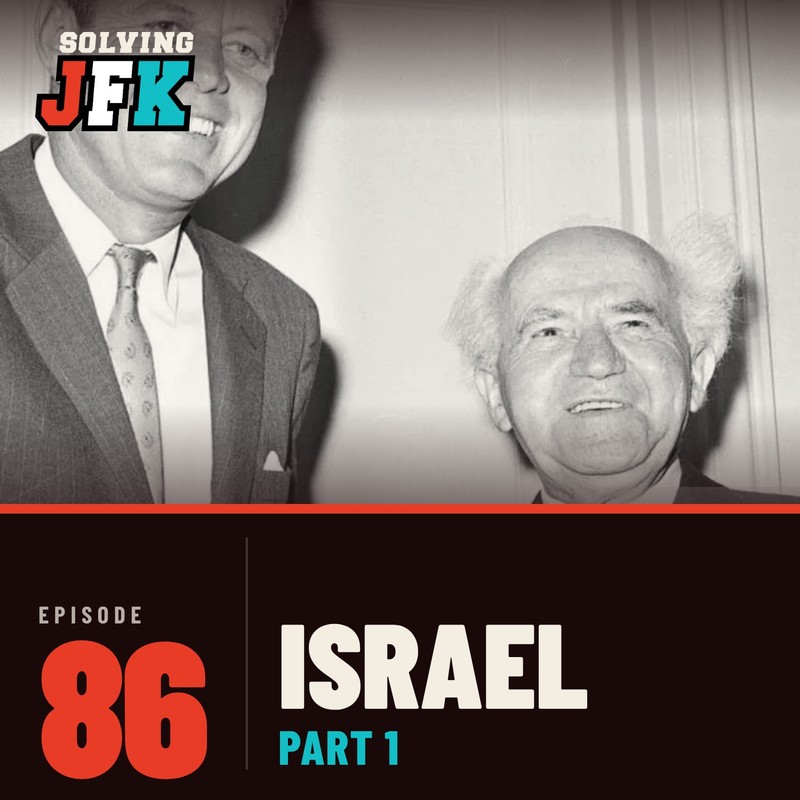
In this episode, we begin a multi-part examination of Israel, focusing on whether serious and escalating policy disputes between the Kennedy administration and Israeli leadership could constitute motive.
This episode examines four major areas of conflict: Kennedy’s effort to enforce the Foreign Agents Registration Act on pro-Israel lobbying groups, his comparatively pro-Arab Middle East policies, disputes over UN Resolution 194 concerning Palestinian refugees, and—most critically—his confrontation with Israeli leaders over Israel’s secret nuclear weapons program at Dimona. Drawing from historical records, declassified materials, and firsthand accounts, this episode lays the groundwork for a deeper exploration of Israel’s potential role.
We are currently making our way through the third season of Solving JFK. Having determined in Season 1 that the Warren Report could not be correct and that there was at least one shot fired from the front, we then turned our undivided attention in Season 2 to the life of Lee Harvey Oswald from birth to death, which revealed that he was no lone nut. In this Season 3, we have been asking the question, if not Oswald, then who?
Thus far, we’ve put some important agencies and individuals under the microscope, including the Secret Service, the FBI and J. Edgar Hoover, Lyndon Johnson, and the Mafia. Next up on our list is Israel.
In this series, we’ll try to answer important questions about the alleged involvement of Israel in the JFK assassination, starting in this episode with whether Israel had a motive for wanting President Kennedy out of office.
DISCLAIMER
There are few topics in modern dis course as sensitive—or as likely to be misunderstood—as exploring allegations of wrongdoing by the State of Israel. In the interest of fostering good-faith and open-minded conversation, now is a good time to clarify the viewpoint of Solving JFK when it comes to these matters.
First, antisemitism is real. It has existed for centuries, it has caused immense harm, and it remains a problem today. I don’t take that lightly, and I don’t approach this subject casually. Any responsible historical inquiry must be alert to the ways prejudice can distort evidence, flatten nuance, and turn analysis into accusation.
At the same time, it must be possible—necessary, even—to distinguish between a people, a religion, and a nation-state. Jewish people are not the State of Israel, and the State of Israel does not represent all Jewish people. Examining the actions, motives, or intelligence services of a sovereign state does not constitute hatred of a people or a faith. If it did, then much of modern American, British, Russian, and French history, for example, couldn’t be examined honestly.
The most troubling allegations discussed in this series are not categorically different from the allegations historians routinely explore regarding the United States itself—covert action, deception, governmental associations with mafia figures, and geopolitical maneuvering. To examine those actions in one country while refusing to examine them in another would not be moral clarity; it would be selective blindness.
JFK’S RELATIONSHIP WITH ISRAEL
When John F. Kennedy ran for president in 1960, like other presidential candidates, he courted the votes of the pro-Israel lobby. But he had a vague record on Israel. Unlike Lyndon Johnson, Senator Kennedy did not come to Israel’s defense during the Suez Crisis in the Fall of 1956,1 when, Israel, Britain and France invaded Egypt in response to Egyptian President Gamal Abdel Nasser nationalizing the Suez Canal earlier that year.2
And, as author Edward Tivnan points out about JFK, QUOTE “He was also a Catholic. Many Jews associated American Catholics with right-wing, pro-McCarthy, and anti-Semitic causes. Worse, there was the touchy issue of the candidate’s father, Joseph P. Kennedy, who as ambassador to Great Britain in the late 1930s had been a supporter of Neville Chamberlain’s policy of appeasing the Nazis.”3 It didn’t help that Joseph Kennedy’s was once quoted as saying that there was a QUOTE “overrepresentation of Jews in high positions.”4
Despite his father, Kennedy was successful at gaining the support of New York apparel manufacturer and financier, Abraham Feinberg, who, along with his associates donated half a million 1960 dollars the Kennedy Campaign.5 Feinberg said that when he told Kennedy the news, he was emotional with gratitude.6
In addition to his domestic support from the pro-Israel Lobby, Kennedy also made a significant shift in how America dealt with the Middle East. Since the inception of the state of Israel, the United States had a policy that it would not sell weapons to Israel or to Arab states. This was so that America could be perceived as being neutral in the event of any conflict.7 Nevertheless, in August of 1962, President Kennedy decided to allow the sale of the defensive Hawk Missiles directly to Israel.8
On the surface it looks like Kennedy was perhaps more supportive of Israel than any president before him. But, when we dive deeper, there were several serious areas of disagreement between President Kennedy and the leaders of Israel. Some people believe that these disagreements were serious enough to be a motive for wanting Kennedy out of office.
The first potential motive is the Kennedy Administration’s insistence that pro-Israel lobbying groups register under the Foreign Agents Registration Act of 1938. I previously mentioned Abraham Feinberg, the man who helped finance Kennedy’s 1960 campaign with half a million dollars from the pro-Israel lobby. According to Seymour Hersh, Feinberg’s job was QUOTE “to ensure continued Democratic Party support for Israel.”9According to President Kennedy‘s close friend Charles Bartlett, Kennedy, summed up Feinberg‘s message to Kennedy as QUOTE “we know your campaign is in trouble. We’re willing to pay your bills if you’ll let us have control of your Middle East policy.” Bartlett said that Kennedy was upset by the level of control expected by Feinberg and decided that QUOTE “if he ever did get to be president, he was going to do something about it.”10
When Kennedy was elected, he wanted to appoint Senator William Fulbright to be Secretary of State, but according to former Kennedy aide, Arthur Schlesinger, Fulbright’s nomination was killed because of pressure from the Israel lobby.11 Senator Fulbright apparently got revenge on Israel for costing him the Secretary of State job by conducting an audit in the Senate regarding QUOTE “an increasing number of incidents involving attempts by foreign governments or their agents to influence the conduct of American foreign policy by techniques outside normal diplomatic channels.”12
On the heels of Fulbright’s committee, on October 11, 1963, the Department of Justice sent a letter to the lawyers for the American Zionist Council with a demand to register as a foreign agent within 72 hours.13 The American Zionist Council refused to register after an October 17, 1963 meeting with the Justice Department.14 The matter of their registration was unresolved when President Kennedy died a little more than a month later. When Lyndon Johnson ascended to power, he did not require registration from the American Zionist Council, or its lobbying arm, the American Israel Public Affairs Group, or AIPAC.15
ISRAEL’S MOTIVE # 2 – JFK’S ARAB FRIENDLY MOVES
The second area of conflict between President Kennedy and Israel was Kennedy’s perceived pro-Arab bias as compared to his predecessor. As Historian Phillip Muelenbeck noted, QUOTE “While the Eisenhower administration sought to isolate Nasser and reduce his influence through building up Saudi Arabia’s King Saud as a conservative rival to Egyptian president [Nasser], the Kennedy administration pursued the exact opposite strategy.”16
One way Kennedy signaled his intentions was through his appointments. Kennedy appointed John Badeau, a scholar with deep knowledge of Arabic language and culture, as ambassador to Egypt, and named Robert Komer, an advocate of closer U.S. ties with Nasser, to the National Security Council with the portfolio of Middle Eastern affairs.17 On the other hand, Kennedy also appointed prominent pro-Israel voices too. For example, Mike Feldman was Kennedy’s deputy special counsel for monitoring Middle East communications.18
Kennedy’s foreign aid budget was also criticized as being anti-Israel. The final Kennedy Administration budget called for 40 million dollars in aid to Israel, which was a reduction from prior years. On the other hand, in Lyndon Johnson’s first budget, for fiscal year 1965, Israeli aid almost doubled to 71 million. The aide package rose again under Johnson to 130 million dollars in 1966.19 Under Kennedy, the allocated funds were almost exclusively for food assistance and development loans. Conversely, President Johnson called for 20% of the Israeli aid to be military assistance in 1965. And that number rose to 71% for military assistance in 1966.20
But, perhaps the most important pro-Arab position of John Kennedy was his view that Algeria, which had long been a French colony, should be independent from France. 11:56 On July 2, 1957, as a Senator, on the floor of the Senate, Kennedy said QUOTE “No amount of mutual politeness, wishful thinking, nostalgia or regret should blind either France or the United States to the fact that if France and the West at large are to have a continuing influence in North Africa, the essential first step is the independence of Algeria along the lines of Morocco and Tunisia.”21
The Israeli government, on the other hand, saw the emergence of Algeria as an independent Arab republic as a threat and fought against it.22 In addition to opposition from the American foreign policy establishment, the right wing paramilitary French Secret Army organization, known as OAS, was dedicated to stopping Algerian independence by any means necessary.23 The OAS viewed President Kennedy as their second biggest enemy behind only French president Charles de Gaulle.24
Algeria gained its independence in July of 1962 - during Kennedy’s presidency, which undoubtedly increased tensions between Kennedy and his Israeli counterparts.25
ISRAEL’S MOTIVE # 3 – UN RESOLUTION 194
The third area of disagreement between President Kennedy and Israel was the enforcement of UN Resolution 194, which, after the 1948 Palestine War, called for Palestinian refugees to be able to return to their land or to be compensated for it.26 In letters to Egyptian President Nasser and other Arab heads of state, President Kennedy expressed his support for the UN Resolution.
When Israel’s Prime Minister, David Ben-Gurion, found out about Kennedy’s communications with the Arab leaders, he wrote a letter to the Israeli ambassador in Washington, saying QUOTE “Israel will regard this plan as a more serious danger to her existence than all the threats of the Arab dictators and kings, than all the Arab armies, than all of Nasser’s missiles and his Soviet MIGs….Israel will fight against this implementation down to the last man.”27
In December of 1962, President Kennedy raised the issue of UN Resolution 194 again during a meeting in Palm Beach with Israeli Minister of Foreign Affairs, Golda Meir (who, herself, would go on to be Prime Minister of Israel). During that meeting Kennedy emphasized American support for Israel but he told Meir that the American-Israel relationship was QUOTE “a two way street.”28
The issue of UN Resolution 194 didn’t go away. After President Kennedy’s United Nations delegation met with Israel on November 20th,1963 requesting continued movement toward implementing UN Resolution 194, the Israeli delegation did not agree.29 On November 22, 1963, of all days, an article in the London Jewish Chronicle said QUOTE “Prime Minister Levi Eshkol summoned the US Ambassador and told him that Israel was shocked by the pro-Arab attitude adopted by the US delegation.”30
We’ve mentioned the issues related to registration of foreign agents, Kennedy’s perceived pro-Arab bias, and Kennedy’s intent on enforcing UN Resolution 194. But, the most serious conflict between Kennedy and Israeli Prime Minister David Ben-Gurion, was Ben-Gurion’s continued development of a nuclear reactor in the Israeli desert at Dimona.
Ben-Gurion had been interested in obtaining a nuclear weapon for Israel since the founding of the country in 1948. On the heels of World War II, he wanted to make sure that another Holocaust could never happen.31So, in the early 1950s, Ben-Gurion, who was both the Defense Minister and the Prime Minister began the methodical and clandestine process of enriching uranium, without letting the Americans know about it. To lead the program, Ben-Gurion tapped Shimon Peres, who would go on to serve multiple terms as Prime Minister.32 To get started, Peres relied on fuel from France and a free nuclear reactor provided by President Eisenhower’s Atoms for Peace program.33
In 1958, an American U-2 spy plane spotted an unusual construction site near the small Desert town of Dimona. Israeli officials initially said the facility was a textile plant. Then later, they described it as QUOTE “a metallurgical research installation.”34 In 1960, after an American reconnaissance satellite provided a clearer picture, CIA director, Allen Dulles, told the outgoing President Eisenhower that Israel was secretly building a nuclear reactor that would allow it to build a nuclear weapon.35 This new problem was among those inherited by President Kennedy when he took office in January of 1961.
KENNEDY AND BEN-GURION MEET
In attempting to peacefully resolve the issue of secret Israeli nuclear proliferation, Kennedy’s ability to influence Prime Minister Ben-Gurion took on paramount importance.
The relationship started well. When Kennedy first spoke to Ben-Gurion, he told him QUOTE “I know I was elected because of the votes of American Jews. I owe them my election. Tell me, is there something that I can do for the Jewish people?” Ben-Gurion was surprised by the frankness and evaded the question by answering QUOTE “You must do what is best for the free world.”36
Despite the diplomatic niceties between the two leaders, the reality was that they had divergent interests when it came to nuclear proliferation. Kennedy wanted to stop Israel from obtaining nuclear weapons. Whereas, a month before Kennedy took office, on December 21, 1960, Ben-Gurion made a statement to the Israeli Knesset acknowledging the existence of a nuclear reactor at Dimona. But Ben-Gurion said the reactor was strictly for research and peaceful purposes.37
President Eisenhower had also told Kennedy that the Dimona complex was designed exclusively for peaceful purposes. But, Kennedy still had two Atomic Energy Commission scientists visit Dimona on May 17, 1961. The scientists were not shown a reprocessing plant that was under construction underground. So, at that time they reported back that they saw QUOTE “no present evidence that the Israelis have weapons production in mind.”38
When Kennedy and Ben-Gurion met in person at the Waldorf-Astoria Hotel in New York about two weeks later on May 30th, the Dimona plant was at the top of the agenda.39 Ben-Gurion stressed that the purpose of the plant was to help Israel with its lack of fresh water. If they had atomic energy, it would be much cheaper to desalinate the sea water so that Israel would have enough fresh water.40 Ben-Gurion agreed to annual inspections of Dimona by American scientists on terms and at times determined by the Israeli Defense Ministry.41 Thus, there was agreement in theory, but there were no established details of when the inspections would begin and how they would be done.
Ben-Gurion later told his biographer that after meeting with Kennedy, he did not take the American president seriously because he looked like a twenty five year old boy.42 According to Abraham Feinberg, QUOTE “There’s no way of describing the relationship between Jack Kennedy and Ben-Gurion because there’s no way Ben-Gurion was dealing with JFK as an equal, at least as far as Ben-Gurion was concerned.”43
The Israeli prime minister, in later private communications to the White House, began to refer to the President as QUOTE “young man”. And Kennedy made it clear to associates that he found the letters to be offensive.44
DIVERGENT NUCLEAR INTERESTS
On September 25, 1961 President Kennedy gave a speech at the United Nations. Here’s the part where he talks about nuclear disarmament:
Today, every inhabitant of this planet must contemplate the day when this planet may no longer be habitable. Every man, woman and child lives under a nuclear sword of Damocles, hanging by the slenderest of threads, capable of being cut at any moment by accident or miscalculation or by madness. The weapons of war must be abolished before they abolish us.45
Kennedy went on to put an exclamation on all that disarmament talk, saying that it even applied to the Soviet Union.
And It is in this spirit that we have presented with the agreement of the Soviet Union--under the label both nations now accept of "general and complete disarmament"--a new statement of newly-agreed principles for negotiation. But we are well aware that all issues of principle are not settled, and that principles alone are not enough. It is therefore our intention to challenge the Soviet Union, not to an arms race, but to a peace race to advanced together, step-by-step stage by stage until general and complete disarm movement has been achieved.46
In light of speeches like this, it’s easy to understand why Kennedy was so intent on stopping Israel from getting a nuclear weapon. While he wanted Israel to be safe from harm, it wouldn’t have been intellectually consistent to allow Israel to create more weapons while Kennedy publicly pushed for all countries to do away with the ones they already had.
In August of 1963, Kennedy and his Soviet and British counterparts, would sign the Limited Nuclear Test Ban treaty which banned nuclear tests underwater, in the air, or in outer space - further demonstrating JFK’s commitment to disarmament that he laid out before the UN in 1961.47
On the other hand, Israel’s desire to have a nuclear weapon was logical, as noted by former Secretary of Defense, Robert McNamara, who said QUOTE “I can understand why Israel wanted a nuclear bomb. There is a basic problem there. The existence of Israel has been a question mark in history and that’s the essential issue.“48
THE SECOND DIMONA INSPECTION
In September of 1962, a second inspection of Dimona was finally allowed. But, what the Atomic Energy Commission inspectors actually experienced was a Potemkin Village, including a QUOTE “false control room…complete with false control panels and computer driven measuring devices.”49 The inspectors would have been able to tell that the reactor was weapons grade if they had seen the reactor’s core. But, the inspectors were not allowed to see the core, QUOTE “for safety reasons.”50
Kennedy, for his part, told his close friend, Charles Bartlett that he was getting tired of the fact that Israeli QUOTE “sons of bitches lie to me constantly about their nuclear capability.”51
After the Cuban Missile Crisis, the Dimona reactor became a policy priority for President Kennedy once again. On April 2, 1963, Kennedy requested that Ben-Gurion allow semiannual American visits to Dimona to ensure that it could not be weaponized, beginning the next month. Ben-Gurion responded on April 25th with a seven page letter noting that a recent Arab proclamation to liberate Palestine was QUOTE “tantamount to planning a new holocaust since the liberation of Palestine is impossible without the total destruction of the people of Israel.” Ben-Gurion followed up again on May 12th, saying QUOTE “Mr. President my people have the right to exist and this existence is in danger.”52
Those are interesting responses from Ben-Gurion given that his position was that the Dimona plant was notfor nuclear weapons, which raises the question, ‘why bring up defense needs and fears of military conflict when talking about Dimona if the purpose of the plant was solving Israel’s fresh water problem?’
On May 18th, President Kennedy wrote back to Ben-Gurion, once again, insisting on periodic inspections of Dimona, and expressing his concern that Arab states would turn to the Soviet Union for assistance if Israel possessed a nuclear bomb.53 Ten days later, Ben-Gurion formally accepted Kennedy’s request, but refused to commit to any details.54 About two weeks after that, Kennedy reiterated the need to start recurring inspections of all of the Dimona facility immediately, and – notably - saying that American support for Israel QUOTE “could seriously be jeopardized if it should be thought that we are unable to obtain reliable information on…Israel’s effort in the nuclear field.”55 The next day, David Ben-Gurion resigned as Prime Minister of Israel and Levi Eshkol took over.56
Eshkol gave Kennedy a vague agreement to a first inspection at the end of 1963.57 And, American diplomats did visit Dimona in January of 1964, noting that the reactor had gone critical on December 26th, but that QUOTE “research was the present intention of the Israelis with the Dimona reactor.”58 As noted by historian Avner Cohen, President Kennedy’s murder brought an abrupt end to the pressure being applied by the United States against Israel to end its nuclear program.59
NEXT TIME ON SOLVING JFK: We continue our exploration of Israel as a potential culprit in the JFK Assassination, turning to questions of means and opportunity, including Israel’s close relationship with the CIA’s Counterintelligence Chief, James Angleton.
Automated transcript
Machine-generated from the audio and unedited, so names and spellings may be wrong. Tap a timestamp to play from that point.
Speaker 3We are currently making our way through the third season of Solving JFK, having determined in season one that the Warren report could not be correct and that there was at least one shot fired from the front. We then turned our undivided attention in season two to the life of Lee Harvey Oswald from birth to death, which revealed that he was no lone nut. If not Oswald, then who? Thus far, we've put some important agencies and individuals under the microscope, including the Secret Service, the FBI and J. Edgar Hoover, Lyndon Johnson, and the Mafia. Next up on our list is Israel. In this series, we'll try to answer important questions about the alleged involvement of Israel in the JFK assassination. Starting in this episode with the question of whether Israel had a motive for wanting President Kennedy out of office.
Speaker 2In Dallas, Texas, three shots were fired at President Kennedy's motorcade in downtown Dallas. The first reports say that President Kennedy has been seriously wounded by this shooting.
Speaker 1And then they have formally charged the assassination question. I guess the hat of the husband man is the uncle. But also act in a loan comes in front of experts.
Speaker 3Mission answers the acting of a pop-pop-pop-pop-pop-pop-pop-pop-pop-pop-pop-pop-pop-pop-pop-pop-pop-pop-pop-pop-pop-pop-pop-pop-pop-pop-pop-pop-pop-pop-pop-pop-pop-pop-pop-pop-pop-pop-pop-pop-pop-pop-pop-pop-pop-pop-pop-pop-pop-pop-pop-pop-pop-pop-pop-pop-pop-pop-pop-pop-pop-pop-pop-pop-pop-pop-pop-pop-pop-pop-pop-pop-pop-pop-pop-pop-pop-pop-pop-pop-pop-pop-pop-pop-pop-pop-pop-pop-pop There are few topics in modern discourse as sensitive or as likely to be misunderstood as exploring allegations of wrongdoing by the state of Israel. In the interest of fostering good faith and open-minded conversation, now is a good time to clarify the viewpoint of solving JFK when it comes to these matters. anti-Semitism is real. It's existed for centuries, it's caused immense harm and it remains a problem today. I don't take that lightly and I don't approach this subject casually. Any responsible historical inquiry must be alert to the ways that prejudice can distort evidence and flatten nuance.
Speaker 3It can turn analysis into accusation. At the same time, it must be possible necessary even to distinguish between a people, a religion, and a nation state. Jewish people are not the state of Israel, and the state of Israel does not represent all Jewish people. Examining the actions, motives, or intelligent services of a sovereign state does not constitute hatred of a people or a faith. If it did, then much of modern American, British, Russian, and French history, for example, couldn't be examined, honestly. The most troubling allegations that will be discussing in this series are not that different from the allegations that historians routinely explore regarding the United States itself. covert action, deception, governmental associations with mafia figures and geopolitical maneuvering to examine those actions in one country while refusing to examine them in another wouldn't be moral clarity, it would be selective blindness.
Speaker 3When John F. Kennedy ran for President in 1960, like other presidential candidates, he courted the votes of the pro-Israel lobby, but JFK had a vague record on Israel. Unlike Lyndon Johnson, Senator Kennedy did not come to Israel's defense during the Suez crisis in the fall of 1956, when Israel, Britain, and France invaded Egypt in response to Egyptian president Gamal Abdel Nasser nationalizing the Suez Canal earlier that year. As author Edward Tivden points out about JFK, quote, Many Jews associated American Catholics with right wing, Pro-Makarthi, and anti-Semitic causes. Worse, there was the touchy issue of the candidate's father, Joseph P. Kennedy, who, as ambassador to Great Britain in the late 1930s, had been a supporter of Neville Chamberlain's policy of appeasing the Nazis. It didn't help that Joseph Kennedy was once quoted as saying that there was a quote over representation of Jews in high positions.
Speaker 3Despite his father, John Kennedy was successful at gaining the support of New York Apparel Manufacturer and Finance Year, Abraham Feinberg, who, along with his associates, donated half a million dollars to the Kennedy campaign. Feinberg said that when he told Kennedy the news, he was emotional with gratitude. In addition to his domestic support from the pro-Israel lobby, Kennedy also made a significant shift in how America dealt with the Middle East. Since the inception of the state of Israel, the United States had a policy that it would not sell weapons to Israel or to Arab states. This was so that America could be perceived as being neutral in the event of any conflict. Nevertheless, in August of 1962, President Kennedy decided to allow the sale of defensive hawk missiles directly to Israel. On the surface, it looks like Kennedy was perhaps more supportive of Israel than any President before him, but when we dive deeper, there were several serious areas of disagreement between President Kennedy and the leaders of Israel.
Speaker 3Some people believe that these disagreements were serious enough to be emotive for Israel wanting President Kennedy out of office. The first potential motive is the Kennedy administration's insistence that pro-Israel lobbying groups register under the Foreign Agents Registration Act of 1938. We just mentioned Abraham Feinberg. The man who helped finance President Kennedy's 1960 campaign with half a million bucks from the pro-Israel lobby. According to Seymour Hirsch, Firmberg's job was, quote, to ensure continued Democratic Party support for Israel. According to President Kennedy's close friend Charles Bartlett, Kennedy summed up Fineburg's message, as quote, We know your campaign is in trouble. We're willing to pay your bills if you let us have control of your Middle East policy. Bartlett said that Kennedy was upset by the level of control expected by Fineburg and decided that quote, if he ever did get to be president, he was going to do something about it.
Speaker 3When Kennedy was elected, he wanted to appoint Senator William Fulbright to be Secretary of State. But according to former Kennedy Aid Arthur Schlesinger, Fulbright's nomination was killed because of pressure from the Israel lobby. Senator Fulbright apparently got revenge on Israel for costing him the secretary of state job by conducting an audit in the Senate regarding, quote, an increasing number of incidents involving attempts by foreign governments or their agents to influence the conduct of American foreign policy by techniques outside normal diplomatic channels. On the heels of Fulbright's committee, on October 11, 1963, the Department of Justice sent a letter to the lawyers for the American Zionist Council with the demand to register as a foreign agent within 72 hours. The American Zionist Council refused to register after an October 17th meeting with the Justice Department. When President Kennedy died a little more than a month later, the matter of their registration was unresolved.
Speaker 3When Lyndon Johnson ascended to power, he did not require registration from the American Zionist Council, or its lobbying arm, the American Israel Public Affairs Group, or APEC. The second area of conflict between President Kennedy and Israel was Kennedy's perceived pro-Arab bias as compared to his predecessors. As historian Philip Muleenbeck noted, quote, while the Eisenhower administration sought to isolate NASA and reduce his influence through building up Saudi Arabia's King Saad as a conservative rival to Egyptian President The Kennedy administration pursued the exact opposite strategy. One way Kennedy signaled his intentions was through his appointments. Kennedy appointed John Bado, a scholar with deep knowledge of Arabic language and culture as ambassador to Egypt and named Robert Comer, an advocate of closer U.S. ties with Nasser to the National Security Council with the portfolio of Middle Eastern Affairs.
Speaker 3On the other hand, Kennedy also appointed prominent pro-Israel voices as well. For example, Mike Feldman was Kennedy's deputy special counsel for monitoring Middle East communications. President Kennedy's foreign aid budget was also criticized as being anti-Israel. The final Kennedy administration budget called for $40 million in aid to Israel, which was a reduction from prior years. On the other hand, in Lyndon Johnson's first budget for fiscal year 1965, Israeli aid almost doubled to $71 million. The aid package rose again under Johnson to $130 million in 1966. Under Kennedy, the allocated funds were almost exclusively for food assistance and development loans. Conversely, President Johnson called for 20% of the Israeli aid to be military assistance in 1965, and that number rose to 71% as military assistance in 1966. But perhaps the most important pro-era position of John Kennedy was his view that Algeria, which had long been a French colony, should be independent from France.
Speaker 3On July 2, 1957, as a senator on the floor of the Senate, Kennedy said, quote, No amount of mutual politeness, wishful thinking, nostalgia, or regret should blind either France or the United States to the fact that if France and the West at large are to have a continuing influence in North Africa, the essential first step is the end dependence of Algeria along the lines of Morocco and Tunisia. The Israeli government, on the other hand, saw the emergence of Algeria as an independent Arab Republic as a threat and fought against it. In addition to opposition from the American foreign policy establishment, the right-wing paramilitary French Secret Army Organization, known as OAS, was dedicated to stopping Algerian independence by any means necessary. The OAS viewed President Kennedy as their second biggest enemy behind only French President Charles De Gaulle. Algeria went on to gain its independence in July of 1962 during Kennedy's presidency, which undoubtedly increased the tensions between Kennedy and his Israeli counterparts.
Speaker 3The third area of disagreement between President Kennedy and Israel was the enforcement of UN resolution 194, which after the 1948 Palestine War called for Palestinian refugees to be able to return to their land or to be compensated for it. In letters to Egyptian President Nasser and other Arab heads of state, President Kennedy When Israel's Prime Minister David Ben Gurion found out about Kennedy's communications with the Arab leaders, he wrote a letter to the Israeli ambassador in Washington saying, quote, Israel will regard this plan as a more serious danger to her existence than all the threats of the Arab dictators and kings, than all the Arab armies. than all of NASA's missiles and his Soviet mix, Israel will fight against this implementation down to the last man. In December of 1962, President Kennedy raised the issue of UN resolution During a meeting in Palm Beach with Israeli Minister of Foreign Affairs, Golden Mayer, who herself would go on to be Prime Minister of Israel.
Speaker 3During that meeting, Kennedy emphasized American support for Israel, but he told Mayer that the American Israel relationship was, quote, a two-way street. The issue of UN resolution 194 didn't go away. After President Kennedy's United Nations delegation met with Israel on November 20, 1963, requesting continued movement toward implementing UN Resolution 194 that Israeli delegation did not agree. On November 22, 1963, of all days, an article in the London Jewish Chronicle said, quote, Prime Minister Levi Eschkaul summoned the U.S. ambassador and told him that Israel was shocked by the pro-Arab attitude adopted by the U.S. delegation. We've mentioned the issues related to registration of foreign agents. Kennedy's perceived pro-era bias and Kennedy's intent on enforcing UN Resolution 194. But the most serious conflict between Kennedy and his really prime minister David Ben Gurion was Ben Gurion's continued development of a nuclear reactor in the Israeli desert at Demona.
Speaker 3Ben Gurian had been interested in obtaining a nuclear weapon for Israel since the founding of the country in 1948. On the heels of World War II, he wanted to make sure that another Holocaust could never happen. So in the early 1950s, Ben Gurian, who was both the defense minister and the prime minister, began the methodical and clandestine process of enriching uranium without letting the Americans know about it. To lead the program, Ben Gurion tapped Shimon Perez. To get started, Perez relied on fuel from France and a free nuclear reactor provided by President Eisenhower's Atoms for Peace Program. In 1958, an American U2 spy plane spotted an unusual construction site near the small desert town of Demona. Israeli officials initially said the facility was a textile plant. Later, they described it as, quote, a metallurgical research installation. In 1960, after an American reconnaissance satellite provided a clearer picture, CIA director Alan Delis told the outgoing President Eisenhower that Israel was secretly building a nuclear reactor that would allow it to build a nuclear weapon.
Speaker 3This new problem was among those inherited by President Kennedy when he took office in January of 1961. In attempting to peacefully resolve the issue of secret Israeli nuclear proliferation, Kennedy's ability to influence Prime Minister Ben Gurion took on paramount importance. The relationship started well. When Kennedy first spoke to Ben Gurion, he told him quote, I know I was elected because of the votes of American Jews. I owe them my election. Tell me, is there something that I can do for the Jewish people? Ben Gurion was surprised by the frankness and evaded the question by answering quote, you must do what is best for the free world. Despite the diplomatic niceties between the two leaders, the reality was that they had divergent interests when it came to nuclear proliferation. Kennedy wanted to stop Israel from obtaining nuclear weapons, whereas a month before Kennedy took office on December 21, 1960, Ben Gurian made a statement to the Israeli-Connecite acknowledging the existence of a nuclear reactor at Demona.
Speaker 3Ben Gurion said the reactor was strictly for research and peaceful purposes. President Eisenhower had also told Kennedy that the Demona complex was designed exclusively for peaceful purposes. Still, Kennedy had two atomic energy commission scientists The scientists were not shown a reprocessing plant that was under construction underground. So at the time they reported back, they saw, quote, no present evidence that the Israelis have weapons production in mind. When Kennedy and Ben Gurian met in person at the Waldorf Astoria Hotel in New York about two weeks later on May 30th, the Demona plant was at the top of the agenda. Ben Gurian stressed that the purpose of the plant was to help Israel with its lack of fresh water. If they had atomic energy, it would be much cheaper to desalinate the sea water so that Israel would have plenty of fresh water. At this meeting, Ben Gurion agreed to annual inspections of Demona by American scientists on terms and at times that would be determined by the Israeli Defense Ministry.
Speaker 3Thus, there was agreement in theory, but there were no established details of when the inspections would begin or how they would be done. Ben Gurion later told his biographer that after the meeting with Kennedy, he did not take the American president seriously because he looked like a 25-year-old boy. According to Abraham Feinberg, quote, there's no way of describing the relationship between Jack Kennedy and Ben Gurion, because there's no way Ben Gurion was dealing with JFK as an equal, at least as far as Ben Gurion was concerned. In later private communications to the White House, the Israeli Prime Minister began to refer to the president as, quote, young man. Kennedy made it clear to his associates that he found that greeting to be offensive. On September 25, 1961, President Kennedy gave a speech at the United Nations. Here's the part where he talks about nuclear disarmament.
Speaker 0Today, every inhabitant of this planet must contemplate the day when this planet may no longer be habitable. Every man, woman, and child lives under a nuclear sort of damage, hanging by the slendorist of threads, capable of being cut at any moment by accident, or miscalculation, or by madness. The weapons of war must be abolished before they abolish us.
Speaker 3In that same speech, Kennedy went on to put an exclamation on all that disarmament talk, saying that it even applied to the Soviet Union.
Speaker 0And it is in this spirit that we have presented with the agreement of the Soviet Union of general and complete disarmament, a new statement of newly agreed principles for negotiation. But we are well aware that all issues of principle are not settled and that principles alone are not enough. It is therefore our intention to challenge the Soviet Union not to an arms race, but to a peace race. to advance together step by step stage by stage until general and complete disarmament has been achieved.
Speaker 3In light of speeches like this, it's easy to understand why Kennedy was so intent on stopping Israel from getting a nuclear weapon. While he wanted Israel to be safe from harm, it would not have been intellectually consistent for Kennedy to allow Israel to create more weapons, while he publicly pushed for all other In August of 1963, Kennedy and his Soviet and British counterparts would sign the limited nuclear test band treaty which banned nuclear tests under water, in the air, or in outer space. Even further demonstrating JFK's commitment to disarmament that he laid out before the UN in 1961. On the other hand, Israel's desire to have a nuclear weapon was logical. As noted by former Secretary of Defense, Robert McNamara, who said, quote, I can understand why Israel wanted a nuclear bomb. There is a basic problem there. The existence of Israel has been a question mark in history. That's the essential issue.
Speaker 3In September of 1962, a second inspection of Demona was finally allowed, but what the atomic energy commission inspectors actually experienced was a Potemkin village, including a, quote, false control room, complete with false control panels, and computer-driven measuring devices. The inspectors would have been able to tell that the reactor was weapons if they had seen the reactors core, but these inspectors were not allowed to see the core, quote, for safety reasons. Kennedy, for his part, told his close friend Charles Bartlett that he was getting tired of the fact that Israeli, quote, sons of bitches lied to me constantly about their nuclear capability. After the Cuban Missile Crisis, the Demona Reactor became a policy priority for President Kennedy once again. On April 2, 1963, Kennedy requested that Ben Gurion allows semi-annual American visits to Demona to ensure that it could not be weaponized beginning the next month.
Speaker 3Ben Gurian responded on April 25 with a 7-page letter noting that a recent Arab proclamation to liberate Palestine was, quote, tantamount to planning a new Holocaust since the liberation of Palestine is impossible without the total destruction of the people of Israel. Ben Gurian followed up again on May 12, saying, quote, Mr. President, my people have the right to exist, and this existence is in danger. Those are interesting responses from Ben Gurian, given that his position was that the Demona plant was not for nuclear weapons. which raises the question, why bring up defense needs and fears of military conflict when talking about Demona if the purpose of the plant was actually solving Israel's fresh water problem. On May 18th, President Kennedy wrote back to Ben Gurion once again insisting on periodic inspections of Demona and expressing his concern that Arab states would turn to the Soviet Union for assistance if Israel possessed a nuclear bomb.
Speaker 3Ten days later, Ben Gurion formally accepted Kennedy's request but refused to commit to any details. About two weeks after that, Kennedy reiterated the need to start recurring inspections of all of the demonic facility immediately, and notably saying that American support for Israel, quote, could seriously be jeopardized if it should be thought that we are unable to obtain reliable information on Israel's effort in the nuclear field. The day after Kennedy said that their relationship could be seriously jeopardized, David Ben Gurian resigned as Prime Minister of Israel and Levi Eschgall took over. Prime Minister Eschgall gave Kennedy a vague agreement to a first inspection at the end of 1963 and American diplomats did visit Demona in January of 1964, noting that the reactor had gone critical on December 26, but that, quote, research was the present intention of the Israelis with the Demona Reactor.
Speaker 3As noted by historian Afner Cohen, President Kennedy's murder brought an abrupt end to the to end its nuclear program. Next time on Solving JFK, we continue our exploration of Israel as a potential culprit in the JFK assassination. Turning to questions of means and opportunity, including Israel's close relationship with CIA counterintelligence chief James Angleton. If you heard anything that you believe is out of context or if you have additional information to offer, you can let us know at solving JFK podcast at gmail.com. Please provide citations to the record for any fact that you're relying on. For transcripts, sources, and official podcast merchandise, visit solvingjfkpodcast.com. Thanks for listening. Visit solvingjfkpodcast.com for more information.