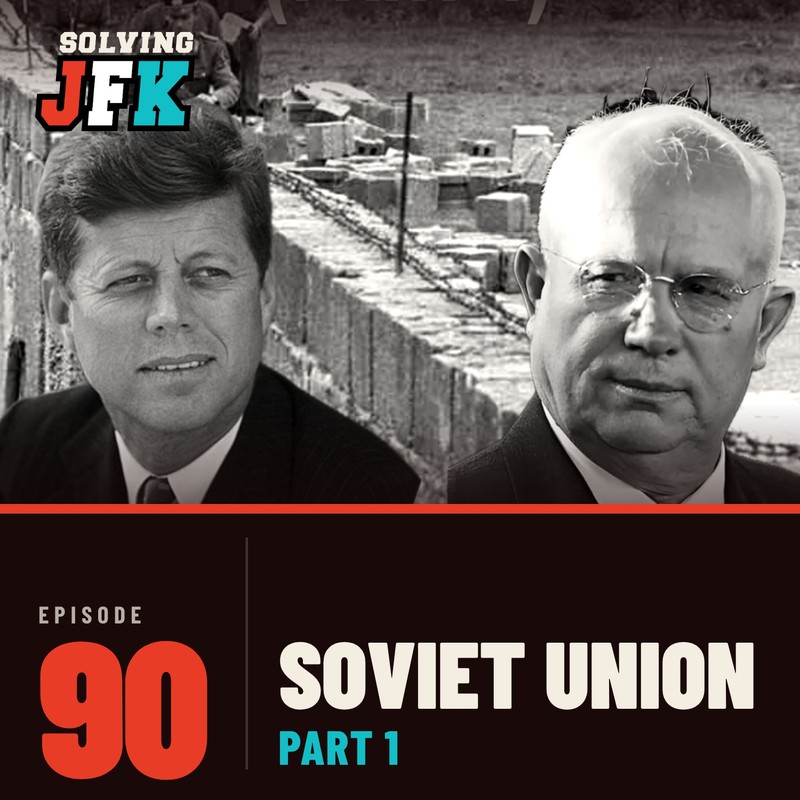
In Part 1 of this new series, Solving JFK zooms out to examine the Cold War backdrop that shaped the world leading up to President Kennedy’s assassination. From the so-called “missile gap” and early U.S.–Soviet tensions to the failed Bay of Pigs invasion, this episode explores the fragile and often volatile relationship between Kennedy and Soviet Premier Nikita Khrushchev. While often portrayed as either a Cold War hawk or dove, Kennedy emerges here as something more complex—navigating intense pressure from both sides while attempting to avoid catastrophic conflict.
The episode also dives into the high-stakes geopolitical flashpoints of 1961, including Berlin, Vienna, and the creation of a secret backchannel between the White House and the Kremlin through Soviet agent Georgi Bolshakov. As tensions escalate to the brink of nuclear confrontation at Checkpoint Charlie, listeners begin to see how close the world came to disaster—and how critical Kennedy’s decision-making may have been in preventing it. This foundational episode sets the stage for examining the Soviet angle in the JFK assassination, including Lee Harvey Oswald’s connections to the USSR and the mysterious events in Mexico City.
Emerging in the aftermath of World War II, the Cold War was a decades-long geopolitical rivalry between the United States and the Soviet Union, along with their respective allies. The Cold War pitted the capitalist nations of the Western world against the communist states aligned with Moscow and shaped global politics until the Soviet Union collapsed in 1991. Despite the intensity of the conflict, and as you will see, partially thanks to the cool-headed performance of President John F. Kennedy, the two superpowers never fought each other directly – although there were many close calls.
Instead, the struggle played out through proxy wars, intelligence operations, political influence campaigns, and a relentless competition for military, technological, and ideological supremacy.1 Then, at the height of the Cold War, only about a year after the Americans and Soviets were teetering on the brink of nuclear annihilation, President Kennedy was assassinated.
Given that the USSR was the chief geopolitical rival of the United States, it follows that, in order to have a comprehensive review of the JFK Assassination, we need to put the Russians under the microscope. When we look at Lee Harvey Oswald’s time in the Soviet Union, his correspondence with the Soviet Embassy once he was back in the States, and most importantly, his alleged trip to Mexico City, Oswald can be seen as either a potential Soviet actor – or someone who was made to look that way. The plot thickens even further when we consider President Johnson’s documented statements to several Warren Commissioners about QUOTE “a little incident in Mexico City” which referenced Oswald’s alleged meeting with KGB Assassinations Agent, Valeriy Kostikov.2
We’ll get to all of that in this series. But, first, we have to lay the groundwork by looking at the relationship between the US and the Soviet Union, and more specifically, between President Kennedy and Soviet Premier Nikita Khrushchev. In this episode, we review Kennedy’s relationship with Khruschev up until the Cuban Missile Crisis with a focus on Vienna, Berlin, and Kennedy’s off the books backchannel to Khrushchev – Georgi Bolshakov. Coming up next on Solving JFK.
Theme Song
Soviet Union Pre-JFK
The question of whether President Kennedy was a Cold War hawk is still debated today. Those who argue that elements of the military-industrial complex or the CIA killed Kennedy also tend to assert that the reason why was because he was a Cold War dove who was working against the interests of the establishment. Official story defenders (or people who think some other non military-industrial complex reason is why Kennedy died) often rebut this argument about how much Kennedy loved peace by citing to Kennedy’s run of the mill Cold War Hawk positions. It turns out that there is some truth to be found on both sides of that debate.
In August 1958, Senator John Kennedy gave a speech from the Senate floor emphasizing his concerns about the so-called missile gap between the United States and the Soviet Union. He said that, since the United States dropped nuclear bombs on Japan in World War II, American nuclear power had been the foundation of American defense and was the ultimate deterrent to Soviet attack. But, since then, the Soviets had built up a similar nuclear striking power.
Kennedy said QUOTE “We are rapidly approaching that dangerous period which General Gavin and others have called the "gap" or the "missile-lag period" - a period, …"in which our own offensive and defensive missile capabilities will lag so far behind those of the Soviets as to place us in a position of great peril."3
Kennedy then highlighted that the Soviets could take out 85% of American industry and 43 of the 50 largest cities.4 In retrospect, we now know that there was no missile gap between the two countries. America was winning. And it wasn’t close. However, the Gaither Committee of President Eisenhower’s National Security Council, determined in 1957 that the US was behind the Soviets in ballistic missiles.5 Senator Kennedy, who was preparing to make a run for president in 1960 saw the missile gap as a winning issue. He based his position on the Gaither Committee report, and the refusal of President Eisenhower to provide any evidence from U-2 spy planes to confirm that there was no missile gap. According to historian Robert Dallek, the reason Eisenhower didn’t share any evidence with Kennedy is that Eisenhower thought Kennedy was going to lose the presidential election anyway.6
Enter JFK
It turned out that Ike was wrong about JFK. On January 25, 1961, during President Kennedy’s first press conference, he announced the release of two American pilots who had been in Soviet custody since 1960.7The apparent Soviet goodwill continued with Premier Khrushchev’s announcement that QUOTE “Step by step, it will be possible to remove existing suspicion and distrust and cultivate seeds of friendship and practical cooperation." Kennedy responded that he was ready "to cooperate with all who are prepared to join in genuine dedication to the assurance of a peaceful and a more fruitful life for all mankind."8 While the two leaders got off to a good start, the honeymoon would be short lived.9
In mid-April 1961, the Kennedy administration authorized the CIA’s plan to invade Cuba at the Bay of Pigs, a failed operation that significantly heightened tensions between the United States and the Soviet Union and shaped Premier Khrushchev’s early perception of President Kennedy. We’ll cover the Bay of Pigs invasion in depth when we get to Cuba.
After the Bay of Pigs, Khruschev noted in a letter to Kennedy QUOTE “It is a secret to no one that the armed bands invading [Cuba] were trained, equipped, and armed in the United States of America." He then promised to give Cuba QUOTE "all necessary help to repel armed attack." He also warned that QUOTE "conflagration in one region could endanger settlements elsewhere" – a veiled reference to the predicament in Berlin.10
This led to an exchange of letters between the two leaders, with Kennedy defending the Bay of Pigs invasion and telling Khruschev that the worldwide communist revolution was not inevitable – and Khruschev responding with a 15 page letter restating everything he already said. Kennedy didn’t respond to the letter, but he did take Khruschev up on his offer to meet in person in Vienna in June.11
The Bolshakov Backchannel
With the escalating possibility of nuclear war in mind, President Kennedy was looking for a way to have informal backchannel communications with Premier Khruschev. The man who would serve that role was Khruschev’s secret GRU military intelligence agent in Washington who worked undercover as a journalist at the Soviet Embassy – Georgi Bolshakov. On May 9, 1961, Attorney General Robert Kenedy met with Bolshakov on a park bench in the National Mall. During this meeting, according to Bolshakov, Bobby Kennedy told him, QUOTE:
“The president believes that strained relations between our two countries come chiefly from misunderstandings and misinterpretations of one another's intentions and actions…. My brother's mistake is he hasn't removed [Dulles, Lemnitzer and others] right away. These men make outdated recommendations and suggestions which are out of keeping with the president's new course. My brother has been compelled to go by their mistaken judgments in decision making. Cuba has changed all our foreign policy concepts. For us, the events in the Bay of Pigs are not a flop, but the best lesson we have ever learned. So we are no longer going to repeat our past mistakes."12
Then, the attorney general told Bolshakov that he feared for his brother’s life because he was surrounded by people in the American government who insisted upon a militant stand against the Soviets. RFK told Bolshakov QUOTE “they can put him away any moment. Therefore, he must tread carefully in certain matters and never push his way through.”13 In other words, the American attorney general - and the President’s brother - was telling a Russian GRU agent that the President could not trust his own military or CIA.
After their meeting, Bobby Kennedy told Bolshakov he would meet with him every couple of weeks. This commitment from the attorney general was especially risky, given that various government agents trailed him everywhere he went.14 Starting in September of 1961, Bolshakov would personally deliver messages directly from Khruschev to President Kennedy through either Bobby Kennedy or Press Secretary, Pierre Salinger.15As James Douglass noted, the agencies monitoring the Bolshakov exchanges were alarmed that the new president was cutting them out of the loop and resolving issues without their permission.16
RFK and Bolshakov would become close, with Bolshakov regularly visiting RFK's home, Hickory Hill, in McLean, Virginia. The Attorney General even tried to invite Bolshakov to a party of government officials on board the presidential yacht, the Sequoia, but CIA Director John McCone said QUOTE "If he gets on the boat, I get off."17
Geopolitical Hot Spots
As President Kennedy prepared for his face to face meeting with Khruschev in Vienna, he knew there were several geopolitical hot spots where potential Cold War confrontations could break out at any moment.
First, of course, there was Cuba, which would be a clear topic of discussion due to the recent disastrous Bay of Pigs invasion. There were also the issues of Laos and Thailand, where the Americans and Soviets had troops.18 Then, there was the Soviet assistance of Patrice Lumumba’s followers in the Congo after Lumumba was assassinated. Kennedy sent Vice President Johnson to Senegal to combat the Soviet’s presence. The Senegalese must have been very impressed with the lighters they received from Johnson on behalf of the United States that were engraved simply with the letters LBJ.19
Other than Cuba, the biggest hot spot was Berlin. After World War II, Germany was divided into British, French, and American zones which made up West Germany, and a Soviet-occupied area that was East Germany. Berlin was 110 miles into Soviet East Germany, making West Berlin a capitalist island in the communist East German nation. Berlin itself was also divided into 4 corresponding parts – the west for the British, French, and Americans, and the East for the USSR.
In 1961, an increasing amount of East Germans were fleeing to the west through Berlin, which was an embarrassment to the Soviets.20 Khruschev’s problem wasn’t just the exodus of skilled professionals seeking a better life in the West. He also faced West Berliners crossing over to the East to take advantage of the communal and cheap services offered there because there was no barrier between East and West Berlin.21
According to Professor John Newman, the Soviet plan was to draw the Americans into conflicts in Laos, Cuba, the Congo, and elsewhere so that the Soviets could have a better chance of taking Berlin.22 Also, Germany was the birthplace of Karl Marx.23 So, it was a matter of personal pride for Khruschev to make all of Germany communist – not just East Germany. Kennedy, for his part, understood that the price of invading Cuba was potentially losing West Berlin.24
Vienna
As the June 3rd meeting between President Kennedy and Premier Khruschev in Vienna approached, Soviet officials asked Khruschev to confirm that the customary exchanging of gifts was approved. (In this case, 12 cans of black caviar and Russian vinyl records). Khruschev gave his approval, foreshadowing the tone of the coming meeting, saying QUOTE “One can exchange presents even before a war."25
At the U.S. Embassy in Vienna, during his first in-person meeting with President Kennedy, the Soviet Premier came in looking for a fight. He began by extolling the virtues of Communism and talking about how the American empire exploits people. Even when Kennedy tried to compliment the growth of the Soviet economy, Khruschev ignored his attempt to find common ground.26 At lunch, Kennedy saw two medals on Khruschev’s jacket and asked what they were. When Khruschev responded that they were peace prizes, JFK said QUOTE “I hope you get to keep them.”27
The first sign of Khruschev opening up was when he was talking to first lady, Jacqueline Kennedy at dinner that night. In response to Khrushchev telling her about the number of teachers per capita in Ukraine, Jackie said QUOTE “Oh, Mr. Chairman, don’t bore me with statistics.” Khruschev thought this was hilarious and for a moment, seemed to let down his guard.28
The next day the men got down to the business they traveled to Austria to discuss. Kennedy acknowledged making a QUOTE “misjudgment” with the Bay of Pigs. Khruschev admonished Kennedy that all people’s revolutions were not communist plots. Then, he threatened, that if the United States refused to sign a peace treaty on terms agreeable to the Soviets, he would unilaterally sign a treaty with East Germany, which would have the practical effect of closing off Western access to Berlin.29 Kennedy responded QUOTE “We are in Berlin not because of someone’s sufferance. We fought our way there. If we accepted the loss of our rights, no one would have any confidence in U.S. commitments and pledges.”30
Khruschev then said QUOTE “No force in the world would prevent the Soviet Union from signing a peace treaty with East Germany.” He added that only a QUOTE “madman who should be put in a straightjacket” would want such a conflict.31 And that QUOTE “It is up to the U.S. to decide whether there will be war or peace,” to which Kennedy responded QUOTE, “Then, Mr. Chairman, there will be war. It will be a cold winter.”32
One bright spot from the President’s trip to Austria was Khrushchev’s agreement to begin using unofficial communication channels to bypass formalities going forward.33 The relationship between Bobby Kennedy and Georgi Bolshikov was already there. Kennedy and Khrushchev just needed to use it.
Immediately after Vienna, the hostilities between the Americans and the Soviets ticked up to a new level. In July of 1961, Newsweek reported that plans were being made to remove American civilians from West Germany and France and to bring in American nuclear weapons. In response, Khruschev canceled his plans to reduce Soviet forces by more than a million men and instead increased the defense budget by 1/3.34Kennedy then called for more military funding and increased the size of the army by 125,000 soldiers.35
BERLIN
On July 25th, not long after he sat face to face with Khrushchev, President Kennedy gave a speech to Americans on radio and television about the crisis in Berlin:
We cannot and will not permit the Communists to drive us out of Berlin, either gradually or by force. For the fulfillment of our pledge to that city is essential to the morale and security of Western Germany, to the unity of entire Free World. Soviet strategy has long been aimed, not merely at Berlin, but at dividing and neutralizing all of Europe, forcing us back on our own shores. We must meet our oft-stated pledge to the free peoples of West Berlin--and maintain our rights and their safety, even in the face of force--in order to maintain the confidence of other free peoples in our word and our resolve. The strength of the alliance on which our security depends is dependent in turn on our willingness to meet our commitments to them.36
On August 13th, 1961, about two weeks after Kennedy gave that speech laying out the American policy towards Berlin, the East Germans put up security barriers to block access from East to West Berlin.37 Under the cover of darkness, police and army units began laying concertina wire and putting up barricades. 32,000 combat and engineer troops were brought in to begin building the Berlin Wall while the Soviet army stood watch.38
On August 19th, Kennedy sent Vice President Lyndon Johnson to Berlin, where he rode in a motorcade with hundreds of thousands of spectators lining the roads, and gave a speech to a massive crowd in an effort to let West Berliners know that the United States had their backs.39
I have come across the ocean to Berlin by direction of the President of the United States, John F. Kennedy. He wants you to know and I want you to know and the United States wants you to know, that the pledge he has given to the freedom of West Berlin and to the rights of Western access to Berlin is firm.40
In September, President Kennedy’s personal representative in West Berlin, Retired General Lucius Clay, began secret preparations to tear down the new Berlin Wall. Unbeknownst to President Kennedy, General Clay ordered that a duplicate of the wall be built in a forest so that American tanks with bulldozer attachments could practice knocking the wall down. Another General, Bruce Clarke, found out about Clay’s plan to knock down the Berlin wall and told him it was against the President’s policy, which held General Clay at bay for awhile.41
As General Clay was preparing to escalate Cold War tensions behind Kennedy’s back, the President was trying to calm things down. On September 25th, JFK gave his famous sword of Damocles speech to the United Nations. While he blamed Moscow for causing the Berlin crisis, he also said that he challenged the Soviets to a peace race and not an arms race. This struck a much more friendly chord in Moscow than his July speech about Berlin.42
A few days after Kennedy’s UN Speech, Khrushchev sent a 26 page letter to the president via Soviet Press spokesman Mikhail Kharmalov to Press Secretary, Pierre Salinger. The Soviet Premier praised Kennedy and said that he QUOTE “prepossessed” people with his “informality, modesty, and frankness, which are not to be found very often in men who occupy such a high position.” Khrushchev highlighted the importance of backchannel communications, saying QUOTE “Only in confidential correspondence can you say what you think without a backward glance at the press.” This was the first time since Vienna that Khruschev said kind words to Kennedy, which Khruschev was able to do because of the private nature of the communications.43
But many Americans were not impressed by Kennedy’s deliberative approach to the Soviets. After his UN Speech, Kennedy was accused by a Texas journalist at a White House luncheon of heading an administration of QUOTE “weak sisters”. The journalist, Ted Dealey, the publisher of the Dallas Morning News, said that America needed a QUOTE “man on horseback” and “many people in Texas and the Southwest think you are riding Caroline’s tricycle.” Kennedy responded QUOTE “Wars are easier to talk about than they are to fight. I’m just as tough as you are and I didn’t get elected President by arriving at soft judgments.” Ted Dealey, the man who was being so rude to Kennedy at the White House, was the son of George Dealey, for whom Dallas’s Dealey Plaza was named in 1934.44
Checkpoint Charlie
In October of 1961, amid concerns that General Clay was preparing to bulldoze the Berlin Wall, the Soviets sent troops and 33 tanks into the city limits of East Berlin.45 On October 27th, the Americans responded by moving 10 tanks all the way to center of the Berlin Wall, known as Checkpoint Charlie. The American tanks, led by General Clay, came in ready to knock the wall down with bulldozer attachments engaged.46 This escalation led to the armies of the United States and the USSR being face to face at point blank range – less than 100 yards away - and ready to fire for the first time during the Cold War. The tense standoff lasted for 16 hours. During that time, four American nuclear submarines were on standby in the North Sea, each with 16 warheads ready to be deployed.47
The potentially apocalyptic showdown at Checkpoint Charlie was brought to an end by using the communication backchannel that Bobby Kennedy had been working to develop, Georgi Bolshakov. RFK later said QUOTE “I got in touch with Bolshakov and said the President would like them to take their tanks out of there in twenty four hours. He said he’d speak to Khrushchev, and they took their tanks out in twenty four hours.”48 Sure enough, within 20 minutes of the Soviets removing their tanks, the American tanks responded in kind and also moved back from the Berlin Wall.49
On November 9, 1961, Khrushchev sent Kennedy another long letter about Soviet American differences over Germany. Days earlier Khruschev told reporters QUOTE “for the time being, it was not good for Russia and the United States to push each other.” After getting through Vienna and Checkpoint Charlie, the two leaders began to build a rapport. But, the easing of tensions wouldn’t last long. And the resolve and judgment of President Kennedy and Premier Khruschev would once again be tested to the extreme, about a year later during the Cuban Missile Crisis.
NEXT TIME ON SOLVING JFK: We continue to explore the relationship between President Kennedy and Premier Khruschev, this time focusing on the Cuban Missile Crisis and the shared steps both leaders took towards slowing down global nuclear proliferation.
Automated transcript
Machine-generated from the audio and unedited, so names and spellings may be wrong. Tap a timestamp to play from that point.
Speaker 0Emerging in the aftermath of World War II, the Cold War was a decades-long geopolitical rivalry between the United States and the Soviet Union, along with their respective allies. The Cold War pitted the capitalist nations of the Western world against the communist states aligned with Moscow and shaped global politics until the Soviet Union collapsed in 1991. Despite the intensity of the conflict, and, as you will see, partially thanks to the cool-headed performance of President John F. Kennedy, the two superpowers never fought each other directly, although there were many close calls. Instead, the struggle played out through proxy wars, intelligence operations, and political influence campaigns and a relentless competition for military, technological, and ideological supremacy. Then, at the height of the Cold War, only about a year after the Americans and Soviets were teetering on the brink of nuclear annihilation, President Kennedy was assassinated.
Speaker 0Given that the USSR was the chief geopolitical rival of the United States, it follows that in order to have a comprehensive review of the JFK assassination, we need to put the Russians under the microscope. When we look at Lee Harvey Oswald's time in the Soviet Union, his correspondence with the Soviet embassy once he was back in the States, and most importantly, his alleged trip to Mexico City, Oswald can be seen as either a potential Soviet actor or someone who was made to look that way. The plot thickens even further when we consider President Johnson's documented statements to several Warren commissioners about, quote, a little incident in Mexico City, which referenced Oswald's alleged meeting with KGB Assassinations agent Valerie Costakov. We'll get to all of that in this series, but first we have to lay the groundwork by looking at the relationship between the United States and the Soviet Union and more specifically between President Kennedy and Soviet Premier Nikita Kruschev.
Speaker 0In this episode, we review Kennedy's relationship with cruise cheve up to the Cuban missile crisis with a focus on Vienna, Berlin, and Kennedy's off-the-books back channel of communication to cruise cheve, Georgie Bolshikov, coming up next on Solving JFK.
Speaker 3In Dallas, Texas, three shots were fired at President Kennedy's motorcade in downtown Dallas. The first reports say that President Kennedy has been seriously wounded by this shooting.
Speaker 1This is Solving JFK.
Speaker 0I'm your host, Matt Crumpton. The question of whether President Kennedy was a cold war hawk is still debated today. Those who argue that elements of the military industrial complex or the CIA killed Kennedy also tend to assert that the reason why was because he was a cold war dove who was working against the interests of the establishment. Official story defenders, or people who think some other non-military industrial complex reason is why Kennedy died, often rebut this argument about how much Kennedy loved peace by citing to Kennedy's run of the mill called War Hawk positions. It turns out that there's some truth to be found on both sides of that debate. In August of 1958, Senator John Kennedy gave a speech from the Senate floor, emphasizing his concerns about the so-called missile gap between the United States and the Soviet Union. Kennedy said that, ever since the U.S. dropped nuclear bombs on Japan during World War II,
Speaker 0American nuclear power had been the foundation of American defense and was the ultimate deterrent to Soviet attack. Since then, the Soviets had built up a similar nuclear striking power. In his Senate speech, Kennedy said quote, We are rapidly approaching that dangerous period, which general Gavin and others have called the Gap, or the missile lag period, a period in which our own offensive and defensive missile capabilities will lag so far behind those of the Soviets as to place us in a position of great peril. Kennedy then highlighted that the Soviets could take out 85% of American industry In retrospect, we now know that there was no missile gap. America was winning and it wasn't close. However, the Gayther Committee of President Eisenhower's National Security Council determined in 1957 that the U.S. was behind the Soviets in ballistic missiles. Senator Kennedy, who was preparing to make a run for President in 1960, saw the missile gap as a winning issue.
Speaker 0He based his position on the Gayther Committee report and also the refusal of President Eisenhower to provide any evidence from U2 spy planes that would confirm that there was no missile gap. According to historian Robert Dalik, the reason Eisenhower didn't share any evidence with Kennedy is that Eisenhower thought Kennedy was going to lose the presidential election anyway. At the end of the day, Eisenhower was wrong about JFK. He was elected president. And on January 25th, 1961, during President Kennedy's first ever press conference, he announced the release of two American pilots who had been in Soviet custody since 1960. The apparent Soviet goodwill continued with premier cruise chives announcement that, quote, step by step, it will be possible to remove existing suspicion and distrust and cultivate seeds of friendship and practical cooperation. Kennedy responded that he was ready, quote, to cooperate with all who are prepared to join in genuine dedication to the assurance of a
Speaker 0While the two leaders got off to a good start, the honeymoon would be short-lived. In mid-April of 1961, the Kennedy administration authorized the CIA's plan to invade Cuba at the Bay of Pigs, a failed operation that significantly heightened tensions between the United States and Soviet Union and shaped premier cruise chaves early perception of President Kennedy. We'll cover the Bay of Pigs invasion in depth when we get to Cuba. After the Bay of Pigs, Cruz Chav noted in a letter to Kennedy, quote, It is a secret to no one that the armed bands invading Cuba were trained, equipped, and armed in the United States of America. He then promised to give Cuba, quote, all necessary help to repel armed attack. He also warned that, quote, conflagration in one region could endanger settlement elsewhere, which was availed reference to the predicament in Berlin. This back and forth led to an exchange of letters between the two leaders with Kennedy defending the Bay of Pigs invasion and telling cruisechev that the worldwide communist revolution was not inevitable,
Speaker 0and cruisechev responding with a 15-page letter restating everything he already said. Kennedy didn't respond to that letter, but he did take cruisechev up on his offer to meet in person in Vienna in June. With the escalating possibility of nuclear war in mind, President Kennedy was looking for a way to have informal back-channel communications with Premier Kruschev. The man who would serve that role was Kruschev's secret GRU military intelligence agent in Washington, who worked undercover as a journalist at the Soviet embassy, Georgie Bolshakov. On May 9, 1961, Attorney General Robert Kennedy met with Bolshikov on a park bench in the National Mall. During this meeting, according to Bolshikov, Bobby Kennedy told him, quote, The President believes that strained relations between our two countries come chiefly from misunderstandings and misinterpretations of one another's intentions and actions.
Speaker 0My brother's mistake is he hasn't removed dullest, lemnitser and others right away. These men make outdated recommendations and suggestions which are out of keeping with the President's new course. My brother has been compelled to go by their mistaken judgments in decision-making. Cuba has changed all our foreign policy concepts. For us, the events in the Bay of Pigs are not a flop, but the best lesson we have ever learned. So we are no longer going to repeat our past mistakes. The attorney general then told Bolshikov that he feared for his brother's life because he was surrounded by people in the American government who insisted upon a militant stand against the Soviets. RFK told Bolshikov QUOTE. They can put him away any moment, therefore he must tread carefully in certain matters and never push his way through. In other words, the American Attorney General and the President's brother was telling a Russian GRU agent that the president could not trust his own military or CIA.
Speaker 0After their meeting, Bobby Kennedy told Bolshikov that he would meet with him every couple of weeks. This commitment from the Attorney General was especially risky given that various government Starting in September of 1961, Bolshikov would personally deliver messages directly from cruisechev to President Kennedy through either Bobby Kennedy or Press Secretary Pierre Salinger. As author James Douglas noted, the agency's monitoring bullshacov's exchanges were alarmed that the new president was cutting them out of the loop and resolving issues without their permission. RFK and Bolshikov would become close with Bolshikov regularly visiting RFK's home, Hickory Hill, in McLean, Virginia. The attorney general even tried to invite Bolshikov to a party of government officials on board the presidential yacht, the Sequoia, but CIA director John McCone said, quote, if he gets on the boat, I get off.
Speaker 0As President Kennedy prepared for his face-to-face meeting with Cruzchev in Vienna, he knew there were several geopolitical hotspots. First, of course, there was Cuba, which would be a clear topic of discussion due to the recent disastrous Bay of Pigs invasion. There were also the issues of louse and tyland where the Americans and Soviets had troops. Then, there was the Soviet assistance of Patrice Lamumbus followers in the Congo after Lamumbus was assassinated. President Kennedy sent Vice President Johnson to cynical to combat the Soviet presence in Africa. The Senegalese must have been very impressed with the lighters they received from Johnson on behalf of the United States that were engraved simply with the letters LBJ. Aside from Cuba, the biggest hotspot was Berlin. After World War II, Germany was divided into French, British, and American zones which made up West Germany and a Soviet occupied area that was East Germany.
Speaker 0Berlin was 110 miles into Berlin itself was also divided into four corresponding parts, the West for the British, French, and Americans, and the East for the USSR. By 1961, an increasing amount of East Germans were fleeing to the West through Berlin, which was an embarrassment to the Soviets. Cruz Chav's problem wasn't just the Exodus of skilled professionals seeking a better life in the West. He also faced the issue of West Berliners crossing over to the East to take advantage of the communal and cheap services offered there because there was no barrier between East and West Berlin. Professor John Newman frames the strategies of the Cold War combatants this way. The Soviet plan was to draw the Americans into conflicts in Laos, Cuba, the Congo, and elsewhere so that the Soviets could have a better chance of taking Berlin. Also, Germany was the birthplace of Karl Marx. So it was a matter of personal pride for Kruschev to make all of Germany communist, not just East Germany.
Speaker 0Kennedy, for his part, understood that the price of invading Cuba was potentially losing West Berlin. As the June 3rd meeting between President Kennedy and Premier Crouchchev in Vienna approached, Soviet officials asked Crouchchev to confirm that the customary exchanging of gifts was approved. In this case, 12 cans of black caviar and Russian vinyl records. Cruz chev gave his approval for shadowing the tone of the coming meeting, saying quote, one can exchange presence even before a war. At the US Embassy in Vienna during his first in-person meeting with President Kennedy, the Soviet premier came in looking for a fight. He began by extoling the virtues of communism and talking about how the American Empire Even when Kennedy tried to compliment the growth of the Soviet economy, Cruz Chav ignored his attempt to find common ground. At lunch, Kennedy saw two medals on Cruz Chav's jacket and asked what they were.
Speaker 0When Cruz Chav responded that they were peace prizes, JFK said, quote, I hope you get to keep them. The first sign of cruise chav opening up was when he was talking to first lady Jackie Kennedy at dinner that night. In response to cruise chav telling her about the number of teachers per capita in Ukraine, Jackie said, quote, Cruisechev thought this was hilarious, and for a moment, seemed to let down his guard. The next day, the men got down to the business they traveled to Austria to discuss. Kennedy acknowledged making a quote, Cruschev admonished Kennedy that all people's revolutions were not communist plots. Then he threatened that if the United States refused to sign a peace treaty, on terms agreeable to the Soviets, he would unilaterally sign a treaty with East Germany, which would have the practical effect of closing off Western access to Berlin. Kennedy responded, quote, We are in Berlin, not because of someone's sufferings, we thought our way there.
Speaker 0If we accepted the loss of our rights, no one would have any confidence in U.S. commitments and pledges. Cruschev responded, quote, He added that only a quote, madman who should be put in a straight jacket would want such a conflict. And that quote, it is up to the US to decide whether there will be war or peace, to which Kennedy responded, quote, then Mr. Chairman, there will be war. It will be a cold winter. One bright spot from the President's trip to Austria was cruisechev's agreement to begin using unofficial communication channels to bypass formalities going forward. The relationship between Bobby Kennedy and Georgie Bolshakov was already there. President Kennedy and cruisechev just needed to use it. Immediately after Vienna, the hostilities between the Americans and Soviets ticked up to a new level. In July of 1961, newsweek reported that plans were being made to remove American civilians from West Germany and France and to bring in American nuclear weapons.
Speaker 0In response, cruisechev canceled his plans to reduce Soviet forces by more than a million men and instead increased the Soviet defense budget by a third. President Kennedy then called for more military funding and increased the size of the army by 125,000 soldiers. On July 25, 1961, not long after he sat face to face with cruise chev, President Kennedy gave a speech to Americans on radio and television about the crisis in Berlin.
Speaker 2We cannot and will not permit the communists to drive us out of Berlin either gradually or by force, for if the fulfillment of our pledge to that city. The fulfillment of our pledge to that city is essential to the morale and security of West Germany to the unity of Western and Tire Free World. Soviet strategy has long been aimed not merely at Berlin but at dividing and neutralizing all of Europe forcing us back on our own shores. We must meet our often stated pledge and maintain our rights and their safety even in the face of force in order to maintain the confidence of other free peoples in our world and our resolve. The strength of the alliance on which our security depends is dependent in turn on our willingness to meet our commitments to them.
Speaker 0On August 13th, about two weeks after Kennedy gave that speech, laying out the American policy towards Berlin, the East Germans put up security barriers to block access from East to West Berlin. Under the cover of darkness, police and army units began laying concertino wire and putting up barricades. 32,000 combat and engineer troops were brought in to begin building the Berlin Wall while the Soviet army stood watch. On August 19th, Kennedy sent Vice President Johnson to Berlin, where he rode in a motorcade with hundreds of thousands of spectators lining the roads and gave a speech to a massive crowd in an effort to let West Berliners know that the United States had their backs.
Speaker 4of the President of the United States John F. Kennedy. He wants you to know and I want you to know and the United States wants you to know that the pledge he has given to the freedom of West Berlin and to the right of Western
Speaker 0In September, President Kennedy's personal representative in West Berlin retired General Lucius Clay began secret preparations to tear down the new Berlin Wall. Unbeknownst to President Kennedy, General Clay ordered that a duplicate of the wall be built in a forest so that American tanks with bulldozer attachments could practice knocking the wall down. Another general, Bruce Clark, found out about Clay's plan to knock down the Berlin Wall and told him it was against President Kennedy's policy, which held General Clay at bay for a while. As General Clay was preparing to escalate Cold War tensions behind Kennedy's back, the president was trying to calm things down. On September 25, JFK gave his famous sort of democles speech to the United Nations, while he blamed Moscow for causing the Berlin crisis, he also said that he challenged the Soviets to a peace race and not an arms race. This struck a much more friendly chord in Moscow than his July speech about Berlin.
Speaker 0A few days after Kennedy's U.N. speech, Cruz Chav sent a 26-page letter to the president, via Soviet press spokesman Mikhail Karmalov, to press secretary Pierre Salinger. The Soviet premiere praised Kennedy, and said that he, quote, prepossessed people with his informality, modesty, and frankness, which are not to be found very often in men who occupy such a high position. Cruschev highlighted the importance of back-channel communications, saying, quote, only in confidential correspondence can you say what you think without a backwards glance at the press. This was the first time since Vienna that Cruschev had said anything nice to Kennedy, which he was able to do because of the private nature of the communications. But many Americans were not impressed by Kennedy's deliberative approach to the Soviets. After his UN speech, Kennedy was accused by a Texas journalist of heading an administration of, quote, weak sisters at a White House luncheon.
Speaker 0The journalist, Ted Deely, the publisher of the Dallas Morning News, said that America needed a quote, man on horseback, and that many people in Texas and the Southwest think you are riding Caroline's tricycle. The president responded, quote, "'Wars are easier to talk about than they are to fight. I'm just as tough as you are and I didn't get elected president by arriving at soft judgments." Ted Deely, the man who was being so rude to Kennedy at the White House, was the son of George Deely, for whom Dallas's Deely Plaza was named in 1934. In October of 1961, amid concerns that General Clay was preparing to bulldoze the Berlin Wall, the Soviets sent troops and 33 tanks into the city limits of East Berlin. On October 27, the Americans responded by moving 10 tanks all the way to the center of the Berlin Wall, known as checkpoint Charlie. The American tanks, led by General Clay, came in ready to knock the wall down with bulldozer attachments engaged.
Speaker 0This escalation led to the armies of the United States and the Soviet Union being face to face at point blank range, less than 100 yards away, and ready to fire for the first time ever during the Cold War. The tent standoff lasted for 16 hours. During that time, For American nuclear submarines were on standby in the North Sea, each with 16 warheads ready to be deployed. The potentially apocalyptic showdown at Checkpoint Charlie was brought to an end by using the communication back channel that Bobby Kennedy had been working to develop, Georgie Bolshikov. RFK later said QUOTE. I got in touch with Bolshakov and said the president would like them to take their tanks out of there in 24 hours. He said he'd speak to cruisechev and they took their tanks out in 24 hours. Sure enough, within 20 minutes of the Soviets removing their tanks, the American tanks responded in kind and also retreated from the Berlin Wall.
Speaker 0On November 9th, Khrushchev sent Kennedy another long letter about Soviet American differences over Germany. Days earlier, Khrushchev told reporters, quote, For the time being, it was not good for Russia and the United States to push each other. After getting through Vienna and checkpoint Charlie, the two leaders began to build a rapport, but the easing of tensions wouldn't last long, and the resolve and judgment of President Kennedy would once again be tested to the extreme about a year later during the Cuban missile crisis. Next time on Solving JFK, we continue to explore the relationship between President Kennedy and Premier Crouchchev and the shared steps that both leaders took towards slowing down global nuclear proliferation. If you heard anything that you believe is out of context, or if you have additional information to offer, you can let us know at solving JFK podcast at gmail.com.
Speaker 0Please provide citations to the record for any fact that you're relying on. For transcripts, sources, and official podcast merchandise, visit solvingjfkpodcast.com. Thanks for listening. Visit solvingjfkpodcast.com for more information.