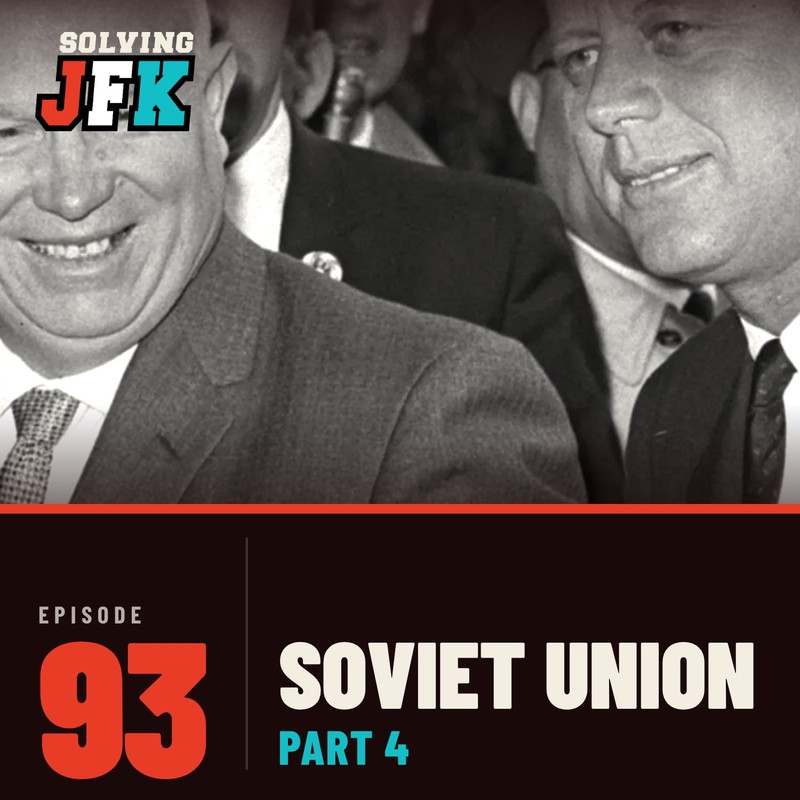
We wrap up the Cold War context by looking at Kennedy's push for peace with Khrushchev in the final months of his life, including the American University speech, the Limited Test Ban Treaty, and a secret Khrushchev letter proposing further cooperation that the State Department never even showed to the President. Then we stress-test former CIA Director James Woolsey's claim in "Operation Dragon" that Oswald killed Kennedy on Khrushchev's direct orders after meeting with Soviet assassination chief Valeriy Kostikov in Mexico City. The problem? FBI Director Hoover told LBJ the day after the assassination that the man at the Soviet Embassy was not Oswald. A suspicious letter to the Soviets contained information Oswald couldn't have known. And LBJ himself clearly didn't buy the Soviet conspiracy angle, but he used the threat of one to strong-arm Earl Warren into chairing the Commission and steering it toward the lone gunman conclusion.
As we work our way through all of the potential culprits in the JFK Assassination, we’ve been excavating the history of American-Soviet relations during the Cold War, with an eye towards answering the question of whether the Soviets had a hand in President Kennedy’s murder.
In this episode, we first turn to President Kennedy’s move towards peace with Premier Khruschev. Then, we assess the argument asserted by former CIA director James Woolsey, that Lee Harvey Oswald killed president Kennedy alone, with the help of the Soviets.
Moving Towards Peace
President Kennedy entered the White House determined to put an end to nuclear proliferation throughout the world.1 His resolve was only strengthened by coming to the brink of nuclear war during the Cuban Missile Crisis.
On May 6th, 1963, Kennedy issued National Security Action Memorandum 239, which ordered his national security advisors to pursue a nuclear test ban and a policy of general and complete nuclear disarmament.2As a first step to this extremely idealistic goal, Kennedy had been trying to convince Khruschev to join him in a Limited Test Ban Treaty, which would allow the nuclear powers to keep their weapons, but require them to stop poisoning the environment with nuclear tests. However, hardliners in both governments rejected attempts at peace and instead encouraged the two Cold War leaders to double down on militarism.3
On June 10, 1963, in a commencement speech at American University, President Kennedy made a direct plea to the Soviet people for better relations. To avoid sabotage from the Defense and State Departments, he kept the text of his speech a secret that only his closest advisors knew. In that speech, JFK urged a genuine peace, and not simply the old line of Pax Americana – or peace through American strength.4 Here’s a clip:
In short, both the United States and its allies, and the Soviet Union and its allies, have a mutually deep interest in a just and genuine peace and in halting the arms race. Agreements to this end are in the interests of the Soviet Union as well as ours--and even the most hostile nations can be relied upon to accept and keep those treaty obligations, and only those treaty obligations, which are in their own interest.
So, let us not be blind to our differences--but let us also direct attention to our common interests and to the means by which those differences can be resolved. And if we cannot end now our differences, at least we can help make the world safe for diversity. For, in the final analysis, our most basic common link is that we all inhabit this small planet. We all breathe the same air. We all cherish our children's future. And we are all mortal.5
The president’s now celebrated call for peace received little fanfare in the U.S, but Premier Khruschev told British Labour party leader, Harold Wilson, that the American University speech impressed him, and helped Khruschev push back against pressure from the Chinese government to not enter an agreement with the United States.6
Limited Test Ban Treaty
On the heels of the American University speech, and, a few days later, a direct hotline between the White House and the Kremlin being installed,7 there seemed to be a real opportunity to secure a nuclear testing treaty. Khurshchev’s primary concern with such a treaty had been reaching a process to determine whether an event was an earthquake or a nuclear test. He did not want Western investigators in the Soviet Union because that would reveal just how behind the Soviets were in the arms race.8
Khruschev agreed to the treaty, which banned all nuclear tests except for underground ones, in June of 1963.9 On September 24th, the US Senate approved the treaty by a vote of 80 to 19. While it did not stop other countries from developing nuclear weapons, the treaty did mark a clear pause in what had been escalating cold war tensions.10
On October 10, 1963, after Khruschev publicly signed the Limited Test Ban Treaty, Soviet Deputy Foreign Minister, Valerian Zorin, passed a note to American ambassador, Foy Kohler. The note was from Khruschev to President Kennedy. Kohler, who was a Cold War hawk, never passed Khruschev’s letter on to President Kennedy.11Khruschev thought the letter was important enough to read on Soviet radio.
Khruschev’s letter, which Ambassador Kohler played down, proposed QUOTE “a non-aggression pact between NATO countries and [the Soviet Union], creation of nuclear free zones in various regions of the world…, measures for the prevention of surprise attacks, and a series of other steps.” The State Department, which never told Kennedy about the note, drafted a 2 sentence response to Khrushchev, which was never sent to him due to a State Department clerical error.12
While Kennedy never found out about Khruschev’s letter, he did take further actions in pursuit of peace with the Soviets, including selling wheat to Russia after there was a severe grain shortage there – against the advice of pretty much all of his staff.13 JFK also called for joint efforts with the Soviets to go to the moon and to explore outer space.14
The Woolsey Theory
It appears that, as of the time of JFK’s death, his relationship with Khrushchev was at an all-time high. So, what then, is the argument that the Soviets killed President Kennedy? A 2021 book by former CIA Director, James Woolsey, called Operation Dragon, claims that Oswald fired the shots based on the orders of Khruschev himself. A big part of Woolsey’s argument comes down to Valeriy Kostikov.
In Episode 55, we covered Lee Harvey Oswald’s alleged meeting with Kostikov, who was known at the highest levels of the CIA to be the most senior Soviet assassinations agent in the Western Hemisphere. There were many reasons to doubt that the real Oswald actually attended the meeting, including Oswald being sighted in Texas during that time, the CIA’s surveillance of the Soviet and Cuban embassy not capturing Oswald’s voice or face, and, most importantly, FBI Director Hoover’s statement to President Johnson that Oswald was impersonated at the Soviet Embassy.15
Woolsey, without even addressing what Hoover told LBJ, says that Oswald did meet with Kostikov, and that the purpose of that meeting was to plan the assassination of President Kennedy. Woolsey theorizes that the Soviet agents working with Oswald were George de Mohrenschildt in Dallas, and Kostikov, in Mexico City.16According to Woolsey, Khrushchev changed his mind and tried to call the assassination off, but Oswald went forward with it anyway. 17
Oswald and Kostikov
We know from a book written by Soviet Embassy official, Oleg Nechiporenko, that someone who claimed to be Lee Harvey Oswald met with officials at the Soviet Embassy, including Kostikov. If Lee Harvey Oswald really did meet with the head of assassinations for the Soviet Union six weeks before President Kennedy was assassinated, the implications of that meeting are massive.18 It would demonstrate that Oswald was not just a lone nut. And, instead, he was, at a minimum, in contact with the Soviets for the purpose of killing the president. On the other hand, if Oswald did not actually meet with Kostikov, then we have to explain all of the evidence that is in the record to make it look like he did, and then try to understand why that evidence was created in the first place.
We previously noted that, on October 8, 1963, after Oswald’s alleged meeting with Kostikov, the Mexico City CIA station requested information from CIA HQ on Oswald. When CIA HQ responded, it knowingly provided an outdated file on Oswald that did not have information about his time in New Orleans or interactions with the Cuban Exiles there.
When John Newman and Jefferson Morley showed Jane Roman these files and asked why the wrong information was sent to the Mexico City station, she admitted that she was QUOTE “signing off on something she knows not to be true.”19 And Roman was not the only one who misled the Mexico City station. James Angleton’s aide, Ann Egerter, and Tom Karamissines, the Assistant Deputy Director of Plans, also knew about the skullduggery.20
You may remember that, around the same time that Jane Roman signed off on the incomplete Oswald file, a man named Marvin Gheesling at the FBI turned off the flash alert on Oswald on October 9th, the day before it would have been triggered by the October 10th response from CIA HQ to Mexico City Station.21
On top of that, we cannot forget the strange details of Oswald’s phone calls and visits with the Cuban and Soviet Embassies. For example, the first call from this supposed Oswald person to the Soviet Consulate was exclusively in Spanish. But, when Oswald spoke to the Soviets from the Cuban Embassy, it was in broken Russian. One of the days when Oswald was said to have made a call from the Cuban Embassy to the Soviet Embassy, the Cuban Embassy was closed, and the call would have been impossible. And, finally, the CIA’s wire taps of both embassies and photographic surveillance failed to create evidence that Oswald was there. Although, according to the CIA, there was evidence, they just erased it.22 And those are just a few of the problems with believing either the official story about Oswald’s Mexico City trip or James Woolsey’s theory.
This, of course, begs the question, why would the CIA HQ lie about Oswald’s file before President Kennedy was assassinated if Oswald was just some lone nut?23
The Letter to the Soviets
Aside from Mexico City, Woolsey argues that there is additional evidence that Oswald was working with the Soviets in an operational capacity in the form of a letter from Oswald to the Soviet Embassy.
On Monday, November 18th, 1963, just days before President Kennedy would be killed, the Soviet Embassy in Washington received a letter signed Lee H. Oswald. The letter said QUOTE “This is to inform you of recent events since my meetings with comrade Kostin in the Embassy of the Soviet Union in Mexico City.”24 The letter continues QUOTE “I had not planned to contact the Soviet Embassy in Mexico so they were unprepared. Had I been able to reach the Soviet Embassy in Havana as planned, the embassy there would have had time to complete our business.”25 The phrases “as planned” and “our business” appear to reference some pre-existing plan that Oswald had with the Soviets. Woolsey asserts that Oswald’s use of the name “Kostin” when referring to Kostikov in that letter, demonstrates that Oswald knew Kostikov’s codename and was using it, especially since the name is used in correspondence with the Soviet Embassy.26
On the other hand, the letter, which was dated November 9th and postmarked November 12th, also contains a reference to the removal of Cuban Consulate official, Eusebio Azcue.27 Oswald’s letter says QUOTE “the Cuban Consulate was guilty of a gross breach of regulations, I am glad he has since been replaced.” The challenge with this fact for people who assert that the letter is authentic is that Eusebio Azcue was not removed from his role at the Cuban Consulate until November 18th. There is no way that Oswald could have known about Azcue’s future November 18th termination when the letter was postmarked on November 12th.28
From the perspective of the Soviets, we now have the documents available from their side to see how they handled this document. On November 26th, Ambassador Anatoly Dobrynin sent a Top Secret telegram from Washington to Moscow saying QUOTE
“This letter was clearly a provocation. It gives the impression we had close ties with Oswald and were using him for some purposes of our own. It was totally unlike any other letter the embassy had previously received from Oswald. Nor had he ever visited our embassy himself. The suspicion that the letter is a forgery is heightened by the fact that it was typed, whereas the other letters the embassy had received from Oswald before were handwritten…One gets the definite impression that the letter was concocted by those who, judging from everything, are involved in the President’s assassination. It is possible that Oswald himself wrote the letter as it was dictated to him, in return for some promises, and then, as we know, he was simply bumped off after his usefulness had ended.”29
We should note that there is some corroboration for Oswald actually writing this letter. Ruth Paine claimed that she saw Oswald type the letter in her home on her typewriter on November 9th, 1963 – the date of the letter. She found a handwritten draft of the letter and gave it to the FBI. So, either Oswald really did write that letter, or Ruth Paine participated in providing cover for someone else who wrote the letter.30
Other Arguments Oswald Worked with Soviets
Aside from Valeriy Kostikov meeting a man who introduced himself as Lee Harvey Oswald at the Soviet Embassy in Mexico City, and the Oswald letter to the Soviet Embassy in November of 1963, James Woolsey raises additional arguments why Oswald was a Soviet spy.
First, Oswald was trained in the use of microdots, as Oswald mentioned to Dennis Osteen, his co-worker at Jaggers-Chiles-Stovall. Woolsey confirmed that hiding microdots under a postage stamp was a favorite technique of the KGB. Further, the fact that the first 18 pages of Marina Oswald’s Book of Useful Advice were missing, is consistent with the Soviet microdot system, where pages of a common book would be used to decipher codes.31 The argument that Oswald knew how to use microdots, and thus, must be connected with intelligence, is usually used by critics of the case against the Warren Commission to assert that Oswald has intelligence ties. However, Woolsey uniquely claims that Oswald did have knowledge of microdots but that it was from the Soviets, as opposed to American intelligence.
Second, Woolsey notes that there are QUOTE “dozens of KGB codes and operational patterns” in the evidence, but none of them were identified by the Warren Commission because they did not understand KGB spycraft.32 Finally, Woolsey, asserts that Marina Oswald’s backstory was consistent with the backstory of other women who married foreigners on behalf of the KGB, which is supported by a 29 point document outlining why the CIA thought Marina Oswald likely was associated with Soviet intelligence.33
LBJ’s Reaction
The conversations that the new president, Lyndon Johnson, had with those around him in the hours and days immediately after the assassination help to shed light on President Johnson’s mindset. Did Johnson think the Soviets were involved? And if so, what steps did he take in response?
At Parkland Hospital, Johnson said to press secretary, Malcolm Kilduff, QUOTE “we don’t know whether it’s a communist conspiracy34 or not – are they prepared to get me out of here?”35 Despite LBJ’s apparent concern of a Soviet conspiracy, Johnson did not attempt to contact the White House Situation Room, the Joint Chiefs, or the Secretary of Defense. When Johnson spoke to Secretary of Defense McNamara around 6:20pm, he simply asked, QUOTE “any important matters pending?”36 Not exactly the question that someone worried about a Soviet conspiracy would ask.
As soon as Johnson and his team were back in Washington on the night of the assassination, Johnson aide Cliff Carter personally called Dallas DA Henry Wade, Texas Attorney General, Waggoner Carr, and Police Chief, Jesse Curry, asking all of them to avoid any discussions relating to conspiracy.37 According to Wade, Carter told him QUOTE “any word of a conspiracy – some plot by foreign nations – to kill President Kennedy would shake our nation to its foundation. President Johnson was worried about some conspiracy on the part of the Russians…it would hurt foreign relations if I alleged a conspiracy. Whether I could prove it or not, I was to charge Oswald with plain murder.”38
The LBJ Hoover 11/23/63 Call
So, Johnson talked about being worried that a Soviet conspiracy was behind President Kennedy’s murder, but his actions did not reflect his words. In my view, the most important piece of evidence on the question of whether Johnson really thought there was a communist conspiracy is what remains of the transcript of Johnson’s call with J. Edgar Hoover on the morning after the assassination.
As noted previously on this podcast, the phone call, which is about 15 minutes long, was intentionally erased at some point. To add further confusion to the matter, the written transcript of the call that survived appears to be less than half the length of the call. In other words, some of the transcript was almost certainly deleted.
Still, the surviving transcript raises serious doubts about the Oswald Kostikov meeting. Johnson asks Hoover QUOTE “Have you established anymore about the visit to the Soviet Embassy in Mexico in September?”39We do not know how Johnson knew about Mexico City. But, he must have found out either earlier during this call (and it was erased), or at some other time after the assassination and before 10am the next day. Hoover responds to LBJ’s question as follows QUOTE “No, that’s one angle that’s very confusing for this reason. We have up here the tape and the photograph of the man who was at the Soviet Embassy, using Oswald’s name. That picture and the tape do not correspond to this man’s voice. Nor to his appearance. In other words, it appears that there was a second person who was at the Soviet Embassy down there.”40
Hoover followed up after his call with President Johnson by sending a 5 page memo to the President that said FBI agents reviewed the tape of the man claiming to be Oswald at the Soviet Embassy and concluded the voice was not Lee Harvey Oswald’s.41 Another memo from Hoover to James Rowley of the Secret Service said QUOTE “Agents who have conversed with Oswald in Dallas have observed photographs of the individual referred to above and have listened to a recording of his voice. These special agents are of the opinion that the above referred to individual was not Lee Harvey Oswald.”42
So, Hoover was certain that the accused assassin WAS NOT in Mexico City. If Johnson was really worried about a communist plot, it seems to me that he would have some questions when hearing that it wasn’t really Oswald in Mexico City, like, for example, “what do you mean it was a second person down there?”
Incident in Mexico City
Johnson demonstrated a surprising lack of curiosity about the details of Hoover’s claim that Oswald was impersonated in Mexico City to make it look like he met with the Soviets. If it was just a lack of curiosity, that would be one thing. But, LBJ ignored Hoover’s statement about an Oswald impostor, and then knowingly lied to future Warren Commissioners to get them to agree to work on the case. We know for sure that Johnson strongly implied to Earl Warren and Richard Russell that Oswald DID meet with Kostikov in Mexico City. Here’s Johnson bragging to Senator Russell about how he convinced Chief Justice Warren to serve on the commission:
“You want to know the truth? And I just pulled out what Hoover told me about a little incident in Mexico City and I said now, I don’t want Mr. Kruschev to be testifying before a camera that he killed this fella or that Castro killed him. And all I want you to do is look at the facts and bring any other facts you want in here and determine who killed the president. I think you’d put your uniform on, as fat as you are, and do anything you could to save one American life. Now, I’m surprised that you, the chief justice of the United States would turn me down. And he started crying and he said, well, I won’t turn you down. I’ll just do whatever you say.”43
Since we know that Hoover told LBJ that Oswald was impersonated at the Soviet Embassy, it is a near certainty that Johnson 1) did not believe that there was a Soviet conspiracy, and 2) actively used the threat of a Soviet conspiracy to recruit respected officials for his presidential commission. Johnson then directed them towards doing the right thing and finding that Oswald alone killed Kennedy, or else there would probably be a nuclear war if the truth was pursued. I think that’s what Johnson meant by “You put on your uniform.”
When we compare Oswald’s alleged Kostikov meeting with the false claim from CIA informant Gilberto Alvarado that Oswald was paid by the Cubans to kill Kennedy, we find that Kostikov is only alluded to in the Hoover/Johnson call on the 23rd. However, the Alvarado claim was communicated in frequent and detailed messages. This raises the question, if Oswald was really working for the Soviets, why was so much effort spent on the false claim of Alvarado, but almost no ink or time was spent on the headline – that Oswald supposedly met with the head of Western Hemisphere assassinations for the KGB.44
Next time on Solving JFK: We wrap up the series on the Soviet Union as a potential culprit, by looking at newly released Soviet documents related to the assassination of President Kennedy.
Automated transcript
Machine-generated from the audio and unedited, so names and spellings may be wrong. Tap a timestamp to play from that point.
Speaker 0As we work our way through all of the potential culprits in the JFK assassination, we've been excavating the history of American Soviet relations during the Cold War, with an eye towards answering the question of whether the Soviets had a hand in President Kennedy's murder. In this episode, we first turned to President Kennedy's move toward peace Then, we assess the argument asserted by former CIA director James Woolsey that Lee Harvey Oswald killed President Kennedy alone, and with the help of the Soviets.
Speaker 3In Dallas, Texas, three shots were fired at President Kennedy's motorcade in downtown Dallas. The first reports say that President Kennedy has been seriously wounded by this shooting The flash, apparently official, Elizabeth Kennedy, died at the time of the PM, at the time of the PM's time. Dallas, please, this morning, resume on Tuesday, and then they have formally charged the assassination of President Trump. I guess the hard of the PM is... This is Solving JFK.
Speaker 0I'm your host, Matt Crumpton. President Kennedy entered the White House determined to put an end to nuclear proliferation throughout the world. His resolve was only strengthened during the Cuban missile crisis when the world came to the brink of nuclear annihilation. On May 6, 1963, Kennedy issued national security action memorandum 239, which ordered his national security advisers to pursue a nuclear test ban and a policy of general and complete nuclear disarmament. As a first step to this extremely idealistic goal, Kennedy had been trying to convince cruise chef to join him in a limited test band treaty, which would allow the nuclear powers to keep their weapons, but would require them to stop poisoning the environment with nuclear tests. However, hardliners in both governments rejected attempts at peace, and instead encouraged On June 10th, in a commencement speech at American University, President Kennedy made a direct plea to the Soviet people for better relations.
Speaker 0To avoid sabotage from the defense and state departments, he kept the text of his speech a secret that only his closest advisors knew. In that now famous American University speech, JFK urged a genuine peace, not simply the or peace through American strength. Here's a clip.
Speaker 2In short, both the United States and its allies and the Soviet Union and its allies have a mutually deep interest in a just and genuine peace and in holding the arms race. Agreements to this end are in the interests of the Soviet Union as well as ours and even the most hostile nations. can be relied upon to accept and keep those treaty obligations and only those treaty obligations which are in their own interest. So let us not be blind to our differences, but let us also direct attention to our common interests and the means by which those differences can be resolved and if we cannot end now our differences, at least we can help make the world safe for diversity. For in the final analysis, our most basic common link is that we all inhabit this small planet. We all breathe the same air. We all cherish our children's futures, and we are all mortal.
Speaker 0President Kennedy's call for peace received little fanfare in the U.S. But Premier Cruzchev told British Labor Party leader Harold Wilson that the American University speech impressed him and helped Cruzchev push back against pressure from the Chinese government to not enter an agreement with the United States. On the heels of the American University speech, and a few days later, a direct hotline between the White House and the Crumlin being installed, there seemed to be a real opportunity to secure a nuclear testing treaty. Cruise Chav's primary concern with the treaty was reaching a process to figure out whether an event was an earthquake or a nuclear test. He didn't want Western investigators inside the Soviet Union, Because that would reveal just how behind the Soviets were in the arms race. In June of 1963, not long after Kennedy's American University speech, Kruschev agreed to the treaty, which banned all nuclear tests except for underground ones.
Speaker 0On September 24, the U.S. Senate approved the treaty by a vote of 80 to 19. While the limited test band treaty didn't stop other countries from developing nuclear weapons, the treaty did mark a clear pause in what had been escalating cold war tensions. On October 10th, after cruise chev publicly signed the limited test band treaty, Soviet Deputy Foreign Minister Valerian Zorin passed a note to American ambassador foicolor. Kohler, who was a Cold War Hawk, never passed Khrushchev's letter on to the president. Khrushchev, on the other hand, thought the letter was important enough to read on Soviet state radio. Khrushchev's letter, which Ambassador Kohler played down, proposed, quote, a non-aggression pact between NATO countries and the Soviet Union, Creation of nuclear-free zones in various regions of the world measures for the prevention of surprise attacks and a series of other steps. The State Department, which never told Kennedy about the note, drafted a two-sentence response to cruisechev, which was never sent to him due to a clerical error in the State Department.
Speaker 0While Kennedy never found out about Kruschev's letter, he did take further actions and pursuit of peace with the Soviets, including selling them wheat after there was a severe grain shortage against the advice of pretty much everyone in his cabinet. The president also called for joint efforts with the Soviets to go to the moon and to explore outer space. It appears that as of the time of Kennedy's death, his relationship with Kruschev was at an all-time high. So what then is the argument that the Soviets killed President Kennedy? A 2021 book by former CIA director James Woolsey called Operation Dragon claims that Oswald fired the shots based on the orders of Kruschev himself. A big part of Woolsey's argument comes down to Valerie Costa-Cov. In episode 55, we covered Lee Harvey Oswald's alleged meeting with Costa-Cov, who was known at the highest levels of the CIA to be the most senior Soviet assassinations agent in the Western Hemisphere.
Speaker 0There were many reasons to doubt that the real Oswald actually attended the meeting, including Oswald being cited in Texas during that time. The CIA surveillance of the Soviet and Cuban embassies failing to capture Oswald's voice or face, and most importantly, the statement from FBI director Hoover to President Johnson that Oswald was impersonated at the Soviet embassy. Wolzy, without even addressing what Hoover told LBJ, says that Oswald did meet with Costa Kov, and that the purpose of that meeting was to plan the assassination of President Kennedy. Wolzy theorizes that the Soviet agents working with Oswald were George Demoranschilt in Dallas and Costa Kov in Mexico City. According to Woolsey, Kruzchev changed his mind and tried to call the assassination off, but Oswald went forward with it anyway. We know from a book written by Soviet embassy official Oleg Nechiporinko, that someone who claimed to be Lee Harvey Oswald met with officials at the Soviet embassy, including Costa-Kov.
Speaker 0Flee Harvey Oswald really did meet with the head of assassinations for the Soviet Union six weeks before President Kennedy was assassinated, the implications of that meeting are massive. It would demonstrate that Oswald was not just alone not, and instead he was at a minimum in contact with the Soviets for the purpose of killing the President. On the other hand, if Oswald did not actually meet with Costa-Cov, then we have to explain all of the evidence that's in the record to make it look like he did, and then try to understand why that evidence was created in the first place. We previously noted that on October 8, 1963, after Oswald's alleged meeting with Costa Cove, the Mexico City CIA station requested information from CIA HQ on Oswald. When CIA HQ responded, it knowingly provided an outdated file on Oswald that did not When John Newman and Jefferson Morley showed Jane Roman these files and asked why the wrong information was sent to the Mexico City Station, she admitted that she was, quote, signing off on something she knows not to be true.
Speaker 0And Roman wasn't the only one who misled the Mexico City station. James Angleton's aid and Egerter and Tom Caramassinus, the assistant deputy director of plans, also knew about the Skull Duggery. You may remember that around the same time that Jane Roman signed off on the incomplete Oswald file, a man named Marvin Giesling at the FBI turned off the flash alert on Oswald on October 9th. The day before it would have been triggered by the October 10th response from CIA HQ to Mexico City Station. On top of that, we can't forget the strange details of Oswald's phone calls and visits with the Cuban and Soviet embassies. For example, the first call from this supposed Oswald person to the Soviet consulate was exclusively in Spanish, but when Oswald spoke to the Soviets from the Cuban embassy, it was in broken Russian. One of the days when Oswald was said to have made a call from the Cuban embassy to the Soviet embassy, the Cuban embassy was closed and a call would have been impossible.
Speaker 0And finally, the CIA's wiretaps and photographic surveillance of both embassies failed to create any evidence to show that Oswald was there. Although, according to the CIA, there was evidence they just erased it. And those are just a few of the problems with believing either the official story about Oswald's Mexico City Trip or James Woolsey's theory. This, of course, begs the question, why would the CIA HQ lie about Oswald's file before President Kennedy was assassinated if Oswald was just some lone nut? Aside from Mexico City, Wolzi argues that there is additional evidence that Oswald was working with the Soviets in an operational capacity in the form of a letter from Oswald to the Soviet embassy in November of 1963. On Monday, November 18th, just days before President Kennedy would be killed, the Soviet embassy in Washington received a letter signed Lee H. Oswald. The letter said, quote, This is to inform you of recent events since my meetings with Comrade Kostin and the embassy of the Soviet Union in Mexico City.
Speaker 0The letter continues, quote, I had not planned to contact the Soviet embassy in Mexico, so they were unprepared. Had I been able to reach the Soviet embassy in Havana as planned, the embassy there would have had time to complete our business. The phrase is, as planned, and our business, appear to reference some pre-existing plan that Oswald had with the Soviets. Wolzi asserts that Oswald's use of the name Kostin when referring to Kostakov in that letter demonstrates that Oswald knew Kostakov's code name and was using it. Conversely, the letter, which was dated November 9th and postmarked November 12th, Also contains a reference to the removal of Cuban consulate official U.S.A.B.O. as Q. Oswald Letter says QUOTE. The Cuban consulate was guilty of a gross breach of regulations. I am glad he has since been replaced. The challenge with this statement from Oswald, for people who assert that the letter is authentic, is that UCBO ASCUE was not removed from his role at the Cuban Consulate until November 18th.
Speaker 0There's no way that Oswald could have known about ASCUE's future November 18th termination when the letter was postmarked on November 12th. From the perspective of the Soviets, We now have the documents available from the Soviet side to see how they handled this letter. On November 26th, Ambassador Annatoli Dobrennan sent a top secret telegram from Washington to Moscow saying, quote, This letter was clearly a provocation. It gives the impression we had close ties with Oswald and we're using him for some purposes of our own. It was totally unlike any other letter the embassy had previously received from Oswald. Nor had he ever visited our embassy himself. The suspicion that the letter is a forgery is heightened by the fact that it was typed, whereas the other letters the embassy had received from Oswald before were handwritten. One gets the definite impression that the letter was concocted by those who judging from everything are involved in the president's assassination.
Speaker 0It is possible that Oswald himself wrote the letter as it was dictated to him in return for some promises. And then, as we know, he was simply bumped off after his usefulness had ended. We should note that there is corroboration for Oswald actually writing this letter. Ruth Payne said that she saw Oswald type the letter at her house on her typewriter on November 9th, the date of the letter. Pain also found a handwritten copy of the letter and gave it to the FBI. So either Oswald really did write the letter or Ruth Pain participated in providing cover for someone else who wrote the letter. Aside from Costa-Cov meeting a man who claimed to be Oswald in Mexico City, and the Oswald letter to the Soviet embassy in November of 1963, James Woolsey raises additional arguments why Oswald was a Soviet spy. First, Oswald was trained in the use of microdots, as Oswald mentioned to Dennis Osteen, his co-worker at Jagger's Child's Stovell.
Speaker 0Woolsey, the former CIA director, confirmed that hiding microdots under a postage stamp was a favorite technique of the KGB. Further, the fact that the first 18 pages of Marina Oswald's book of useful advice were missing is consistent with the Soviet micro dot system, where pages of a common book would be used to decipher codes. The argument that Oswald knew how to use micro dots and thus must be connected with intelligence is usually used by critics of the case against the Warren Commission to assert that Oswald had intelligence ties. However, Woolsey uniquely claims that Oswald did have knowledge of microdots, but that it was from the Soviets, as opposed to American intelligence. Second, Woolsey notes that there are, quote, dozens of KGB codes and operational patterns in the evidence. but none of them were identified by the Warren Commission because they didn't understand KGB spycraft.
Speaker 0Finally, Woolsey asserts that Marina Oswald's backstory was consistent with the backstory of other women who married foreigners on behalf of the KGB, which is supported by a 29 point CIA document outlining why the agency thought Marina was associated The conversations that the new president, Lyndon Johnson, had with those around him in the hours and days immediately after the assassination, helped to shed light on President Johnson's mindset. Did Johnson think the Soviets were involved? And if so, what steps did he take in response? At Parkland Hospital, Johnson said to press Secretary Malcolm Killduff, quote, ''We don't know whether it's a communist conspiracy or not. Are they prepared to get me out of here?'' Despite LBJ's apparent concern of a Soviet conspiracy, he made no attempts to contact the White House situation room, the joint chiefs, or the Secretary of Defense. When Johnson spoke to Secretary McNamara around 620 p.m., he's simply asked, quote, any important matters pending?
Speaker 0Not exactly what you would expect a president to ask if he was worried about a Soviet conspiracy. On the night of the assassination, as soon as Johnson and his team were back in Washington, Johnson-Aid Cliff Carter called Dallas-D.A. Henry Wade, Texas Attorney General Wagner Carr, and Dallas Police Chief Jesse Curry, asking all of them to avoid any discussions relating to conspiracy. According to Wade, Carter told him, quote, Any word of a conspiracy, some plot by foreign nations, to kill President Kennedy, would shake our nation to its foundation. President Johnson was worried about some conspiracy on the part of the Russians. It would hurt foreign relations if I alleged a conspiracy. Whether I could prove it or not, I was to charge Oswald with plain murder. So Johnson talked about being worried that the Soviets were behind President Kennedy's death, but his actions didn't match his words.
Speaker 0In my view, the most important piece of evidence on the question of whether Johnson really believed in a communist conspiracy is what remains of the transcript of Johnson's call with Jay Edgar Hoover on the morning after the assassination. As previously noted on this podcast, the phone call, which is about 15 minutes long, was intentionally erased at some point. To add further confusion, the written transcript of the call that survived appears to cover less than half the length of the call. In other words, not only was the tape deleted, some of the transcript was almost certainly removed as well. Even still, the surviving transcript raises serious doubts about the Oswald Costa-Cov meeting. In the transcript, Johnson asks, quote, Have you established any more about the visit to the Soviet embassy in Mexico in September? We don't know how Johnson knew about Mexico City. but he must have found out either earlier during this call, and it was erased, or some other time after the assassination and before 10am the next morning.
Speaker 0Hoover responds to LBJ's question as follows, quote, no, that's one angle that's very confusing for this reason. We have up here the tape and the photograph of the man who was at the Soviet embassy using Oswald's name, that picture and the tape do not correspond to this man's voice, nor to his appearance. In other words, it appears that there was a second person who was at the Soviet embassy down there. Hoover followed up after his call with Johnson by sending a five-page memo to the president that said FBI agents reviewed the tape of the man claiming to be Oswald at the Soviet embassy and concluded that the voice was not Leigh Harvey Oswald. Another memo from Hoover to James Rally of the Secret Service said, quote, agents who have converse with Oswald and Dallas have observed photographs of the individual referred to above and have listened to a recording of his voice. These special agents are of the opinion that the above referred to individual was not Le Harvi Oswald.
Speaker 0So J. Edgar Hoover was certain that the accused assassin was not in Mexico City with Costa Cove. If Johnson was really worried about a communist plot, it seems to me that he'd have some questions when hearing from Hoover that it wasn't really Oswald in Mexico City. Like, for example, what do you mean it was a second person down there? Johnson demonstrated a surprising lack of curiosity about the details of Hoover's claim that Oswald was impersonated in Mexico City. If it was just a lack of curiosity, that would be one thing. But LBJ completely ignored Hoover's statement about an Oswald imposter, and then knowingly lied to future warren commissioners to get them to agree to work on the case. We know for sure that Johnson strongly implied to Earl Warren and Richard Russell that Oswald did meet with Costa Cove in Mexico City. Here's Johnson bragging to Senator Russell about how he convinced Chief Justice Warren to serve on the commission.
Speaker 1Two hours later, I called him and ordered him down here and he didn't more come. I insisted he come, he came down there and he told me no fire. And I just forgot what Hoover told me. I got a little interest in Mexico City, and I said now, I don't want the... That's good you have to be told tomorrow, and be test-fined for camera that he killed his fellow. And if the Castro killed him, and all I want you to do is look at the facts and bring any other found in here, and determine who killed the President, and I think you've put on uniform, or all I want, that is you are, and do anything you could say one American lie, I've not surprised that you, the Chief Justice of the United States, would turn me down. And start crying and he said, well, I won't turn you down, I'll just do whatever he's saying.
Speaker 0Since we know that Hoover told LBJ that Oswald was impersonated at the Soviet Embassy, it's a near certainty that Johnson, one, did not believe that there was a Soviet conspiracy and two actively used the threat of a Soviet conspiracy to recruit respected officials for his presidential commission. Johnson then directed them towards doing the right thing and finding that Oswald alone killed Kennedy. Or else, there would probably be a nuclear war if the truth was pursued. I think that's what Johnson meant when he said you put on your uniform. When we compare Oswald's alleged costacov meeting with the known false claim from CIA informant Gilberto Alvarado that Oswald was paid by the Cubans to kill Kennedy, we find that costacov is only alluded to in the Hoover Johnson call on the 23rd. However, the Alvarado claim was communicated in frequent and detailed messages, This raises the question, if Oswald was really working for the Soviets, why was so much effort spent on the false claim of Alvarado, but almost no ink or time was spent on the headline that Oswald supposedly met with the head of Western Hemisphere assassinations for the KGB.
Speaker 0Next time on Solving JFK, we wrap up the series on the Soviet Union as a potential culprit by looking at newly released Soviet documents related to the assassination of President Kennedy. If you heard anything that you believe is out of context, or if you have additional information to offer, you can let us know at solving JFK podcast at gmail.com. Please provide citations to the record for any fact that you're relying on. For transcripts, sources, and official podcast merchandise, visit solvingjfkpodcast.com. Thanks for listening. Visit solvingjfkpodcast.com for more information.