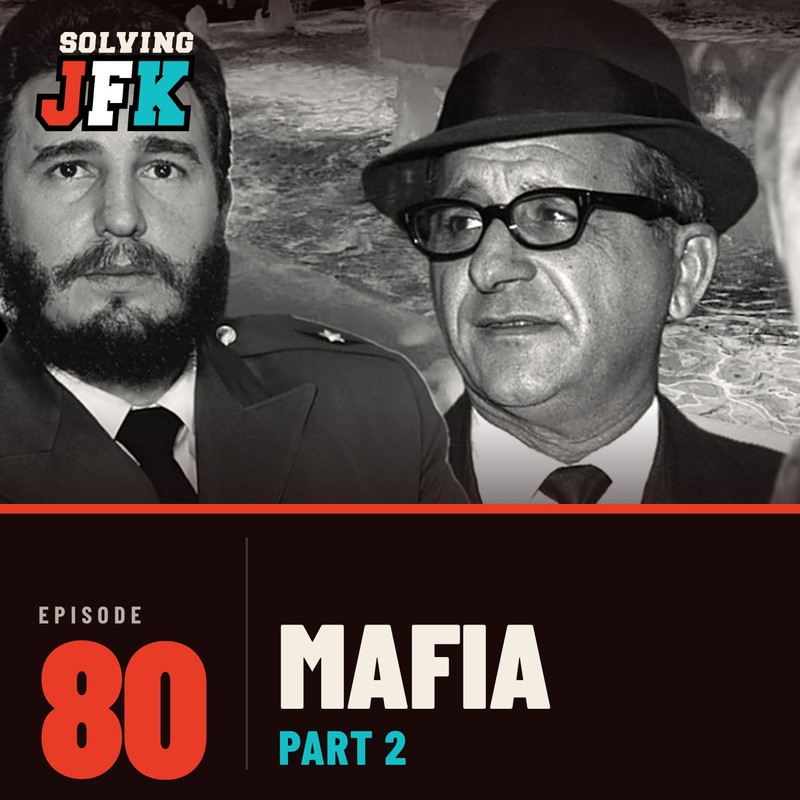
In this episode, we look at what the Church Committee had to say about the CIA’s efforts to assassinate Cuban Revolutionary leader Fidel Castro in partnership with the Mafia through cut-out Robert Maheu.
“There are some very important witnesses who simply have not been interrogated fully on this matter. Subcommittee was unable to do it in the time available and there are important leads that were uncovered in the investigation that clearly need to be followed up.” – Frank Church
“This report documents the failures of the U.S. Intelligence establishment in their investigation of President Kennedy’s assassination and their cover up to the Warren Commission.” - Senator Richard Schweiker1
We just heard from Senator Frank Church, who led a Senate Committee, in 1975 to investigate intelligence activities. The second person was Senator Richard Schweiker, who would go on to be a vocal critic of the official JFK assassination story.
While the Church Committee was organized to look into abuses of the CIA, FBI, NSA, and IRS, there was a great deal of valuable information the committee uncovered that potentially touches on the Kennedy Assassination. In this episode, we look at what the Church Committee had to say about the CIA’s efforts to assassinate Cuban Revolutionary leader Fidel Castro in partnership with the Mafia through cut-out Robert Maheu.
Robert Maheu Starts His Agency
Robert Maheu’s unique career began as a law student during World War II. In 1941, Maheu was recruited out of Georgetown Law to work for the FBI as a counterintelligence officer in Europe. After the war, Maheu worked for the FBI until 1947, when he opened his own private detective agency in Washington, D.C.2
One of Maheu’s main clients became the newly formed Central Intelligence Agency, which kept Maheu on a monthly retainer.3 Maheu said of the agency QUOTE “The CIA was my first steady client, giving me 'cut-out' assignments” which were the jobs where the Agency could not officially be involved.4 According to historian, Evan Thomas, the television series, Mission Impossible, was based on Maheu’s detective agency.5
Maheu associate and former Washington Post reporter, John Gerrity, said that in 1954 he and Maheu were summoned to Vice President Richard Nixon’s office. During this meeting, Vice President Nixon gave Maheu approval to use various dirty tricks to sabotage a pending agreement between Greek shipping magnate, Aristotle Onassis, and the King of Saudi Arabia. These tricks included wire-tapping and planting derogatory stories in newspapers. (And, yes, this is the same Aristotle Onassis who would go on to marry Jackie Kennedy.6)
Maheu had already been retained to break up the Onassis/Saudi deal by a direct competitor of Onassis – Stavros Niarchos.7 The CIA supported Niarchos because they feared that if the Onassis/Saudi deal went through, the United States would lose its monopoly control of Saudi Arabian oil.8 Nixon was so serious about not losing the oil monopoly that he reportedly told Maheu, QUOTE “And just remember, if it turns out we have to kill the bastard, don’t do it on American soil.”9
In 1955, Maheu was retained for the first time by reclusive billionaire, Howard Hughes. Hughes hired Maheu to look into a potential relationship between his fiance, Jean Peters, and another man. Maheu would continue to work for Hughes until 1970, when the two men had a falling out. During all of those years, Maheu never met Howard Hughes in person. The men corresponded with letters and telephone calls exclusively.10
Maheu Mafia Context
In the Summer of 1960, Robert Maheu continued to do regular work on behalf of both the CIA and Howard Hughes. It was around this time that the CIA requested Maheu to contact Johnny Roselli, a high ranking mobster with the Chicago Outfit, to ask about getting the mafia’s help to kill Fidel Castro.11 Just a year earlier, Castro’s revolution toppled the government of Fulgencio Batista, which had been friendly to the United States.
The CIA and the Eisenhower/Nixon Administration were increasingly concerned about Castro’s Leftist politics. At the same time, the mafia, which had been able to operate freely under Batista, was now kicked out of Cuba by the Castro regime, costing the mob, and Santo Trafficante, specifically, a lot of money.12 On top of that, after Castro took over, he kicked all of the CIA agents out of Cuba, which meant that the best American contacts left on the island were mafia associated.13
Bringing in Bob Maheu to contact organized crime was one of many plots by the CIA to kill Castro that were documented by the final report of the Church Committee.14 At first, the CIA just tried to make Castro look bad so that he would be perceived as an ineffective leader. For example, they infused a box of cigars with a chemical that caused temporary disorientation, hoping Castro would smoke one before a speech and say crazy things. There was another plan to dust Castro’s shoes with thallium salts, which would cause his beard hair to fall out, making him appear too sick to lead. This tactic was tested, but not actually used.15
We’ll cover the other plots against Castro, involving both sabotage and assassination, when we get to the series on the Cuban exiles.
Enter Roselli
In August of 1960, Richard Bissell, the CIA’s Deputy Director of Plans, asked Colonel Sheffield Edwards, the Director of the Office of Security, to find someone who could assassinate Fidel Castro. Edwards brought in the Chief of Operational Support, James O’Connell, to help with the project.16 O’Connell had served as Maheu’s case officer since Maheu had been working for the CIA. He and Maheu were close friends.17
Maheu told the Church Committee that O’Connell asked him to contact his mafia friend, Johnny Roselli, to see if he would participate in a plan to kill Fidel Castro. Maheu had known Roselli since the late 1950s as the man keeping an eye on Las Vegas on behalf of the Chicago mob, which was led by Sam Giancana.18 O’Connell also knew Roselli before approaching him about the Castro plot, because O’Connell previously had dinner with Roselli and Maheu at Maheu’s home.19 That’s how close these guys all were before the plan was even in motion.
Maheu told the CIA that he was going to QUOTE “approach Roselli as the representative of businessmen with interest in Cuba who saw the elimination of Castro as the first essential step to the recovery of their investments.” But, in reality, Maheu gave up the cover immediately to Roselli. Maheu told Roselli that the mission was backed by QUOTE “high government officials.” Maheu then requested that Roselli help to recruit Cubans for the job.20 He offered $150,000 (which is over $1.5 million in today’s dollars) to successfully accomplish the hit on Castro, but Roselli declined any payment.21
As a condition of enlisting his help, Roselli insisted on meeting someone with the government. In September of 1960, Maheu and Roselli met at the Plaza Hotel in New York City with James O’Connell, who Maheu identified to Roselli as the CIA’s Operational Support Chief.22 This satisfied Roselli that the mission was legit, and Roselli then went to Florida to recruit Cubans for the operation. He told the Cubans that he worked for nickel mining interests on Wall Street who wanted to see Castro out of power.23
In October of 1960, a month after the New York Plaza Hotel meeting, Roselli introduced Maheu to two people he planned to bring in on the project: a man named Sam Gold and another man named Joe. CIA Support Chief O’Connell also attended the meeting under the name “Joe Olds.” The meeting was held at the luxurious Fontainebleau Hotel in Miami Beach.24
When he got back home, Robert Maheu saw an article about the 10 most wanted criminals in America in Parade Magazine. Looking at the pictures, he realized that Sam Gold was really Sam Giancana and that Joe was Santo Trafficante. O’Connell also saw the same magazine and recognized Giancana and Trafficante, which he relayed to Sheffield Edwards.25
Sam Giancana’s Extracurricular Wiretap
According to Maheu, Sam Giancana’s role was to find someone in Castro’s entourage who could accomplish the assassination. Ultimately, Giancana was not successful in that task because the Cubans Roselli ended up using were not the ones procured by Giancana.26 While Giancana did not end up providing tangible assistance to kill Castro, he was successful in extracting a favor from Maheu that led to J. Edgar Hoover finding out about the CIA’s partnership with the Mafia.27
Giancana, Maheu, and Roselli stayed in Miami for several months in late 1960 in an effort to recruit Cubans for the plot. During that time, Giancana came to believe that his girlfriend, singer Phyllis McGuire, was cheating on him. Giancana was upset about this prospect and threatened to drop everything he was working on for Maheu in Miami to go to Las Vegas and see for himself if she was cheating. In an effort to keep the project on track and keep Giancana in Miami, Maheu agreed to hire a private investigator to shadow McGuire.
The investigator who took the job attempted to install a wiretap on the hotel room phone of singer Dan Rowan, the man Giancana suspected his girlfriend was seeing. While installing the bug, the investigator was caught red handed.28 It turns out, according to Maheu and O’Connell, that Colonel Sheffield Edwards himself approved placing the bug on Rowan’s phone line in order to appease Giancana.29
However, in addition to Maheu wanting Giancana to stay in Miami to finalize the plan to kill Castro, there is also an argument that the CIA independently wanted to tap Rowan’s phone because they wanted to see what Giancana had been telling his girlfriend about the Castro plot. We know from an October 18, 1960 memo from J. Edgar Hoover to Richard Bissell that Giancana was telling people in several conversations that Castro would soon be assassinated by a girl dropping a poison pill in his drink. So, the CIA may have been concerned that Giancana was compromising operational security with his loose lips.
When the FBI found out about the illegal wiretap by Maheu’s investigator, the Bureau wanted to press charges against Maheu, Roselli and Giancana. But, when Maheu told the FBI about the nature of the operation, the CIA was able to convince Director Hoover to take no action due to the national security implications.30
Did the Plots Work?
Ok, so we know that the CIA worked with specific members of the Mafia, namely Roselli, Trafficante, and Giancana. But, what do we know about the actual plots?
Initially, the CIA wanted a gangland style killing where Castro would be gunned down, but Giancana said it would be too hard to recruit Cubans to do something so dangerous. Roselli expressed that he wanted to use an assassination method that was QUOTE “nice and clean, without getting into any kind of out and out ambushing.” Everyone agreed that poison pills would be the best way to effect the assassination.31
In February 1961, the poison pills, which had been tested and proven to be lethal, were given to Johnny Roselli by Support Chief O’Connell. The pills were then given to a Cuban for delivery to the island in advance of the planned Bay of Pigs invasion. By early March, the poison pills were delivered to an official close to Castro who had been bribed by the mafia. But, this official then lost his job with the Cuban government and his access to Castro, and did not move forward with the plot.32
After the first plan failed, Dr. Tony Verona, a leading figure in the Cuban exile movement, was approached to help.33 Incidentally, Verona was on Trafficante’s payroll to ensure gambling, prostitution, and drug monopolies in Cuba if Castro could be ousted. Verona said he had a contact who worked at a restaurant frequented by Castro. In exchange for equipment and about $10,000 in cash, Verona agreed to help kill Castro and was given the money and a new set of poison pills when he met with Maheu, Roselli, and Trafficante at the Fontainebleau Hotel.34 Like the first one, this plot was also aborted because Castro stopped visiting the restaurant where Verona’s friend was working.35
Enter Bill Harvey
After two failed attempts to kill Fidel Castro while working with Roselli, Giancana, and Trafficante, the operation, referred to internally by the CIA as the QUOTE “gambling syndicate operation,” was transferred from Sheffield Edwards to Bill Harvey. Harvey is a notorious and legendary figure in the CIA who many official story critics believe is at the heart of the assassination plot. His name will come up again in future episodes and he will get his own deep dive at some point.
In early 1961, Bill Harvey was tasked with creating the capability within the CIA to disable foreign leaders, including assassinations. This capability was known as Executive Action and was eventually given the cryptonym, ZR/Rifle.36
In April of 1962, Harvey asked Sheffield Edwards to put him in touch with Johnny Roselli. CIA Support Chief O’Connell then introduced Harvey to Roselli in Miami. Harvey instructed Roselli to maintain his Cuban contacts, but to avoid dealing with Maheu or Giancana, who Harvey believed were untrustworthy and unnecessary.37 On April 21st, on the orders of Richard Helms, Harvey traveled to Miami with four poison pills, which he delivered to Roselli.38
Roselli was in touch with Tony Verona, the Cuban he worked with on the earlier unsuccessful attempt. This time, Verona requested guns, communications equipment and a boat radar. Bill Harvey and Miami JM-WAVE station chief, Ted Shackley, rented a U-Haul truck and personally delivered the arms and equipment to a parking lot and handed Roselli the keys to give to Verona.39 The equipment, weapons, and poison pills arrived in Cuba in May and were supposed to be used by a three man team to kill Castro.
On May 7, Attorney General Robert Kennedy was told about the euphemistically named “gambling syndicate operation” for the first time by the CIA. Prior to this briefing, RFK had no knowledge of any plots involving the CIA and the mafia working together.40 According to Sheffield Edwards, the attorney general was very upset when he heard that Giancana was involved.41 The CIA lied to RFK and told him that the operation had been terminated. But, the reality was that it was still ongoing. RFK’s response was to order that the mafia should never be used again without the administration’s knowledge and consent.42
Four Months after the attorney general was told that the operation was over, Roselli was still trying to work with Cubans to kill Castro. But, as of September 1962, there had been no action. Roselli told Harvey that a second team had been send to Cuba to use the supplies that were already on the island. It was around this time that Harvey lost faith in the operation and told Roselli, QUOTE “there was not much likelihood [the operation] was going anyplace or that it should be continued.”43
In Mid-February, 1963, Harvey formally terminated the operation with Roselli at a meeting in Los Angeles. He told Roselli to taper off his communications with the Cubans. Roselli followed Harvey’s instructions. However, he never told the Cubans that the $150,000 bounty on Castro’s head had been withdrawn. For their part, none of the mafia leaders who worked on the plot, not even Roselli, were ever compensated by the government.44
In the end, the result of the Mafia’s dalliance with the Central Intelligence Agency was a handful of failed attempts and a get out of jail free card for the wiretapping of Sam Giancana’s girlfriend’s new beau. According to the Church Committee, the plan to work with the mafia was put into action by the CIA, through official channels, essentially because it was what the CIA thought the president wanted, even though it was not explicitly ordered.45
However, author Don Fulsom claims that the Vice President at the time, Richard Nixon, directed the plan for the CIA to work with the Mafia because he wanted to use the Mafia’s contacts who were still in Cuba. Nixon had personal knowledge of these contacts because he had been to Havana to gamble at a Casino controlled by Santo Trafficante in 1952.46 Fulsom’s story is backed up by what former JFK Press Secretary, Pierre Salinger, says Robert Maheu told him. Salinger said Maheu QUOTE: “said he had been in contact with the CIA, that the CIA had been in touch with Nixon, who had asked them to go forward with this project . . . It was Nixon who had [Maheu] do a deal with the Mafia in Florida to kill Castro.47
One possible reason Nixon may have wanted to work with the Mafia is because they were already bribing him, according to Edward Grady Partin, a Baton Rouge union member who became a government informant against Jimmy Hoffa. Partin said that he was at a meeting between Hoffa and Carlos Marcello where Marcello provided a suitcase with half a million dollars cash to Hoffa, which was to be delivered as a bribe to Richard Nixon. This was just the first of two equal payments according to Partin.48 On the other hand, author Jim DiEugenio notes that Partin was not a particularly reliable witness and he became an informant only to save himself. Also, there is no other corroboration for this alleged bribe.
It would make sense for Nixon to hand pick Maheu because he had worked with him on two other successful operations, including the Aristotle Onassis deal subterfuge. Also, Maheu’s main client, Howard Hughes, was a political backer of Nixon, who had met with Nixon not long before the operations began.49 According to what Santo Trafficante told F. Lee Bailey’s investigator, Nixon reached out to Hughes - who was a defense industry contractor - directly to solve the Castro problem. And Hughes then delegated the project to Maheu.50
NEXT TIME ON SOLVING JFK: We continue our study of the relationship between the Mafia and the JFK Assassination by looking at the Kennedy Administration’s actions against the mob and what the HSCA had to say about organized crime involvement. Then, we begin zooming in on mafia figures like Meyer Lansky, Jimmy Hoffa, Sam Giancana, Johnny Roselli, Santo Trafficante, and Carlos Marcello.
Automated transcript
Machine-generated from the audio and unedited, so names and spellings may be wrong. Tap a timestamp to play from that point.
Speaker 1There are some very important witnesses who were simply had have not been interrogated fully on this matter. Subcommittee was unable to do it in the time available. And there are important leads that were uncovered in the investigation that clearly need to be followed up.
Speaker 0This report documents the failures of the U.S. intelligence establishment in their investigation of President Kennedy's assassination and their cover-up to the Warren Commission.
Speaker 4We just heard from Senator Frank Church, who in 1975 led a committee to investigate intelligence activities. The second person was Senator Richard Schwecker, who would go on to be a vocal critic of the official JFK assassination story. While the church committee was organized to look into issues of abuses within the CIA, the FBI, the NSA, and the IRS, there was a great deal of valuable information the committee uncovered. that potentially touches on the Kennedy assassination. In this episode, we look at what the Church Committee had to say about the CIA's efforts to assassinate Cuban Revolutionary Leader Fidel Castro in partnership with the Mafia through cutout Robert Mayhew.
Speaker 3In Dallas, Texas, three shots were fired at President Kennedy's motorcade in downtown Dallas. The first reports say that President Kennedy has been seriously wounded by this shooting.
Speaker 2This is Solving JFK. I'm your host, Matt Crumpton.
Speaker 4Robert May Hughes' unique career began as a law student during World War II. In 1941, May Hughes was recruited out of Georgetown Law to work for the FBI as a counterintelligence officer in Europe. After the war, Mayhew worked for the FBI until 1947 when he opened his own private detective agency in Washington, D.C. One of Mayhew's main clients became the newly formed Central Intelligence Agency, which kept Mayhew on a monthly retainer. Mayhew said of the agency, quote, The CIA was my first steady client giving me cutout assignments, which were the jobs where the agency could not officially be involved. According to historian Evan Thomas, the television series Mission Impossible was based on Mayhew's detective agency. Mayhew associate and former Washington Post reporter John Garrity said that in 1954 he and Mayhew were summoned to Vice President Nixon's office. During this meeting, Nixon gave Mayhew approval to use various dirty tricks to sabotage a pending agreement between Greek shipping
Speaker 4These tricks included wire-tapping and planting derogatory stories in newspapers. And yes, this is the same Aristotle O'Nasses who would go on to marry Jackie Kennedy. May Hugh had already been retained to break up the O'Nassus Saudi deal by a direct competitor of O'Nassus, Stavros Nearkos. The CIA supported Nearkos because they feared that if the O'Nassus' Saudi deal went through, the United States would lose its monopoly control over Saudi Arabian oil. Nixon was so serious about not losing the oil monopoly that he reportedly told Mayhew, quote, and just remember, if it turns out we have to kill the bastard, don't do it on American soil. In 1955, Robert Mayhew was retained for the first time by reclusive billionaire Howard Hughes. Hughes hired Mayhew to look into a potential relationship between his fiancée Jean Peters and another man. Mayhew would continue to work for Hughes doing various projects until 1970 when the two men had a falling out.
Speaker 4During all of those years, Mayhew never met Howard Hughes in person. The men exclusively corresponded with letters and phone calls. In the summer of 1960, Robert Mayhew continued to do regular work on behalf of both the CIA and Howard Hughes. It was around this time that the CIA requested that Mayhew Contact Johnny Ricelli, a high-ranking mobster with the Chicago outfit. The CIA wanted Mayhew to ask Ricelli about getting the mafia's help to kill Fidel Castro. Just a year earlier, Castro's revolution toppled the government of Fulgencio Batista, an ally of the United States. The CIA and the Eisenhower Nixon administration were increasingly concerned about Castro's leftist politics. At the same time, the Mafia, which had been able to operate freely under Batista, found themselves kicked out of Cuba by the Castro regime, On top of that, after Castro took over, he kicked all of the CIA agents out of Cuba, which meant that the best contacts left on the island were mafia adjacent.
Speaker 4Bringing in Bob Mayhew to contact organized crime was one of many plots by the CIA to assassinate Castro that were documented by the final report of the Church Committee. At first, the CIA just tried to make Castro look bad so that he would be perceived as an ineffective leader. For example, they infused a box of cigars with a chemical that caused temporary disorientation, hoping that Castro would smoke one before a speech, and then say crazy things. There was another plan to dust Castro's shoes with gallium salts, which would cause his beard hair to fall out, making it appear that he was too sick to lead. This tactic was tested, but never actually used. We'll cover all the other plots against Castro, including sabotage and assassination attempts In August of 1960, Richard Bissell, the CIA's deputy director of plans, asked Colonel Sheffield Edwards the director of the Office of Security to find someone who could assassinate Fidel Castro.
Speaker 4Edwards brought in the Chief of Operational Support, James O'Connell, to help with the project. O'Connell had served as Mayhew's case officer ever since Mayhew had been working for the CIA. He and Mayhew were close friends. May you told the Church Committee that O'Connell asked him to contact his mafia friend, Johnny Rosselli, to see if he would participate in a plan to kill Fidel Castro. Mayhew had known Ricelli since the late 1950s as the man keeping an eye on Las Vegas on behalf of the Chicago mob, which was led by Sam Giancana. O'Connell also knew Ricelli even before approaching him about the Castro plot because O'Connell previously had dinner with Ricelli and Mayhew at Mayhew's home. Mayhew told the CIA that he was going to quote, approach Roselli as the representative of businessmen with interest in Cuba, who saw the elimination of Castro as the first essential step to the recovery of their investments.
Speaker 4But in reality, Mayhew gave up the cover immediately to Roselli. He told Roselli that the mission was backed by, quote, He then requested that Roseli help him recruit Cubans for the job. To accomplish the hit on Castro, Mayhew offered $150,000, which is over $1.5 million in today's money. Roseli declined any payment. As a condition of enlisting his help, Roseli insisted on meeting someone with the government In September of 1960, Mayhew and Rosalie met at the Plaza Hotel in New York City with James O'Connell, who Mayhew identified to Rosalie as the CIA's operational support chief. This satisfied Rosalie that the mission was legit, and Rosalie then traveled to Florida to begin recruiting Cubans for the operation. He told the Cubans that he works for nickel mining interests on Wall Street who wanted to see Castro out of power. In October of 1960, a month after the New York Plaza Hotel meeting, Rosely introduced Mayhew to two people he planned to bring in on the project, a man named Sam Gold and another man named Joe.
Speaker 4CIA support chief O'Connell also attended the meeting under the name Joe Ols. This meeting was held at the luxurious fountain blue hotel, which is still open today in Miami Beach. Shortly after the meeting with Sam Gold and Joe, Mayhew saw an article about the 10 most wanted criminals in America in Parade Magazine. Looking at the pictures, he realized that Sam Gold was really Sam Giancana, and that Joe was Santo Traficante. O'Connell also recognized Giancana and Traficante from the same magazine, which he relayed to Sheffield Edwards, who took no action. According to Mayhew, the role of Sam Giancano was to find someone in Castro's entourage who could accomplish the assassination. Ultimately, Giancano was not successful in that task, because the Cubans Roselli ended up using were not the ones procured by Giancano. While Giancana did not end up providing tangible assistance to kill Castro, he was successful in extracting a favor from Mayhew that led to Jay Edgar Hoover finding out about the CIA's partnership with the Mafia.
Speaker 4Giancana, Mayhew, and Ricelli stayed in Miami for several During that time, Giancana came to believe that his girlfriend, Singer Phyllis McGuire was cheating on him. He was so upset about this prospect that he threatened to drop everything he was working on for Mayhew in Miami to go to Las Vegas and see for himself if she was cheating. In an effort to keep the project on track and to keep Giancana in Miami, May he agreed to hire a private investigator to Shadow McGuire. The investigator who took the job attempted to put a wiretap on the hotel room phone of singer Dan Rowan, the man Giancana suspected his girlfriend was seeing. While he was installing the bug, the investigator was caught red-handed. It turns out, according to Mayhew and O'Connell, that Colonel Sheffield Edwards approved placing the bug on Rowan's phone line in order to appease Giancana. However, in addition to Mayhew wanting Giancana to stay in Miami to finalize the plan to kill Castro,
Speaker 4There's also an argument that the CIA independently wanted to tap Rowan's phone, because they wanted to see what Giancana had been telling his girlfriend about the Castro plot. We know from an October 18th, 1960 memo from Jay Edgar Hoover to Richard Bissel, that Giancana was telling people in several conversations, that Fidel Castro would soon be assassinated by a girl dropping a poison pill in his drink. So the CIA may have been concerned that Giancano was compromising operational security with his loose lips. When the FBI found out about the illegal wiretap by Mayhue's investigator, the bureau wanted to press charges against Mayhue, Roseli, and Giancana, but when Mayhue told the FBI about the nature of the operation, the CIA was able to convince director Hoover to take no action due to the national security implications. Okay, so we know that the CIA worked with specific members of the Mafia, namely, Roselli, Traficante, and Giancana, but what do we know about the actual plots?
Speaker 4Initially, the CIA wanted a gangland-style killing where Castro would be gunned down, but Giancano was concerned that it would be too hard to recruit Cubans to do something so dangerous. Rosely expressed that he wanted to use an assassination method that was, quote, Everyone agreed that poison pills would be the best way to affect the assassination. In February of 1961, the poison pills, which had been tested and proven to be lethal, were given to Johnny Ricelli by Support Chief O'Connell. The pills were then given to a Cuban for delivery to the island in advance of the planned Bay of Pigs invasion. By early March, the poison pills had been delivered to an official close to Castro, who had been bribed by the mafia. This official then lost his job with the Cuban government and his access to Castro, and was no longer able to move forward with the plot. After the first plan failed, leading figure in the Cuban exile movement, Dr. Tony Verona was approached to help.
Speaker 4Incidentally, Verona was on Traficante's payroll to ensure gambling, prostitution, and drug monopolies in Cuba if Castro could be ousted. Verona said he had a contact who worked at a restaurant that was frequented by Castro. In exchange for equipment and about $10,000 in cash, Verona agreed to help kill Castro. He was given the money and a new set of poison pills when he met with Mayhew, Roselli, and Traffa Conte at the Fountain Blue Hotel. Like the first one, this plot was also aborted because Castro stopped visiting the restaurant where Verona's friend was working. After two failed attempts to kill Castro while working with Roselli, Giancana, and Traficante, the operation referred to internally by the CIA as the, quote, gambling syndicate operation was transferred from Sheffield Edwards to Bill Harvey. Harvey is a notorious figure of legendary stature in the CIA, who many official story critics believe is at the heart of the assassination plot.
Speaker 4His name will come up again in future episodes and he'll get his own deep dive at some point. In early 1961, Bill Harvey was given the assignment of creating the capability within the CIA to disable foreign leaders, including assassinations. This capability was known as executive action, and was eventually given the cryptonym, Z.R. Rifle. In April of 1962, Harvey asked Sheffield Edwards to put him in touch with Roseli. CIA support Chief O'Connell then introduced Harvey to Roseli in Miami. Harvey told Roseli to maintain his Cuban contacts, but to avoid dealing with Mayhew or On April 21st, on the orders of Richard Holmes, Bill Harvey traveled to Miami with four poison pills, which he then delivered to Rosselli. Rosselli was still in touch with Tony Verona, the Cuban he worked with on the earlier unsuccessful attempt. This time around, Verona requested guns, communications equipment, and a boat radar.
Speaker 4Harvey and Miami J.M. Wave station chief Ted Shackley rented a U-Holl truck and personally delivered the arms and equipment to a parking lot and handed resell the keys to give to Verona. The equipment, weapons, and poison pills arrived in Cuba in May and were supposed to be used by a three-man team to kill Castro. On May 7th, Attorney General Robert Kennedy was told for the first time about the euphemistically named gambling syndicate operation by the CIA. Prior to this briefing, RFK had no knowledge of any plots involving the CIA and the Mafia working together. According to Sheffield Edwards, the attorney general was very upset when he heard that Giancano was involved. The CIA lied to the Attorney General and told him that the operation had been terminated, but the reality was it was still ongoing. RFK's response was to order that the mafia should never be used again without the administration's knowledge and consent, which the CIA immediately violated.
Speaker 4Four months after the attorney general was told the operation was over, Roselli was still trying to work with the Cubans to kill Castro. As of September 1962, they had not been successful. Roselli told Harvey that a second team had been sent to Cuba to use the supplies that were already on the island. It was around this time that Harvey lost his faith in the operation and told Roseli, quote, there was not much likelihood the operation was going any place or that it should be continued. In mid-February of 1963, Bill Harvey formally terminated the operation with Roselli at a meeting in Los Angeles. He told Roselli to taper off his communications with the Cubans. Roselli followed Harvey's instructions. However, he never told the Cubans that the $150,000 bounty on Castro's head had been withdrawn. For their part, none of the Mafia leaders who worked on the plot, not even Johnny Ricelli, were ever compensated by the government.
Speaker 4In the end, the result of the Mafia's Dalians with the Central Intelligence Agency was a handful of failed attempts and to get out of jail According to the Church Committee, the plan to work with the Mafia was put into action by the CIA through official channels, essentially because it was what the CIA thought the president wanted, even though it was not explicitly ordered. On the other hand, Author Dawn Folsom claims that Vice President Richard Nixon directed the plan for the CIA to work with the Mafia because he wanted to use the Mafia's contacts who were still in Cuba. Nixon had personal knowledge of these contacts because he had been to Havana himself to gamble at a casino controlled by Santo Traficante in 1952. Fulcim's claim is backed up by what former JFK press secretary Pierre Salinger says that Robert Mayhew told him. Salinger said Mayhew, quote, said he had been in contact with the CIA, that the CIA had been in touch with Nixon, who had asked them to go forward with this project.
Speaker 4It was Nixon who had Mayhew do a deal with the mafia in Florida to kill Castro. One possible reason Nixon may have wanted to work with the mafia is because they were already bribing him, according to Edward Grady Parton, a union member from Baton Rouge who became a government informant against Jimmy Hoffa. Part and said that he was at a meeting between Hoffa and Carlos Marcelo, where Marcelo provided a suitcase with half a million dollars in cash to Hoffa, which was being delivered as a bribe to Richard Nixon. This was just the first of two equal payments according to Parton. On the contrary, author Jim D. Eugenio notes that Parton was not a particularly reliable witness, and he became an informant only to save himself. Also, there's no other corroboration for this alleged bribe of Nixon. It would make sense for Richard Nixon to hand-pick Robert Mayhew because he had worked with him on other successful operations, including the Aristotle O'Nassus Deal Subterfuge.
Speaker 4Additionally, Mayhew's main client, Howard Hughes, was a political backer of Nixon, who had met with Nixon not long before these operations began. According to what Santo Traficante told F. Lee Bailey's investigator, Nixon reached out to Hughes directly to solve the Castro problem and Hughes then delegated the project to Robert Mayhew. Next time on Solving JFK, we continue our study of the relationship between the Mafia and the JFK assassination by looking at the Kennedy administration's actions against the mob and what the HSCA had to say about organized crime involvement. Then we begin zooming in on Mafia figures like Myer Lansky, Jimmy Hoffa, Sam Giancana, Johnny Rosselli, Santo Traficante, and Carlos Marcelo. If you heard anything that you believe is out of context, or if you have additional information to offer, you can let us know at solving JFK podcast at gmail.com. Please provide citations to the record for any fact that you're relying on.
Speaker 4For transcripts, sources, and official podcast merchandise, visit solvingjfkpodcast.com. Thanks for listening. Visit solvingjfkpodcast.com for more information.