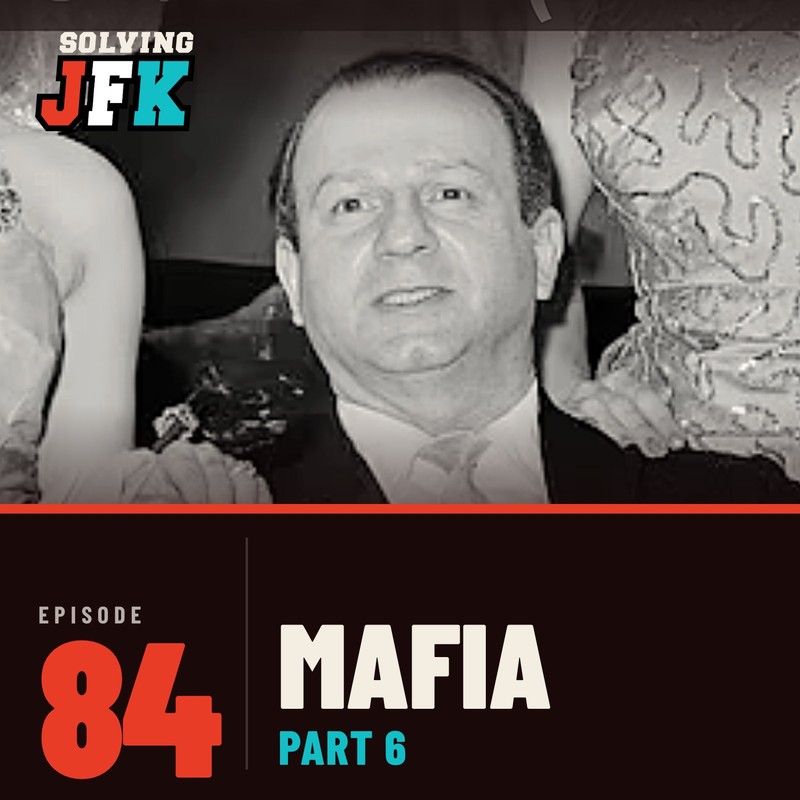
When Jack Ruby stepped out of a crowd in the basement of the Dallas Police Department and fired a single bullet into Lee Harvey Oswald, the nation lost its best chance to learn what Oswald might have revealed about the Kennedy assassination. In Episode 26, we covered the strange events of that weekend in November 1963, from Ruby’s mysterious money transfer to the conflicting stories about how he gained access to Oswald.
In this episode, we go deeper. Who was Jack Ruby? How did a Chicago-born hustler with mob ties end up silencing the most important suspect in modern American history? We trace Ruby’s journey from his early days working for Al Capone, to his years in Dallas running nightclubs and crossing paths with underworld figures, corrupt lawmen, and political operatives.
When Jack Ruby stepped out of the crowd and fired a single shot into Lee Harvey Oswald’s abdomen, the best chances of finding out about Oswald’s potential role in the assassination died with him at Parkland Hospital. In Episode 26, we dissected Ruby’s actions from November 21st through the 24th of 1963, including the suspicious security lapses at the Dallas Police Department, the strange money transfer Ruby made minutes before the shooting, and the conflicting testimony about how he even got into the basement in the first place.
What emerged was a portrait of a man who didn’t act like someone overcome by emotion or vengeance. Ruby’s own words suggested that he was part of something larger and that “powerful people” had put him in that position. In this episode, we go beyond Ruby killing Oswald to explore who Jack Ruby really was, the people he was connected to, and whether his ties to organized crime might finally explain why the man accused of killing the president was silenced before he could ever speak.
Young Ruby
Jacob Leon Rubenstein was born in Chicago in 1911. Like Lee Havey Oswald, he came from a troubled background, spending time locked up as a juvenile offender, and bouncing around to different foster homes after his parents split up and his mother was committed to a mental institution. After Rubenstein dropped out of school when he was 16, he made money scalping tickets to sporting events and was known by the nickname, Sparky, on the streets.1 Around this time, Rubenstein delivered sealed envelopes at the rate of $1 per errand for the number one racketeer in Chicago: Al Capone.2 Yes, that’s right. According to reporter, Seth Kantor, young Sparky Rubenstein was working for none other than Al Capone!
In 1933, at 22 years old, Rubenstein moved to Los Angeles and began selling horse race tip sheets at the Santa Anita racetrack. Incidentally, Johnny Roselli later told the Kefauver Committee that he also moved to Los Angeles from Chicago in 1933, for the purpose of overseeing gambling at the Santa Anita race track on behalf of the Chicago mafia.3 This raises the question of whether Ruby went out West as part of a group of Chicago Outfit affiliated people, which included Roselli. If not, it’s quite the coincidence.
In 1939, Rubenstein returned to Chicago and became an organizer for the Scrap Iron and Junk Handlers Union, an organization that was taken over by the mob shortly after its creation. After the mafia takeover was complete, Rubenstein ascended to the role of union secretary. Not long after that, the founder of the Scrap Iron Junk Handlers Union, Leon Cooke, was found shot to death. When Rubenstein was questioned by the police about the murder, he clarified that his job was simply to pick up money on behalf of the union. After Cooke’s murder, Rubenstein continued to work for the Union and its mafia connected leaders.4
In 1943, Jack Rubenstein was drafted into the Army, where he served as an aircraft mechanic with an honorable record during World War II.5 When the war was over, Rubenstein worked with four of his brothers on a new business making random trinkets like key chains, miniature cedar chests, and bottle openers. It was at this time that Rubenstein and his brothers legally changed their last names from Rubenstein to Ruby because they believed they would get more business with a more American sounding name.6 Jack Ruby worked with his brothers for about a year, until he was bought out of the partnership, and moved to Dallas in 1947.
Did Ruby Work for Nixon?
We’ll come back to Ruby’s move to Dallas momentarily. First, we need to address the question of whether Jack Ruby worked as an informant for Richard Nixon when he was a congressman on the House Un-American Activities Committee, which investigated subversive activities of Americans who were believed to have communist ties.7
The document at issue is an undated letter on Department of Justice letterhead that is forwarding on a sworn statement from November 24, 1947. It says QUOTE “It is my sworn statement that one Jack Rubenstein of Chicago noted as a potential witness for hearings of the House Committee on Un-American Activities is performing information functions for the staff of Congressman Richard Nixon…It is requested Rubenstein not be called for open testimony in those aforementioned hearings.” The signature of the person making the statement is redacted.8
When I first found out about this document, I thought, ‘Wow, Ruby was an informant for Richard Nixon? This guy knows everyone!” As we recently covered, it was likely Nixon’s decision, as Vice President and head of the 54-12 National Security Committee, to ask Howard Hughes to work with the mafia to find ways to kill Fidel Castro. If Jack Ruby was tied to Nixon, I don’t know what exactly that would mean, but it would certainly be a whole other can of worms.
Many people say that this sworn statement linking Ruby to Nixon is a forgery because the zip code has 5 digits, and zip codes did not have 5 digits until 1963. But, upon closer examination, the document is actually a cover sheet from a later date with a zip code, and a separate document that is the sworn statement. So, the zip code is not enough to prove that this document is fake.
After diving deep on this topic, the most likely scenario in my view is that the document is authentic. However, it’s probably not referring to the Jack Ruby that we know. The most likely scenario is that the document is talking about a different Jack Rubenstein: the labor leader who later became vice president of the New York State AFL-CIO. That Rubenstein was expelled from the textile workers union after breaking with the union’s communist leadership. Before that, he had been a prominent member of the Young Communist League in the 1920s.9 While it’s also true that Jack Ruby was involved with a union, he had no known ties to communism in any way whatsoever, unlike the other Jack Rubenstein, who literally had been a communist.
While our Jack Ruby did not likely serve as an informant for Nixon on the House Un American Activities Committee, there is evidence that Ruby was an informant for the Kefauver Committee. If Ruby really had underworld ties, that would make a lot of sense. According to a November 30th, 1963 New York Times article, QUOTE “Luis Kutner, a Chicago lawyer, clarified his relationship with Ruby. Mr. Kutner described himself as an adviser to the late Senator Estes Kefauver, Tennessee Democrat, who was chairman of a crime investigation panel. Mr. Kutner said he was never Ruby's lawyer, but he did send Ruby to the committee counsel when Ruby gave the impression he had information on the Chicago underworld.”10
Bribing Dallas Sheriff
In November of 1946, Paul Rowland Jones, a drug smuggler and spokesperson for the Chicago Outfit, approached Dallas County sheriff-elect, Steve Guthrie while Guthrie was on the golf course. Jones asked him if he wanted to make some big money. Guthrie then reached out to the Dallas police to let them know about the bribe offer, and a sting operation was set up against Paul Rowland Jones. Guthrie, police lieutenant, George Butler, and a few others, spoke with Jones over the course of several meetings, all of which were recorded by the Texas Department of Public Safety.11
In exchange for law enforcement looking the other way and allowing mafia activities in Dallas, Jones offered Guthrie a 50/50 split of the revenue.12 During these meetings, it was determined that the mafia would bring in their own man from out of town the next year, in 1947, to operate a new expensive restaurant at the corner of Commerce and Industrial to serve as the front for illegal gambling operations. Jones said that the man would not be Jewish or Italian.13 This incident eventually led to Jones’ conviction for attempted bribery.14
The facts I just laid out are not disputed. Where the dispute comes in is whether or not Jack Ruby is the man Jones was referring to who would be coming in from Chicago. Former Sheriff Guthrie later told the FBI that Jack Ruby had been mentioned specifically by Paul Rowland Jones as the man who was the outsider being brought in by the Chicago syndicate. The FBI report said QUOTE “Ruby’s name came up on numerous occasions, according to Guthrie, as being the person who would take over a very fabulous restaurant at Industrial and Commerce Streets in Dallas. The first floor of that building was to be a regular restaurant and the upper floor would be used for gambling. Ruby was to run this club.” Guthrie advised the FBI that Ruby’s name would be heard on the recordings.
But, according to the FBI, Ruby’s name was not mentioned in any of the recordings they listened to. However, the FBI only received 22 of the 42 records, and they noted that two of the records were completely missing. It is not clear where the other 18 records went.15
Guthrie Analysis
So, we have a bit of a mixed bag here. On one hand, the Sheriff at the time, Guthrie, the one who was initially approached to be bribed, says that Ruby was mentioned numerous times by Jones as the Chicago Mafia’s man in Dallas. One of the cops who was present for those meetings, George Butler, says that is not true and that Ruby was never mentioned. However, the FBI apparently only listened to about half of the recordings anyway. So, it is possible that Ruby was the mob’s man in Chicago. But, this is by no means a certainty, since the recordings showed that Jones said the man would not be Jewish, and, as we know, Jack Ruby was.
The Warren Report said that Jack Ruby initially visited Dallas in 1947 to help his sister, Eva Grant, operate her restaurant, the Singapore Supper Club. He then moved to Dallas full-time due to the failure of his business partnership with his brothers.16 The Warren Report dismissed the allegations of former Dallas County Sheriff, Steve Guthrie that Ruby specifically was mentioned because Jones said that the man the mob sent would not be Jewish and because Lt. Butler claimed that Ruby was never mentioned in any of the conversations.17
However, there is some reason to believe that Lt. Butler may not have been telling the truth. First, Morton Newman, a reporter for the Chicago Daily News, told the FBI within about a week after the assassination that, Lt. George Butler himself told him that Jack Ruby QUOTE “came to Dallas from San Francisco or Chicago in the late 1940s and was involved in an attempt to bribe Sheriff Steve Guthrie.”18
Second, Butler reached out to Dallas police officers investigating Ruby’s background and told them that Oswald was the illegitimate son of Ruby and that Ruby applied for a visa to Mexico at the same time as Oswald.19 Both of those claims were blatantly false, raising the question of whether Butler was intentionally sending investigators on a wild goose chase.
Third, Reporter Thayer Waldo alleged that Butler may have had foreknowledge of Ruby killing Oswald. Waldo knew Lt. Butler to normally be very calm and unemotional. But, shortly before Oswald was brought down to the basement, Waldo told the Warren Commission that Lt. Butler, QUOTE “was an extremely nervous man, so nervous that when I was standing asking him a question after I had entered the ramp and gotten down into the basement area, just moments before Oswald was brought down, he was standing profile to me and I noticed his lips trembling…I had by then spent enough hours talking to this man so that it struck me as something totally out of character.”20
Whether Ruby was specifically mentioned by Jones or not, Jones made it clear that Ruby was known to the Chicago Outfit. He told the FBI that when he first met Jack Ruby in Chicago, he was given immediate assurances by mobsters Jimmy Weinberg and Paul Needle Nose Labiola that Ruby was known to them and was “all right” as far as the Chicago Outfit was concerned. Jones said that he assumed Ruby’s involvement with the mafia was his role in the Scrap Iron Workers Union.21 That is consistent with what Ruby told Dallas businessman, Giles Miller, in 1959. Miller said Ruby told him he wanted to move to California in 1947, but he QUOTE “was directed” to go to Dallas.22
And, if you believe Sam Giancana’s half brother, Chuck, Momo Giancana himself told Chuck that he was sending Jack Ruby down to Dallas and that Ruby was the friend of two other Chicago Outfit enforcers: Dave Yaras and Lenny Patrick.23
Ruby In Business
When Ruby arrived in Dallas, he briefly had a partnership with his sister, Eva, at the Singapore Supper Club, until she left town after constant arguing with Jack. After that, Ruby changed the name of the restaurant to the Silver Spur, a western themed establishment that served as the home base of Paul Rowland Jones and his associates, until Jones went to prison.24
Shortly after Ruby launched the Silver Spur, he was befriended by Ralph Paul, a 48 year old Eastern European immigrant who had access to a lot of cash. Over the years, Paul would serve as a silent partner to Ruby for his establishments, including the Carousel Club, lending Ruby over $5,000. Paul told the Warren Commission that Ruby never repaid any of the loans. Paul owned 50% of the stock of the Carousel Club, but rarely visited the Club and said that he did not know who owned the other half of the company’s shares. Paul claimed that he never received any distributions of profit from the business in the time it operated.25 It is not known where Paul obtained his money. His only other business was a Drive In restaurant that he operated in Arlington, about 20 miles west of the Carousel.26
Despite the capital infusions from Paul, Ruby’s businesses were not successful. And Ruby would often get into fights at the bars he managed, resulting in his right index finger being bitten off of his hand.27 He was arrested 9 times between 1947 and 63 (not counting the Oswald murder), including once for pistol whipping an off-duty Dallas cop. For those infractions, the most serious consequence Ruby faced was a $35 fine for ignoring a traffic summons.28
Ruby Running Guns?
A major question about Jack Ruby’s life is whether he spent time as a gun runner. If there is clear proof that Ruby wasn’t just a night club owner, but was also in the gun smuggling business, it makes it less likely that he was a lone nut. So what’s the evidence for Jack Ruby – the arms trafficker?
James Beaird told the FBI he met Jack Ruby while playing cards in Kemah, Texas in 1957. Beaird claimed that Ruby gathered and stored guns and ammo at a nearby home. And, on weekends, Ruby loaded the munitions onto pickup trucks and delivered them to a 50 foot-long military landing craft at the dock. Beaird said Ruby would drop the arms off in Mexico and Fidel Castro would pick them up on his personal boat and bring back to Cuba. Beaird personally observed new boxes of guns being loaded onto this boat and said that Ruby returned to Kemah from Mexico after the boats were unloaded.29
After President Kennedy was assassinated, Blaney Mack Johnson, said that, in the 1950s, he was an independent pilot who flew numerous cargo flights between Miami and Havana. He told the FBI that “Jack Rubenstein” was active in arranging these flights and was the part owner of two airplanes used to smuggle weapons. Johnson added that Ruby was the part owner of a Havana casino, in which former Cuban president, Carlos Prio had the majority stake.30
In 1954, Jack Ruby befriended, James Woodard, who was a Dallas police officer for a brief period of time. In 1958, Woodard’s sister, Mary came to visit Woodard and his wife, Mary Lou, at their home in Islamorada, in the Florida Keys. Mary brought her daughter, Delores, and her son-in-law, Richard. At that time, Mary met a man named Jack, last name unknown, who was from Chicago, and owned a drinking establishment in Dallas. Mary Lou told her sister in law, Mary, that Jack had a trunk full of guns and was going to supply them to Cubans. This was also confirmed by Mary’s son in law, Richard, who was told by Woodard, in a moment of drunken candor, that Woodard and Jack were running guns to Cuba. When Mary saw Jack Ruby on television after the assassination, she identified him as the same Jack she had met in Islamorada, Florida in 1958. Her daughter, Delores also confirmed that the man they met was Jack Ruby.31
In a March 19, 1964 memorandum from Warren Commission attorneys, Burt Griffin and Leon Hubert, it says QUOTE “Ruby states that he contacted a man in Beaumont, Texas, whose name he recalled was Davis. The FBI has been unable to identify anyone engaged in the sale of arms to Cuba who might be identical with the person named Davis.”32 After Ruby killed Oswald, his first lawyer, Tom Howard, asked him if there were any names of people the prosecution could produce who would be damaging to Ruby’s defense arguments. Ruby told Howard that he had been involved with Davis in running guns.33
Robert McKeown also confirmed that Ruby had told him about working with a man named Davis. While the FBI couldn’t even find Davis’s first name, the CIA was well aware of Thomas Eli Davis, III. According to journalist, Seth Kantor, Davis was a trainer of anti-Castro units at secret bases in Florida, and at another site in South America.34 Davis later sold guns to a French terrorist movement that was attempting to assassinate French President, Charles De Gaulle. Davis, this man Ruby told his lawyer about, was later imprisoned in Algiers and released through the intervention of top secret CIA assassin, with code name QJ-WIN.35
Also, Retired Cuban general Fabian Escalante also confirmed that Ruby was running guns to Cuba in the 1950s.36 On top of that, Dr. Werner Teuter, a psychiatrist who examined Ruby after his arrest, wrote in his notes, QUOTE “there is considerable guilt about the fact that he sent guns to Cuba…He feels he helped the enemy and incriminated himself.”37
So far, that’s six separate sources for Ruby running guns to Cuba: James Beaird, Mary and Delores Woodard, Tom Howard, Fabian Escalante, and Dr. Werner Teuter. And we haven’t even talked about Robert McKeown.
Robert McKeown Background
We previously mentioned Robert McKeown in the context of a Lee Harvey Oswald imposter attempting to purchase four rifles from McKeown in September of 1963 for $10,000. McKeown turned the man down and told him that he could buy the same guns for $75 elsewhere. Either McKeown and his friend, Sam Neal, hallucinated the entire interaction, or someone was trying to make it look like Lee Harvey Oswald was purchasing weapons from the same guy who supplied them to Fidel Castro in the past. It turns out, there is also a link between Robert McKeown and Jack Ruby.
In the early 1950s, McKeown owned and operated a coffee plant in Santiago, Cuba under the regime of Carlos Prio. When Prio was overthrown by Fulgencio Batista in 1952, McKeown worked with Prio to help him regain power by bringing in weapons for his forces, but McKeown was deported by Batista in 1956. He then moved to Miami and continued to smuggle arms to Cuban rebels, who, at that time, were led by Fidel Castro, who was also attempting to oust Batista.38 As we’ll soon cover when we get to the series on Cuba, the CIA was funding both Batista and the Revolutionary forces so that it had influence in either outcome.39 All of this gun running was before Castro was the boogey man of American Intelligence.
In 1957, McKeown returned to his native Texas, living in Baytown, just down the road from Kemah, where James Beaird said Jack Ruby was storing weapons. McKeown then began delivering large quantities of munitions to Mexico to be delivered to Castro for use in the revolution. McKeown confirmed Beaird’s claim that Castro himself piloted the boat from Mexico to pick up the arms, and returned back to Cuba with them.40 In February of 1958, McKeown’s gun running led to his arrest by the Bureau of Alcohol, Tobacco, and Firearms, which resulted in 60 days in jail and a 5 year probation sentence (which was probably the reason why he was so paranoid to sell 4 rifles for to the person saying he was Lee Oswald for more than 100 times their value.)41
McKeown and Ruby
Here’s where Jack Ruby comes in to the Robert McKeown story. Sometime in early 1959, about a week after Castro took power,42 a man from Dallas who said he needed to reach McKeown contacted Harris County, Texas deputy sheriff, Anthony Ayo, for help. It’s not known how the c aller was aware that Ayo was friends with McKeown. At any rate, after getting McKeown’s permission, Ayo gave the man McKeown’s work number.
About an hour later, a man named Rubenstein who said he was from Dallas called McKeown at his business, the J&M Drive-In.43 Rubenstein needed help getting the release of three people who were being detained in Cuba, and offered to pay $5,000 per person. He said the money would come from people in Las Vegas.44McKeown agreed to help in exchange for a $5,000 deposit, but there was no follow up about this matter from Rubenstein.
But, about 3 weeks after this phone call from Rubenstein, a man who did not identify himself showed up in person at the J&M Drive In and offered McKeown $25,000 for a letter of introduction to Fidel Castro. The man said he had an option on a large number of jeeps out of Shreveport, Louisiana and wanted to sell them to Castro for a substantial profit. McKeown agreed, so long as he was paid a $5,000 deposit up front. The man told McKeown that he would go and get the money. But, the man never came back.45 An FBI report from January 1964 says McKeown QUOTE “feels strongly that this individual was in fact Jack Ruby, the man whose photograph he has seen many times recently in the press.” 46
Even the Warren Commission knew that Ruby was likely running guns, based on a March 20, 1964 memorandum from assistant counsels Burt Griffin and Leon Hubert, which said QUOTE “the most promising links between Jack Ruby and the assassination of President Kennedy are established through underworld figures and anti-Castro Cubans, and extreme right-wing Americans.”47 Two months later, Griffin and Hubert wrote in another memo, QUOTE “We believe that a reasonable possibility exists that Ruby has maintained a close interest in Cuban affairs to the extent necessary to participate in gun sales or smuggling.”48
According to HSCA chief counsel, Robert Blakey, Jack Ruby told a friend in his jail cell, QUOTE “They're going to find out about Cuba. They're going to find out about the guns, find out about New Orleans, find out about everything."49
NEXT TIME ON SOLVING JFK: We continue to analyze the life, actions, and relationships of Jack Ruby, including his role as an FBI informant, whether he visited Santos Trafficante in a Cuban prison, his ties to Carlos Marcello, the massive increase in suspicious phone calls from Ruby leading up to the assassination, and a visit from notorious MK Ultra doctor, Louis, Jolyon West.
Automated transcript
Machine-generated from the audio and unedited, so names and spellings may be wrong. Tap a timestamp to play from that point.
Speaker 0When Jack Ruby stepped out of the crowd and fired a single shot into Lee Harvey Oswald's abdomen, the best chances of finding out about Oswald's potential role in the assassination died with him at Parkland Hospital. In episode 26, we dissected Ruby's actions from November 21st through November 24th of 1963, including the suspicious security lapses at the Dallas Police Department, the strange money transfer Ruby made minutes before the shooting and the conflicting testimony about how he even got into the basement in the first place. What emerged was a portrait of a man who did not act like someone overcome by emotion or vengeance. Ruby's own words suggested that he was part of something much larger and that powerful people had put him in that position. In this episode, we go beyond Ruby Killing Oswald to explore who Jack Ruby really was. The people he was connected to, and whether his ties to organized crime might finally explain why the man accused of killing the president was silenced before he could ever speak.
Speaker 2In Dallas, Texas, three shots were fired at President Kennedy's motorcade in downtown Dallas. The first reports say that President Kennedy has been seriously wounded by this shooting.
Speaker 1This is Solving JFK.
Speaker 0I'm your host, Matt Crumpton. Jacob Leon Rubinstein was born in Chicago in 1911. Like Lee Harvey Oswald, he came from a troubled background spending time locked up as a juvenile offender and bouncing around to different foster homes after his parents split up and his mother was committed to a mental institution. After Rubenstein dropped out of school when he was 16, he made money scalping tickets to sporting events, and was known by the nickname Sparky on the streets. Around this time, Rubenstein delivered sealed envelopes at the rate of $1 per errand for the number one racqueteer in Chicago, Al Capone. You heard that right, according to reporter Seth Cantor, young Sparky Rubenstein was working for none other than Al Capone. In 1933, at just 22 years old, Rubenstein moved to Los Angeles and began selling horse-race tip sheets at the Santa Anita Race Track. Incidentally, Johnny Roselli later told the keyfobber committee that he also moved to Los Angeles from Chicago in 1933 for the purpose of overseeing gambling at the Santa Anita Race Track on behalf of the Chicago Mafia.
Speaker 0This raises the question of whether Ruby went out west as part of a group of Chicago outfit affiliated people, which included Roselli. If not, it's quite the coincidence. In 1939, Rubenstein returned to Chicago and became an organizer for the scrap iron and junk handlers union, an organization that was taken over by the Chicago outfit shortly after its creation. After the Mafia takeover was complete, Rubenstein ascended to the role of union secretary. Not long after that, the founder of the scrap iron junk handlers union Leon Cook was found When Rubenstein was questioned by the police about the murder, he clarified that his job was simply to pick up money on behalf of the Union. After Leon Cook's murder, Rubenstein continued to work for the Union and its mafia-connected leaders. In 1943, Jack Rubinstein was drafted into the army, where he served as an aircraft mechanic with an honorable record during World War II.
Speaker 0When the war was over, Rubinstein worked with four of his brothers on a new business, making random trinkets like key chains, miniature It was at this time that Rubenstein and his brothers legally changed their last names from Rubenstein to Ruby because they believed they would get more business with a more American sounding name. Jack Ruby worked with his brothers for about a year until he was bought out of the partnership and moved to Dallas in 1947. We'll come back to Ruby's move to Dallas momentarily. First, we need to address the question of whether Jack Ruby worked as an informant for Richard Nixon when he was a congressman on the House Un-American Activities Committee, which investigated subversive activities of Americans who were believed to have communist ties. The document at issue is an undated letter that's on a department of justice letterhead and is forwarding on a sworn statement from November 24th, 1947.
Speaker 0It says quote, it is my sworn statement that one Jack Rubenstein of Chicago noted as a potential witness for hearings of the House Committee on Un-American Activities is performing information functions It is requested Rubenstein not be called for open testimony in those aforementioned hearings. The signature of the person making the statement has been redacted. When I first found out about this document, I thought, wow, Ruby was an informant for Richard Nixon. This guy knows everybody. As we recently covered, it was likely Nixon's decision as Vice President and head of the 5412 National Security Committee to ask Howard Hughes to work with the mafia to find ways to kill Fidel Castro. If Jack Ruby was tied to Nixon, I don't know what exactly that would mean, but it would certainly be a whole other can of worms. Many people say that this sworn statement linking Ruby to Nixon is a forgery because the zip code has five digits and zip codes did not have five digits until 1963.
Speaker 0Upon closer examination, the document is actually a cover sheet from a later date with a zip code and a separate document that is the sworn statement. So the zip code is not enough to prove that this document is a fake. After diving deep on this topic, the most likely scenario in my view is that the document is authentic. However, it's almost certainly not referring to the Jack Ruby that we know. The most likely scenario is that the document is talking about a different Jack Rubenstein. The Labour leader, who later became Vice President of the New York State AFL CIO, that Rubenstein was expelled from the textile workers union after breaking with the Union's Communist leadership. Before that, he had been a prominent member of the young Communist League in the 1920s. While it's also true that Jack Ruby was involved with the Union, He had no known ties to communism in any way whatsoever. Unlike the other Jack Rubinstein, who literally had been a communist.
Speaker 0While our Jack Rubin was not likely an informant for Nixon, there is evidence that he was an informant for the keyfawver committee. If Ruby really had underworld ties, that would make a lot of sense. According to a November 30th, 1963 New York Times article, quote, Louis Cutner, a Chicago lawyer, clarified his relationship with Ruby. Mr. Cutner described himself as an adviser to the late senator Mr. Cutner said he was never Ruby's lawyer, but he did send Ruby to the committee council when Ruby gave the impression that he had information on the Chicago Underworld. In November of 1946, Paul Roland Jones, a drug smuggler and spokesperson for the Chicago outfit, approached Dallas County Sheriff elect Steve Guthrie while Guthrie was on the golf course. Jones asked Guthrie if he wanted to make some big money and implied that he was offering a bribe. After that, Guthrie reached out to the Dallas police to let them know about this bribe offer.
Speaker 0and a sting operation was set up against Jones. Guthrie police lieutenant George Butler and a few others spoke with Jones over the course of several meetings, all of which were recorded by the Texas Department of Public Safety. In exchange for law enforcement looking the other way and allowing mafia activities in Dallas, Jones offered Guthrie a 50-50 split of the revenue. During these meetings, it was determined that the Mafia would bring in their own man from out of town the next year in 1947 to operate a new expensive restaurant at the corner of commerce and industrial to serve as the front for illegal gambling operations. Jones said that the man would not be Italian or Jewish. The facts I just laid out are not disputed, where the issue comes in is whether or not Jack Ruby is the man Jones was referring to, who would be coming in from Chicago. Former sheriff Guthrie later told the FBI that Jack Ruby had been mentioned specifically by Pol Roll and Jones as the man who was the outsider being brought in by the Chicago outfit.
Speaker 0The FBI report said QUOTE. Ruby's name came up on numerous occasions, according to Guthrie, as being the person who would take over a very fabulous restaurant at industrial and commerce streets in Dallas. The first floor of that building was to be a regular restaurant, and the upper floor would be used for gambling. Ruby was to run this club. Guthrie advised the FBI that they would hear Ruby's name on the recordings. But according to the Bureau, Ruby's name was not mentioned in any of the recordings they listened to. However, the FBI only received 22 of the 42 records, and they noted that two of the records were completely missing. It's not clear what happened to the other 18. So we have a bit of a mixed bag here. On one hand, the sheriff at the time, Guthrie, the one who was initially approached to be bribed, says that Ruby was mentioned numerous times by Jones as the Chicago Mafia's Man in Dallas.
Speaker 0One of the cops who was present for those meetings, George Butler, says that this is not true, and that Ruby was never mentioned. However, the FBI apparently only listened to about half of the recordings anyway. So it's still possible that Ruby was the man that Jones was referring to. But this is not a certainty since we know that the recording say that the man would not be Italian or Jewish and Jack Ruby is of Jewish heritage. The war in reports said that Jack Ruby initially visited Dallas in 1947 to help his sister, Eva Grant, operate her restaurant, the Singapore Supper Club. He then moved to Dallas full-time due to the failure of the business partnership with his brothers. The Warren Report dismissed the allegations of former Dallas County Sheriff Steve Guthrie, because Hull Rollin Jones said that the man the Chicago Mafia was sending to Dallas would not be Jewish and because Lieutenant Butler claimed that Ruby was never mentioned in any of the conversations.
Speaker 0However, there is some reason to believe that Lieutenant Butler may not have been telling the truth. But first, Morton Newman, a reporter for the Chicago Daily News, told the FBI within about a week after the assassination that Lieutenant George Butler himself told Newman that Jack Ruby quote, came to Dallas from San Francisco or Chicago in the late 1940s and was involved in an attempt to bribe Sheriff Steve Guthrie. If Ruby's not the guy Jones is talking about, then why would Butler say he was involved in this whole bribe scheme? Second, Butler reached out to Dallas police officers who were investigating Ruby's background and told them that Oswald was the illegitimate son of Ruby and that Ruby applied for a visa to Mexico at the same time as Oswald. Both of those claims were unsupported and blatantly false, raising the question of whether Butler was intentionally sending investigators on a wild goose chase.
Speaker 0Third, reporter Thayer Waldo alleged that Butler may have had foreknowledge of Ruby killing Oswald. Waldo knew Lieutenant Butler to normally be very calm and unemotional, but shortly before Oswald was brought down to the basement, Waldo told the Warren Commission that Lieutenant Butler quote, Wasn't extremely nervous man, so nervous that when I was standing, asking him a question after I had entered the ramp and gotten down into the basement area, just moments before Oswald was brought down, he was standing profile to me and I noticed his lips trembling. I had by then spent enough hours talking to this man that it struck me as something totally out of character. Whether Ruby was specifically mentioned by Paul Rollin Jones or not, Jones made it clear that Ruby was known to the Chicago outfit. He told the FBI that when he first met Jack Ruby in Chicago, he was given immediate assurances by mobsters Jimmy Weinberg and Paul Needle knows Labiola,
Speaker 0that Ruby was known to them and was all right as far as the Chicago outfit was concerned. Joan said that he assumed Ruby's involvement with the Mafia was his role in the scrap iron workers union. That's consistent with what Ruby told Dallas businessman Giles Miller in 1959. Miller said Ruby told him that he wanted to move to California in 1947, but he quote, was directed to go to Dallas. If you believe Sam G. and Conna's half-brother Chuck, Momo G. and Conna himself told Chuck that he was sending Jack Ruby down to Dallas, and that Ruby was the friend of two other Chicago outfit enforcers, When Jack Ruby arrived in Dallas, he briefly had a partnership with his sister Eva at the Singapore supper club until she left town after constant arguing with Jack. After that, Ruby changed the name of the restaurant to the silver spur, a western themed establishment that served as the home base of Paul Roland Jones and his associates until Jones went to prison.
Speaker 0Shortly after Ruby launched the silver spur, he was befriended by Ralph Paul, a 48-year-old Eastern European immigrant who had access to a lot of cash. Over the years, Paul would serve as a silent partner to Ruby for his establishments, including the Kerasel Club, lending Ruby over $5,000. Paul told the Warren Commission that Ruby never repaid any of the loans. Paul owned 50% of the stock of the carousel club, but rarely visited the club and said that he did not know who owned the other half of the company shares. Paul claimed that he never received any distributions of profit from the business during the time it operated. It's unknown where Ralph Paul obtained his money. His only other business was a drive-in restaurant that he operated in Arlington about 20 miles west of the carousel. Despite the capital infusions from Ralph Paul, Ruby's businesses were not successful, and Ruby would often get into fights at the bars that he managed, resulting in his right index finger being bitten off of his hand.
Speaker 0Ruby was arrested nine times between 1947 and 1963, not counting the Oswald murder, including once for pistol whipping and off-duty Dallas cop. For those nine infractions, the most serious consequence Ruby faced was a $35 fine for ignoring a traffic summons. A major question about Jack Ruby's life is whether he spent time as a gun runner. If there's clear proof that Ruby was not just a nightclub owner, but was also involved in the gun smuggling business, it makes it less likely that Ruby was just a low nut. So what is the evidence for Jack Ruby as an arms trafficker? James Beard told the FBI that he met Jack Ruby while playing cards in Kima Texas in 1957. Beard claimed that Ruby gathered and stored guns and ammo at a nearby home. On weekends, Ruby loaded the munitions onto pickup trucks and delivered them to a 50-foot-long military landing craft at the dock. Beard said that Ruby would drop the arms off in Mexico and Fidel Castro would pick them up on his personal boat and bring them back to Cuba.
Speaker 0Beard personally observed new boxes of guns being loaded onto this boat and said that Ruby returned to Kima from Mexico after the boats were unloaded. After President Kennedy was assassinated, Blaney Mac Johnson said that in the 1950s, he was an independent pilot who flew numerous cargo flights between Miami and Havana. He told the FBI that Jack Rubenstein was active in arranging these flights and was the part owner of two airplanes used to smuggle weapons. Johnson added that Rubinstein was the part owner of a Havana casino in which former Cuban president Carlos Prio had the majority stake. In 1954, Rubi befriended James Woodard, who was a Dallas police officer for a brief period of time. In 1958, Woodard's sister Mary came to visit Woodard and his wife Mary Lou at their home in Ilamarata in the Florida Keys. Mary brought her daughter Dolores and her son-in-law Richard. At that time, Mary met a man named Jack last name unknown, who was from Chicago and owned a drinking establishment in Dallas.
Speaker 0Mary Lou told her sister-in-law Mary that Jack had a trunk full of guns and was going to supply them to the Cubans. This was also confirmed by Mary's son-in-law Richard, who was told by Woodard in a moment of drunken candor that Woodard and Jack were running guns to Cuba. When Mary saw Jack Ruby on television after the assassination, she identified him as the same Jack she had met in Ilamarata in 1958. Her daughter Dolores also confirmed that the man they met was Jack Ruby. In a March 19th, 1964 memorandum from Warren Commission attorney's Bert Griffin and Leon Hubert, it says, quote, Ruby states that he contacted a man in Beaumont, Texas, whose name he recalled was Davis. The FBI has been unable to identify anyone engaged in the sale of arms to Cuba, who might be identical with the person named Davis. After Ruby killed Oswald, his first lawyer, Tom Howard, asked him if there were any names of people the prosecution could produce who would be damaging to Ruby's defense arguments.
Speaker 0Ruby then told his attorney that he had been involved with Davis running guns. Robert MacQun also confirmed that Ruby had told him about working with a man named Davis. While the FBI couldn't even find Davis's first name, the CIA was well aware of Thomas Eli Davis III. According to journalist Seth Canter, Davis was a trainer of anti-Castro units at secret bases in Florida and at another site in South America. Davis later sold guns to a French terrorist movement that was attempting to assassinate French president Charles De Gaulle. Davis, this man Ruby told his lawyer about, was later imprisoned in Algiers and released through the intervention of top secret CIA assassin, codename QJ Win. Also, retired Cuban general Fabian Escalante confirmed that Ruby was running guns to Cuba in the 1950s. On top of that, Dr. Warner Tutor, a psychiatrist who examined Ruby after his arrest, wrote in his notes, quote, There is considerable guilt about the fact that he sent guns to Cuba.
Speaker 0He feels he helped the enemy and incriminated himself. So far, that six different sources for Jack Ruby running guns to Cuba, James Beard, Mary and Dolores Woodard, Tom Howard, Fabian Escalante, and Dr. Warner Tutor. And we haven't even talked about Robert McEwen. We previously mentioned Robert McEwen in the context of a Leigh Harvey Oswald imposter who was attempting to purchase four rifles from McEwen in September of 1963 for $10,000. McEwen turned the man down and told him that he could buy the same guns for $75 elsewhere. Either McCueen and his friend Sam Neal hallucinated the entire interaction, or someone was trying to make it look like Lee Harvey Oswald was purchasing weapons from the same guy who supplied them to Fidel Castro in the past. It turns out there's also a link between Robert McCueen and Jack Ruby. In the early 1950s, McCune owned and operated a coffee plant in Santiago Cuba under the regime of Carlos Prio.
Speaker 0When Prio was overthrown by Fulgencio Batista in 1952, McCune worked with Prio to help him regain power by bringing in weapons for his forces, but McCune was deported by Batista in 1956. He then moved to Miami and continued to smuggle arms to Cuban rebels, who, at that time, were led by Fidel Castro, who was also attempting to oust Batista. As we'll soon cover when we get to the series on Cuba, the CIA was funding both Batista and the Revolutionary Forces, so that it had influence in either outcome. All of this gun running was before Castro was the boogie man of American intelligence. In 1957, McQ and returned to his native Texas, living in Baytown, just down the road from Kima, where James Beard said Jack Ruby was storing weapons. McEwen then began delivering large quantities of munitions to Mexico to be delivered to Castro for use during the revolution. McEwen confirmed Beard's claim that Castro himself piloted the boat from Mexico to pick up the arms and returned back to Cuba with them.
Speaker 0In February of 1958, McCune's gun running led to his arrest by the Bureau of Alcohol, Tobacco, and firearms, which resulted in 60 days in jail and a five-year probation sentence. This is probably the reason why he was so paranoid to sell four rifles for 100 times their value to the person saying he was Le Harbiaz World. Here's where Jack Ruby comes in to the Robert McCueen story. Sometime in early 1959, about a week after Castro took power, a man from Dallas who said he needed to reach McCueen contacted Harris County Texas Deputy Sheriff Anthony Ayo for help. It's not known how the caller was aware that Ayo was friends with McCueen. At any rate, after getting McCune's permission, Deputy Sheriff A.O. gave the man McCune's work number. About an hour later, a man named Rubenstein, who said he was from Dallas, called McCune at his business, the J&M Drive-in. Rubenstein said that he needed help getting the release of three people who were being detained in Cuba.
Speaker 0and offered to pay $5,000 per person. He said the money would come from people in Las Vegas. McEwen agreed to help and exchange for a $5,000 deposit, but there was no follow-up about this matter from Rubenstein. However, about three weeks later, a man who did not identify himself showed up in person at the J&M Drive-in and offered McCue and $25,000 for a letter of introduction to Fidel Castro. The man said he had an option on a large number of jeeps out of Schreefport, Louisiana, and wanted to sell them to Castro for a substantial profit. McEwen agreed, so long as he was paid $5,000 up front. The man told McEwen that he would go and get the money, but he never came back. An FBI report from January 1964 says McCune, quote, feel strongly that this individual was, in fact, Jack Ruby, the man whose photograph he has seen many times recently in the press. Even the Warren Commission knew that Jack Ruby was likely running guns, based on a March 20th 1964 memo from Assistant Council's Bert Griffin and Leon Hubert, which said, quote, the most promising links between Jack Ruby and the assassination of President Kennedy are established through underworld figures and anti-Castro Cubans and extreme right-wing Americans.
Speaker 0Two months later, in another memo, Griffin and Hubert wrote, quote, we believe that a reasonable possibility exists that Ruby has maintained a close interest in Cuban affairs to the extent necessary to participate in gun sales or smuggling. Finally, according to HSCA Chief Council Robert Blakey, Jack Ruby told a friend in his jail cell, quote, They're going to find out about Cuba, they're going to find out about the guns, find out about New Orleans, find out about everything. Next time on Solving JFK, we continue to analyze the life, actions, and relationships of Jack Ruby, including his role as an FBI informant, whether he visited Santos, Traficante and a Cuban prison, his ties to Carlos Marcelo, the massive increase in suspicious phone calls from Ruby leading up to the assassination. and a visit from notorious M.K. Ultra Doctor, Lewis Jollyon West. If you heard anything that you believe is out of context, or if you have additional information to offer, you can let us know at solving JFK podcast at gmail.com.
Speaker 0Please provide citations to the record for any fact that you're relying on. For transcripts, sources, and official podcast merchandise, visit solvingjfkpodcast.com. Thanks for listening. Visit solvingjfkpodcast.com for more information.