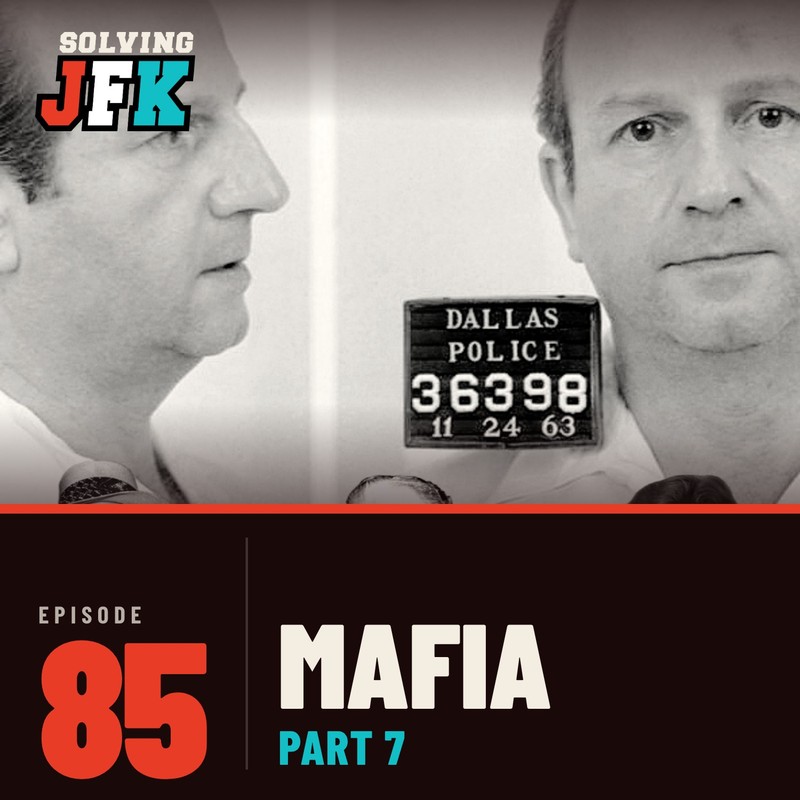
In the last episode, we rewound Jack Ruby’s life long before the basement of the Dallas Police Department and found a man deeply entangled with organized crime, Cuban gun-running, and people far more powerful than he let on.
This episode goes deeper into Ruby’s world and asks how far inside that orbit he really was. We explore Ruby’s stint as an FBI informant, his close relationship with casino manager Lewis McWillie, and the allegation that Ruby visited Mafia boss Santos Trafficante in prison. We also look at Ruby’s ties to Carlos Marcello and analyze the unusual series of long-distance calls he made in the weeks leading up to November 22, 1963.
In the last episode, we stepped back into the world of Jack Ruby, not in the basement of the Dallas Police Department, but in the decades that led him there. By the end of the last episode one thing was clear: Jack Ruby was suspiciously close with many organized crime figures and he very likely was running guns to Cuba before Castro took over.
If the last episode showed us how Ruby entered the orbit of organized crime, this episode looks at just how deep inside that orbit he may have been. We’ll examine Ruby’s stint as an FBI informant, his relationship with Lewis McWillie, the allegation that he visited Mafia boss Santos Trafficante in prison, Ruby’s ties to Carlos Marcello, and the flurry of long distance calls Ruby made in the months and weeks before November 22, 1963. Then, we’ll turn our attention to the stranger than fiction role of one of Jack Ruby’s psychiatrists, Dr. Louis Jolyon West.
FBI Informant
Around the same time as when Robert McKeown said he interacted with Jack Ruby, in March of 1959, Ruby was approached by Dallas FBI Agent Charles Flynn about becoming an informant for the FBI. The Bureau believed that Ruby QUOTE “might have knowledge of the criminal element in Dallas” because he was in the nightclub business.1
Author Lamar Waldron asserts that Ruby likely got permission to be an FBI informant from mafia superiors, like Joe Civello and Joe Campisi. The idea was that, if he became an informant, Ruby would have extra protection for illegal activities and a way to find out what crimes the FBI was interested in.2
Ruby contacted the FBI on 8 different occasions between March and October of 1959. After that, the communications stopped.3 Ruby being an FBI informant for a period of time does not necessarily prove anything. However, it does raise the question of why the Warren Report failed to mention Ruby’s informant status even once.4
Lewis McWillie
If Jack Ruby did not have close ties to the mob, as the Warren Commission asserted, it becomes harder to explain exactly why he took a trip to Cuba in 1959, shortly after Fidel Castro came to power, to visit an extremely connected friend of his, Lewis McWillie. This 1959 Cuba trip to see McWillie is also the root of the allegation that Ruby helped get Santos Trafficante released from a Cuban prison.5 So, who exactly was Lewis McWillie? Did Ruby really visit him in Cuba? And is there any truth to the Trafficante prison visit?
Let’s start with Jack Ruby’s friend, Lewis McWillie. McWillie, who was world class gambler, came up working for Meyer Lansky in Cuban Casinos, where he met Johnny Roselli, in 1938. In the 1940’s, McWillie met Ruby when he worked in Dallas at illegal gambling clubs.6 After that, McWillie worked at the Trafficante-controlled Tropicana and Capri Casinos in Cuba.7
In 1961, Johnny Roselli reached out to McWillie to give him the trusted role of keeping tabs on Frank Sinatra, who Sam Giancana was worried was getting too close to President Kennedy. McWillie was sent to work in a management position at Sinatra’s Cal-Neva Lodge on behalf of the Chicago Outfit. After monitoring Sinatra until Kennedy cut off ties with him, McWillie then went on to continue his casino career in Las Vegas, working at mafia-affiliated places like the Thunderbird.8
In summary, Lewis McWillie worked with Meyer Lansky, and Santos Trafficante, and was then personally asked by Johnny Roselli to keep an eye on Frank Sinatra at his casino on behalf of Sam Giancana. McWillie indisputably had relationships at the highest echelons of La Cosa Nostra. Most importantly, McWillie acknowledged to the HSCA that he was one of Jack Ruby’s best friends throughout the 1950s.9
Ruby Goes to Cuba
What about Ruby going to Cuba to supposedly get Trafficante out of prison? Did that really happen? Even the Warren Report admitted that Jack Ruby went to Cuba while Trafficante was locked up in prison. It said QUOTE “In September 1959, Ruby traveled to Havana as a guest of a close friend and known gambler, Lewis J. McWillie. Both Ruby and McWillie state the trip was purely social.”10 The Warren Report itself avoided the topic of Ruby’s ties to organized crime.11 According to a memo from Warren Commission staff attorneys, Leon Hubert and Burt Griffin,12 rumors that Jack Ruby was involved in illegal activities in Cuba were never even investigated by the Commission.13
Ruby told the FBI in December of 1963 that he visited Lewis McWillie in Havana for 8 to 10 days in August of 1959.14 McWillie was the Pit Boss at the Trafficante-controlled Riviera Casino there.15 McWillie paid for and sent the plane tickets for the Cuba trip to Ruby. But, according to the FBI, QUOTE “following [Ruby’s] arrival, he found he did not have a good time as he expected, he was not a gambler, and after several days in Havana with nothing to do, he was glad to return to Dallas.”16
We know from Jack Ruby’s background that he was a semi-professional gambler. Ruby’s name was found on a list of professional gamblers in the Dallas/Fort Worth area which was in the possession of professional gambler Harry Siedband when he was arrested in 1959.17 Additionally, the Dallas Police Criminal Intelligence Division listed Jack Ruby and Lewis McWillie as being connected with professional gamblers.18And we know Ruby was involved in gambling his entire adult life. So, why did Ruby lie to the FBI about his gambling interest? And why would McWillie ask Ruby to come visit Cuba, right after the new military dictator, Fidel Castro took over, if Ruby didn’t like gambling and had no other interests there?19
McWillie Visits Trescornia
What about this idea that Ruby visited Santos Trafficante in Prison? On June 9, 1959 Fidel Castro ordered Santos Trafficante to be held at Trescornia, a comfortable prison camp in Havana. Trafficante was being held because he had been a Fulgencio Batista collaborator.20 At Trescornia, Trafficante shared a cell with Loran Hall, one of the men who would later come forward as having visited Sylvia Odio, only to recant the story.21
A few years after the murders of Sam Giancana and Johnny Roselli, the HSCA questioned Lewis McWillie about Trafficante, who was still alive at the time. At first, McWillie acted QUOTE “as if he did not even recognize the name.”22 Later, McWillie said of Trafficante, QUOTE “he knew who I was, and he shook hands with me when he saw me, but that was it.”23 McWillie said that he did visit the prison where Trafficante was held one or two times, and that he saw Trafficante there, but he was going to visit someone else.24 McWillie did not remember if Ruby was in Cuba with him when he went to the prison. It was possible, but McWillie did not remember.25
Four days after President Kennedy’s assassination, British journalist, John William Hudson, contacted the US State Department in London and said he was imprisoned at Trescornia in Cuba with QUOTE “an American gangster type named Santos” in 1959. Hudson added that, QUOTE “an individual named Ruby would come to the prison with the person bringing food” to Trafficante.26
Trafficante himself told the HSCA QUOTE “I never remember meeting Jack Ruby. There was no reason for this man to visit me. I have never seen this man before. I have never been to Dallas. I never had no contact with him. I don’t see why he was going to come and visit me.”27 When asked about the allegations of fellow detainee, John William Hudson, Trafficante told the HSCA that he didn’t remember the man. On the other hand, a confidential source told the Committee that Trafficante recalled Hudson and described him as QUOTE “a kook, a funny guy….. a mental case.”28 Another prisoner named Jose Verdacia also recalled a British journalist at Trescornia prison.29
In summary, everyone agrees that in 1959 Ruby went to Cuba to visit his close friend who was as mobbed up as you can be – Lewis McWillie. McWillie, has changing stories about why exactly he wanted Ruby to come to Cuba. And McWilllie admits going to the prison where Trafficante was, and even seeing Trafficante there, and says it is possible that Ruby was with him. Now, I could not find any evidence to establish that Ruby got Trafficante out of jail. But, looking at the official story, it seems quite possible that Ruby went to visit Trafficante at Trescornia, especially considering that Ruby’s travel records state he was in Cuba from August 8th through September 11th, 1959 and Trafficante was in the Cuban prison from June 6th until August 18th, 1959.3031
Ties to Marcello
So, Ruby was extremely close to Lewis McWillie, who was an associate of several major mob figures. But, given that Dallas was in Carlos Marcello’s territory, did Ruby have any links with Marcello? From Episode 83, we know that Joe Civello and Joe Campisi were Marcello’s underbosses in Dallas. Did Ruby know either of them?
Informant, Bobby Gene Moore, worked for Joe Civello as a clerk in his Italian Importing Company and suspected that narcotics were being shipped in because he was told not to open certain packages, even though it was his job. Moore said that Jack Ruby was QUOTE “a frequent visitor and associate of Civello.”32
Ruby also knew the Campisi brothers well. He used to hang out for hours in the Egyptian Lounge restaurant. After the assassination, Ruby’s roommate George Senator testified that Joe Campisi was “one of Ruby’s three closest friends.” The same thing was acknowledged by Ruby’s sister, Eva Grant, who told investigators her brother spent a great deal of time in the Egyptian Lounge.33 Perhaps most telling, Joe Campisi met with Jack Ruby the night before Kennedy was assassinated, and he was the first person to visit Ruby in jail after Ruby shot Oswald.34 Campisi met with Ruby in Jail once again on November 30th.35Further, Ruby also likely knew Carlos Marcello’s brothers, Sammy and Vincent, through his slot machine and jukebox vendor, the Jefferson Music Company.36
But, according to what Marcello told Jack Van Laningham, the ties to Marcello were even more direct. Marcello told him that his organization controlled the Carousel Club and Ruby was just the manager. Marcello also relayed that Ruby had been skimming money that was supposed to be paid to Marcello.37
According to Van Laningham, Marcello summoned Jack Ruby to his Churchill Farms estate to confront him about stealing money. Marcello said that Ruby begged for his life and said he would do anything to avoid the death penalty for stealing from Marcello. Lamar Waldron, the author who has done the most work on the CAMTEX FBI prison sting of Marcello, posits that the favor Marcello called in to Ruby was Ruby killing Oswald.38
Ruby’s Mysterious Pre-Assassination Calls
When Warren Commission staff attorneys Burt Griffin and Leon Hubert recommended to the Commission that an in-depth analysis of Jack Ruby’s phone calls in the months prior to the assassination was necessary, Chief Counsel J. Lee Rankin declined to provide them with the resources they needed because he thought it would be too time consuming.39 However, the HSCA would later analyze Ruby’s calls in 1963, in an effort to determine if Ruby was really involved with organized crime.40
Of the five different business and personal phone lines Ruby used, the HSCA found that there was a significant increase in the number of calls Ruby made in October and November of 1963.41 The HSCA found that Ruby called the following people: Ruby called Carousel Club financier, Ralph Paul, with exceeding frequency, as many as 5 times in one day. Between June and August, Ruby called Lewis McWillie 7 times.42On October 26, 1963, Ruby called Irwin Weiner, who the HSCA referred to as QUOTE “a prominent underworld bondsman who was closely associated with Jimmy Hoffa and Sam Giancana,” among others. Columnist Jack Anderson called Weiner, QUOTE “the underworld’s major financial figure in the Midwest.”43Weiner refused to cooperate with the FBI after the assassination when they questioned him about Jack Ruby’s phone call to him.44
On October 30, 1963, Jack Ruby called Marcello lieutenant, Nofio Pecora at the trailer park he operated. The phone call only lasted one minute. Pecora denied knowing Ruby and said that Ruby must have been calling for someone at the trailer park. Ruby did know Harold Tannenbaum, a Marcello associated nightclub operator in New Orleans, who lived at Pecora’s trailer park and who called Ruby back the same day.45 Ruby made some 18 calls to Tannenbaum between May and November.46
On November 7th, Ruby received a collect call from Jimmy Hoffa’s right hand man, Barney Baker, which lasted 17 minutes.47 The next day, Ruby called Dusty Miller, another close associate of Hoffa and other organized crime figures.48 Other phone calls not highlighted in the HSCA report include several calls to Frank Caracci, a mid-level Marcello operative who was also close with Civello and Campisi. Ruby met with Caracci in person at least once during this period. Further, Ruby called Carlos Marcello’s brother, night club operator, Pete Marcello twice between June and October and visited him in person once.49
Paul, McWillie, Weiner, Miller and Baker all said the subject of their phone calls with Ruby was Ruby asking for help with the American Guild of Variety Artists union, which represented exotic dancers who Ruby needed to hire for the Carousel Club.50 Ruby began to notice that his competitor, Barney Weinstein, was getting around paying the full AGVA union wages to his dancers by using an amateur night ploy.51 Ruby’s complaint was that he was having to pay more to union dancers, while Weinstein was getting away with paying amateurs much less money. Ruby tried to compete and do his own amateur nights. But, they were not successful. It then became Ruby’s mission to get the AGVA to either ban amateur nights or enforce the rules more harshly against his competitor.52
AGVA Analysis
So, what was really going on here? On one hand, there was a real issue that Ruby had with AGVA. All of the people who reiterated the AGVA story were connected with organized crime in some way. But, many of them were also affiliated with unions. Thus, there probably was some truth to the idea that Ruby was calling about a union issue.
On the other hand, when the HSCA diagramed the increase in overall call volume as compared to the calls purportedly related to the Union, the Union calls were a non-issue compared to the overall increase in call volume. For example, from April to September of 1963, the most long distance calls Ruby made in a month was about 40. However, in October, Ruby made about 85 calls and in the first three and a half weeks of November alone, he made about 115 calls. Of the 115 November calls, only about 10 of them were related to the Union dispute.53 So, the AGVA union dispute alone does not explain Ruby’s huge increase in calls, especially in November.
We would not expect any of the people Ruby called to say anything other than Ruby was calling about the union when questioned by the authorities. If there was more than just union issues being discussed, telling a different story would implicate mafia higher-ups, and put the witnesses’ lives in danger.
Ruby in Las Vegas Just Before?
According to FBI reports, Jack Ruby was in Las Vegas the weekend before President Kennedy was assassinated. Sheriff Ralph Lamp said that a quote “very reliable source” told him that Ruby was at the Tropicana Hotel on Saturday, November 16th and was hosted by part owner of the hotel, Preston Feinberg.54
In addition to the Sheriff’s anonymous source, an unnamed FBI Informant who worked at the Tropicana also said that Ruby stayed there on Saturday, November 16th. The FBI Report says QUOTE “She is certain that a Jack Ruby was registered at the hotel because she personally checked out his telephone account for the front office when he checked out. She is unable to explain how the hotel records of Jack Ruby have disappeared.”55
The same FBI report says that another anonymous informant said that two of his co-workers at the Tropicana - Ernie Muscatelle and a bellman named Chuck - told him that Jack Ruby had been there. An informant named Hamer told the FBI that Ruby played golf at the Tropicana with Feinberg on the weekend of November 17thand gave his card with the name of his club to his golf caddy. Hamer said that Ruby often brought strippers form his club to stay at the Tropicana. Another informant claimed that Ruby was a long time friend of Preston Feinberg, who frequently visited Feinberg at the Tropicana.56 When the FBI interviewed Preston Feinberg, he denied it and said that he had never even met Jack Ruby.57
We don’t know for sure that Ruby was in Las Vegas that weekend. But, if all of these informants were telling the truth, and Feinberg was not, then what was Ruby doing in Vegas the weekend before the assassination, and why was his presence there a secret?
Some researchers have speculated that the Las Vegas trip could somehow be related to Ruby killing Oswald. After all, Ruby owed about $44,000 to the IRS at the time he killed Lee Harvey Oswald.58 And (assuming he went to Vegas in the first place) after Ruby got returned to Dallas, on November 19th, he told his tax attorney that he had a connection that was going to supply him with money to settle his tax debts.59
CHAOS: MK ULTRA
In 2019, author Tom O’Neill published a book called Chaos: Charles Manson, the CIA, and the Secret History of the Sixties.60 In that book, O’Neill reviewed MK Ultra documents with a focus on one of its top practitioners, Dr. Louis Jolyon West.
So, what exactly was MK Ultra? Buckle up. It’s one of those things that would be hard to believe, if it were not definitively proven. In the 1950s, the CIA began to experiment on humans with Lysergic Acid Diethylamide, better known as LSD, starting with prisoners and people on military bases who were not aware that they were being drugged.61
During the Korean War, captured American pilots admitted on Korean radio that they sprayed the countryside with biological weapons. This made the CIA believe the pilots must have been drugged. When those pilots returned to the states, they were sent to be deprogrammed. The lead psychiatrist who launched his career into the upper tier of the CIA by successfully getting those pilots to renounce their admissions about using bioweapons, was Dr. Louis Jolyon West, better known simply as Jolly West.62
West began to increasingly work with Dr. Sidney Gottlieb, a poison expert who headed the Chemical Division of the CIA’s Technical Services Staff. In April of 1953, Gottlieb set project MK Ultra into motion.63 The goal of MK Ultra was mind control, including, among other things, implanting false memories and removing true ones without a subject’s awareness.64 The project was so secret that even CIA Director John McCone was not aware of it.65
In 1973, then CIA Director, Richard Helms, ordered Sidney Gottlieb to destroy all MK Ultra files. But, in their hurry to shred documents, the CIA forgot about 16,000 additional papers in an offsite warehouse. The existence of MK Ultra became public knowledge in December of 1974 when journalist, Seymour Hersh, broke a story about it on the front page of the New York Times.66 MK Ultra did a lot of terrible things. Just one example is the story of Army bacteriologist, Frank Olson. Olson was surreptitiously given too much LSD, which resulted in him breaking through a high story window and plummeting to his death. It remains unknown whether he was thrown out the window or he jumped through it. Gerald Ford and CIA director William Colby later apologized for Olson’s death, and his family was paid a large settlement.67
Jolly West
The fact that Jolly West was working directly with Sidney Gottlieb on MK Ultra has been established by the letters between West and a Dr. Sherman Grifford, which was Gottleib’s alias.68 Gottlieb wrote to West that he approved of him relocating to Oklahoma University to become the head of the psychiatry department because QUOTE “it appears at the moment to be a move, which would in the long run be beneficial for us” – presumably because there would be a constant supply of college students to run experiments on.69 In further support of Jolly West’s CIA ties, when West accidentally overdosed an elephant with LSD at the Oklahoma City Zoo in 1962, the Zoo was compensated by the CIA.70
Indeed, West had a Top Secret clearance with CIA throughout his career.71 And that CIA relationship is exactly what makes the actions of Dr. Jolly West as related to Jack Ruby so intriguing.
West Visits Ruby
After Ruby killed Oswald, West first approached Judge Joe B. Brown, who oversaw the grand jury, about being appointed to Ruby’s case. Judge Brown rejected West’s offer to get involved. West later noted in his internal papers that he had been asked to intervene in Ruby’s case, but he did not say by whom. 72
After Ruby was convicted of murdering Oswald at trial, he brought in attorney and psychiatrist Hubert Smith to represent Ruby on appeal. It was Smith who then invited Jolly West to conduct a new psychiatric examination of Jack Ruby. Incidentally, West then helped Smith to secure a teaching position at Oklahoma University.73
On April 26, 1964, Jolly West visited with Jack Ruby in the Dallas County Jail for the first time. On that evening, it was reported in the Dallas papers that West said that Ruby had undergone QUOTE “an acute psychotic break” sometime during the preceding “48 hours.” West added that Ruby QUOTE “was now positively insane.”74
From the date of Jolly West’s first examination with Ruby, every doctor who examined Ruby agreed with West’s diagnosis – that Ruby was now delusional. This was in stark contrast to the six doctors who saw Ruby before Jolly West did, all of whom found Ruby to be sane.75
Judge Brown, who likely remembered West’s earlier efforts to insert himself into the case, had some concerns about the sudden change in Ruby’s mental state. He said QUOTE “I would like some real disinterested doctors to examine Ruby for my own benefit. I want to get the truth out of it.”76
The doctor Judge Brown brought in for another opinion, Dr. William Beavers, confirmed Jolly West’s prognosis of a psychotic break, but added QUOTE “the possibility of a toxic psychosis (ie, poisoning) could be entertained, but is considered unlikely because of the protected situation.”77 Perhaps Beavers would have had a different position if he knew West’s background.
About six weeks after he first saw Jolly West, Jack Ruby testified before Earl Warren and Gerald Ford at the Dallas County Jail. During his testimony, he was all over the place, including accusing his attorneys of working against him and constantly asking to be given a lie detector test and to be taken to Washington where he said he could tell the truth.78
West Conclusion
After being denied by Judge Brown, West still made it on Team Ruby, which implies that the CIA mind control doctor really wanted to be on the case. Ruby’s mental health is fine by all accounts until Dr. West visits with him and then, suddenly, immediately after Dr. West’s visit, Ruby has a psychotic break.
It appears highly likely that Jolly West used some technique, drugging or otherwise, to cause Jack Ruby to have a psychotic break. After all, that’s what Joly West did for a living!
When Tom O’Neill asked Dr. Jay Shirley, a close friend of West’s who worked with him for 45 years, if he thought West would have accepted an assignment from the CIA to scramble Jack Ruby‘s mind, Dr. Shirley responded QUOTE “I feel sort of disloyal to Jolly‘s memory, but I have to be honest with you. My gut feeling would be, Yes, he would be capable of that. If the president asked him to do something or somebody in a higher office, he would break his back to do that without asking too many questions.”79
Incidentally, on the day after Timothy McVeigh’s arraignment for the Oklahoma City bombing, McVeigh was examined at Tinker Air Force Base in Oklahoma by none other than Dr. Louis Jolyon West.80
NEXT TIME ON SOLVING JFK: We’ll be off for one week before coming back for a bonus episode on Dorothy Kilgallen, followed by Recap and Rebuttals episodes for the Mafia and Jack Ruby.
Automated transcript
Machine-generated from the audio and unedited, so names and spellings may be wrong. Tap a timestamp to play from that point.
Speaker 2In the last episode, we stepped back into the world of Jack Ruby, not in the basement of the Dallas Police Department, but in the decades that led him there. By the end, one thing was clear. Jack Ruby was suspiciously close with many organized crime figures, and he very likely was running guns to Cuba before Castro took over. If the last episode showed us how Ruby entered the orbit of organized crime, this episode looks at just how deep inside that orbit he may have been. Will Examine Ruby Stunt as an FBI informant? His relationship with Lewis McWillie. The allegation that he visited Mafia Boss Santos Traficante in prison, Rubie's ties to Carlos Marcello, and the flurry of long-distance calls Rubie made in the months and weeks before November 22, 1963. Then, we'll turn our attention to the stranger than fiction role of one of Jack Rubie's psychiatrists. Dr. Lewis Jolly on West.
Speaker 1In Dallas, Texas, three shots were fired at President Kennedy's motorcade in downtown Dallas. The first reports say that President Kennedy has been seriously wounded by this shooting.
Speaker 0And then they have formally charged the assassination question. I get the hat of the president. Man is the unclean. But also acting alone, and was he a member of experts? Mission answers. The acting alone.
Speaker 2This is Solving JFK. I'm your host, Matt Crumpton. Around the same time as when Robert McCune said that he interacted with Jack Ruby, in March of 1959, Ruby was approached by Dallas FBI agent Charles Flynn about becoming an informant for the FBI. The Bureau believed that Ruby, quote, might have knowledge of the criminal element in Dallas because he was in the nightclub business. Author Lamar Waldron asserts that Ruby likely got permission to be an FBI informant from Mafia Superiors like Joe Sevello and Joe Campisi. The idea was that if he became an informant, Ruby would have extra protection for illegal activities and a way to find out what crimes the FBI was interested in. Ruby contacted the FBI on eight different occasions between March and October of 1959. After that, the communication stopped. Jack Ruby being an FBI informant for a period of time doesn't necessarily prove anything, but it does raise the question of why the Warren report failed to mention Ruby's informant status even once.
Speaker 2If Jack Ruby did not have close ties to the mob, as the Warren Commission asserted, it becomes harder to explain exactly why he took a trip to Cuba in 1959, shortly after Fidel Castro came to power, to visit an extremely connected friend of his, Lewis McWillie. This 1959 Cuba trip to see McWillie is also the root of the allegation that Jack Ruby helped get Santos Traffacante released from a Cuban prison. So who exactly was Lewis McWillie? Did Ruby really visit him in Cuba? And is there any truth to the Traffacante prison visit? Let's start with Jack Ruby's friend, Lewis McWillie. McWillie, who was a world-class gambler, came up working for Meyer Lansky in Cuban casinos, where he met Johnny Roselli in 1938. In the 1940s, McWillie met Ruby when he was working at illegal gambling clubs in Dallas and Fort Worth. After that, McWillie worked at the Traffacante In 1961, Johnny Roselli reached out to McWillie to give him the trusted role of keeping tabs on Frank Sinatra, who Sam Giancano was worried about getting too close to President Kennedy.
Speaker 2McWillie was sent to work in a After monitoring Sinatra until Kennedy cut off ties with him, McWillie then went on to continue his casino career in Las Vegas, working at mob-affiliated places like the Thunderbird. In summary, Lewis McWillie worked with Meyer Lansky and Santos Traficante and was then personally asked by Johnny Roselli to keep an eye on Frank Sinatra at his casino on behalf of Sam Giancana. McWillie indisputably had relationships at the highest echelons of Lakosa Nostra. Most importantly, McWillie acknowledged to the House Select Committee on Assassinations that he was one of Jack Ruby's best friends throughout the 1950s. What about Ruby going to Cuba to supposedly get Traffacante out of prison? Did that really happen? Even the Warren report admitted that Jack Ruby went to Cuba while Traffacante was locked up in prison. The report said QUOTE. In September 1959, Ruby traveled to Havana as a guest of a close friend and known gambler, Lewis J. McWilly.
Speaker 2Both Ruby and McWilly state that the trip was purely social. The war in report itself avoided the topic of Ruby's ties to organized crime. According to a memo from Warren Commission staff attorneys Leon Hubert and Bert Griffin, rumors that Jack Ruby was involved in illegal activities in Cuba were never even investigated by the Commission. Ruby told the FBI and December of 1963 that he visited Lewis McWilly in Havana for eight to ten days in August of 1959. McWillie was the pit boss at the Traficante Controlled Riviera Casino at the time. McWillie paid for and sent the plane tickets for the Cuba trip to Ruby, but according to the FBI, quote, following Ruby's arrival, he found he did not have a good time as he expected. He was not a gambler, and after several days in Havana was nothing to do, he was glad to return to Dallas. we know from Jack Ruby's background that he was a semi-professional gambler.
Speaker 2Ruby's name was found on a list of professional gamblers in the Dallas Fort Worth area, which was in the possession of professional gambler Harry Seed Band when he was arrested in 1959. Additionally, the Dallas Police Criminal Intelligence Division listed Ruby and McWillie as being connected And we know that Ruby was involved in gambling his entire adult life. So why then did Ruby lie to the FBI about his gambling interest? And why would Mick Willie ask Ruby to come to visit him in Cuba right after the new military dictator Fidel Castro took over if Ruby didn't like gambling and had no other reason to be there? What about this idea that Ruby visited Santos Traficante in prison? On June 9th, 1959, Fidel Castro ordered Traficante to be held at Trescornia, a comfortable prison camp in Havana. Traficante was being held because he had been a full-gencio-butista collaborator and also a drug trafficker.
Speaker 2At Trescornia, Traficante shared a cell with Lauren Hall, one of the men who would later come forward as having visited Sylvia Odeo, only to later recant his story. A few years after the murders of Sam Giancana and Johnny Rosselli, the HSCA questioned Lewis McWillie about Traficante, who was still alive at the time. At first, McWillie acted, quote, as if he did not even recognize the name. Later, McWillie said of Traffacante, quote, he knew who I was, and he shook hands with me when he saw me, but that was it. McWillie said that he did visit the prison where Traffacante was held one or two times, and that he saw Traffacante there, but he was going to visit someone else. McWillie did not remember if Jack Ruby was in Cuba with him when he went to the prison. It was possible, but McWillie did not remember. Four days after President Kennedy's assassination, British journalist John William Hudson contacted the U.S. State Department in London and said he was in prison at Treskornia in Cuba with quote, an American gangster type named Santos in 1959.
Speaker 2Hudson added quote, an individual named Santos Traficante himself told the HSEA, quote, I never remember meeting Jack Ruby. There was no reason for this man to visit me. I have never seen this man before. I have never been to Dallas. I never had no contact with him. I don't see why he was going to come and visit me. When asked about the allegations of fellow detainee John William Hudson, Traficante told the H.S.CA that he did not remember the man. On the other hand, a confidential source told the committee that Traficante did recall Hudson and described him as, quote, a cook, a funny guy, a mental case. In summary, everyone agrees that in 1959, Jack Ruby went to Cuba to visit his close friend who was as mobbed up as you can be, Lewis McWillie. McWillie has changing stories about why exactly he wanted Ruby to come to Cuba. and McWillie admits going to the prison where Traffa Conte was and even seeing Traffa Conte there and says it is possible that Ruby was with him.
Speaker 2Now, I couldn't find any evidence that established that Ruby actually got Traffa Conte out of prison. But looking at the official story, it seems that Ruby did go to visit Traficante at Trascornia, especially considering that his travel records say that he was in Cuba from August 8th through September 11th of 1959, and Traficante was in the Cuban prison from June 6th until August 18th. So Jack Ruby was extremely close to Louis McWilly, who was an associate of several major mafia figures. But given that Dallas was in Carlos Marcelo's territory, did Ruby have any links with Marcelo? From episode 83, we know that Josephello and Joe Campisi were Marcelo's underbosses in Dallas. Did Ruby know either of them? FBI informant Bobby Jean Moore worked for Joe Svello as a clerk in his Italian importing company and suspected that narcotics were being shipped in because he was told to not open certain packages, even though that was his job.
Speaker 2More said that Jack Ruby was, quote, a frequent visitor and associate of Svello. Ruby also knew the Kempisi brothers well. He used to hang out in the Egyptian lounge restaurant for hours. After the assassination, Ruby's roommate, George Senator, testified that Joe Kempisi was, quote, one of Ruby's three closest friends. The same thing was acknowledged by Ruby's sister, Eva Grant, who told investigators that her brother spent a great deal of time Perhaps most telling, Joe Campeasy met with Jack Ruby the night before Kennedy was assassinated, and he was the first person to visit Ruby in jail after Ruby shot Oswald. Campeasy visited Ruby in jail again on November 30th. Further, Ruby also likely knew Carlos Marcelo's brothers, Sammy and Vincent, through his slot machine and jukebox vendor, the Jefferson Music Company. According to what Marcelo told Jack Van Laningham, the ties to Marcelo were even more direct than that.
Speaker 2Marcelo told him that his organization controlled the carousel club and that Ruby was just the manager. Marcelo also relayed that Ruby had been skimming money that was supposed to be paid to him. According to Van Lanningham, Marcelo summoned Ruby to his Churchill Farms estate to confront him about stealing money. Marcelo said that Ruby begged for his life and said he would do anything to avoid the penalty of death. The author who's done the most work on the Camtex FBI prison sting, Lamar Waldron, believes that the favor Marcelo called in to Ruby, was for him to kill Li Harvey Oswald. When Warren Commission staff attorneys, Bert Griffin and Leon Hubert recommended to the commission that an in-depth analysis of all of Jack Ruby's phone calls in the months leading up to the assassination was necessary, Chief Council J. Lee Rankin declined to provide them with the resources they needed because he thought it would be too time-consuming.
Speaker 2Luckily, the HSCA would later analyze Ruby's 1963 phone calls in an effort to determine if Ruby really was involved with organized crime. Of the five different business and personal phone lines Ruby used, the HSCA found that there was a significant increase in the number of calls The HSCA found that Ruby called the following people. He called Carousel Club financier Ralph Paul with exceeding frequency as many as five times in one day. Between June and August, Ruby called Lewis McWillie seven times. On October 26, 1963, Ruby called Erwin Weiner, who the HSCA referred to as quote, a prominent underworld bondsman who was closely associated with Jimmy Hoffa and Sam G. and Kana among others. Columnist Jack Anderson called Weiner quote, the underworld's major financial figure in the Midwest. Weiner refused to cooperate with the FBI after the assassination when they questioned him about Jack Ruby's phone call.
Speaker 2On October 30, 1963, Ruby called Marcelo Lutonent, Nofio Pocora at the trailer park he operated. The phone call only lasted one minute. Pocora denied knowing Ruby and said that Ruby must have been calling for someone at the trailer park. Ruby did know Harold Tannenbaum, a Marcelo Associated Nightclub operator in New Orleans, who lived at Pocora's trailer park, and who called Ruby back the same day. Ruby made some 18 calls to Tannenbaum between May and November. On November 7th, Ruby received a collect call from Jimmy Hoffa's right-hand man, Barney Baker, which lasted 17 minutes. The next day, Ruby called Dusty Miller, another closest associate of Hoffa and other organized crime figures. Other phone calls not highlighted in the HSCA report include several calls to Frank Karachi, a mid-level Marcelo operative who was also close with Svello and Campisi. Ruby met with Karachi in person at least once during this period.
Speaker 2Moreover, Ruby called Carlos Marcelo's brother, and visited him in person once. Paul McWilly, Weener, Miller, and Baker all said that the subject of their phone calls with Ruby was Ruby asking for help with the American Guild of Variety Artists Union, which represented exotic dancers who Ruby needed to hire for the Carousel Club. Ruby began to notice that his competitor, Barney Weinstein, was getting around paying the full union wages to his dancers by using an amateur night play. Ruby's complaint was that he was having to pay more to union dancers while Weinstein was getting away with paying amateur's less money. Ruby tried to compete and do his own amateur nights, but they weren't successful. It then became Ruby's mission to get the American Guild of Variety artist to either ban amateur nights or enforce the rules more harshly against his competitor. So what was really going on here? On one hand, there was a real issue that Ruby had with the American Guild of variety artists.
Speaker 2All of the people who reiterated the Union story were connected with organized crime in some way. But many of them were also affiliated with unions. Thus, there probably was some truth to the idea that Ruby was calling about a union issue. On the other hand, when the HSCA diagrammed the increase in overall call volume, as compared to the calls purportedly related to the union issues, the union calls were less than a tenth of the overall increase in call volume. From April to September of 1963, the most long-distance calls that Ruby made in a month was about 40. However, in October, Ruby made about 85 calls, and in the first three and a half weeks of November, he made 115 calls. Of the 115 November calls, only about 10 of them were related to the Union dispute. So Ruby's issue with the variety artist union alone does not explain the huge increase in call volume, especially in November. The thing is, we wouldn't expect any of the people Ruby called to say anything other than Ruby was calling about the union when they were questioned about it by authorities.
Speaker 2If there was more than just the union issues being discussed, telling a different story would potentially implicate Mafia higher-ups and put the witness's lives in danger. According to FBI reports, Jack Ruby was in Las Vegas the weekend before President Kennedy was assassinated. Sheriff Ralph Lamb said that a quote very reliable source told him that Ruby was at the Troppa Canna Hotel on Saturday, November 16th, and was hosted by part owner, Preston Feinberg. In addition to the sheriff's anonymous source, an unnamed FBI informant who worked at the Trappuccana also said that Ruby stayed there on Saturday, November 16th. The FBI report says, quote, she is certain that a Jack Ruby was registered at the hotel because she personally checked out his telephone account for the front office when he checked out. She is unable to explain how the hotel records of Jack Ruby have disappeared. That same FBI report says that another anonymous informant said that two of his co-workers at the Trappicanna, Ernie Muscatelli and a Bellman named Chuck, told him that Jack Ruby had been there that weekend.
Speaker 2An informant named Haymer told the FBI that Ruby played golf at the Trappicana with Fineburg on the weekend of November 17th. Ruby gave his card with the name of his club to his golf caddy. Haymer said that Ruby often brought strippers from the Carousel club to the Trappicana. Another informant claimed that Ruby was a long-time friend of Preston Feinberg, and he frequently visited Feinberg at the Tropicana. When the FBI interviewed Preston Feinberg, he denied even knowing Jack Ruby. We don't know with certainty that Jack Ruby was in Las Vegas that weekend. If all of these informants were telling the truth, and Fineburg was not, then what was Ruby doing in Vegas the weekend before the assassination, and why was his presence there a secret? Some researchers have speculated that the Las Vegas trip could somehow be related to Ruby killing Oswald. After all, Ruby owed about $44,000 to the IRS at the time of Oswald's murder.
Speaker 2Assuming he went to Vegas in the first place, after Ruby returned to Dallas on November 19th, he told his tax attorney that he had a connection that was going to supply him with the money You In 2019, author Tom O'Neill published a book called Chaos, Charles Manson, the CIA, and the secret history of the 60s. In that book, O'Neill reviewed MKL tradocuments with a focus on one of the program's top practitioners, Dr. Lewis Jaleon West. So what exactly was M.K. Ultra? Buckle up, it's one of those things that would be hard to believe if it were not definitively proven. In the 1950s, the CIA began to experiment on humans with less-searchic acid dithilomide, better known as LSD. The experiments began with prisoners and people on military bases During the Korean War, captured American pilots admitted on Korean radio that they sprayed the countryside with biological weapons. This made the CIA believe that the pilots must have been drugged.
Speaker 2When those pilots returned to the states, they were sent to be deprogrammed. The lead psychiatrist who launched his career into the upper tier of the CIA by successfully getting those pilots to renounce their admissions about using bioweapons was Dr. Lewis Jolly on West, better known simply as Jolly West. West began to increasingly work with Dr. Sidney Gottlieb, a poison expert who headed the chemical division of the CIA's technical services staff. In April of 1953, Gottlieb set Project MK Ultra into motion. The goal of MK Ultra was mine control, including, among other things, implanting false memories and removing true ones without a subject's awareness. The project was so secret that even CIA director John McCone was not aware of it. In 1973, then CIA Director Richard Helms ordered Sydney Gottlieb to destroy all M.K. Ultrafiles. In their haste to shred documents, the CIA apparently forgot about 16,000 additional files in an off-site warehouse.
Speaker 2The existence of MK Ultra became public knowledge in December of 1974 when journalist Seymour Hirsch broke a story about it on the front page of the New York Times. MK Ultra did a lot of terrible things. Just one example is the story of army bacteriologist Frank Olsen. Olsen was serapticiously given too much LSD, which resulted in him breaking through a high story window and plummeting to his death. It remains unknown whether Olsen jumped out of the window or he was thrown through it. President Gerald Ford and CIA Director William Colby later apologized for Olsen's death and his family was paid a large settlement. The fact that Jolly West was working directly with Sidney Gottlieb on MK, has been established by the letters between West and Dr. Sherman Griffard, which was Gottlieb's alias. Gottlieb wrote to West that he approved of him relocating to Oklahoma University so that he could become the head of the psychiatry department there.
Speaker 2Gottlieb said, quote, it appears at the moment to be a move which would in the long run be beneficial for us, presumably because there would be a constant supply of college students to run experiments on. In further support of the idea that Jolly West had CIA ties, when West accidentally overdosed The zoo was compensated by the CIA. Indeed, Jolly West had a top secret clearance with CIA throughout his career. That CIA relationship is exactly what makes the actions of Dr. West as related to Jack Ruby, so suspicious. After Ruby killed Oswald, West first approached Judge Joe Brown, who oversaw the grand jury about being appointed to Ruby's case. Judge Brown rejected Jolly West's offer to get involved. West later noted in his internal papers that he had been asked to intervene in Ruby's case, but he didn't say by whom. After Ruby was convicted of murdering Oswald at trial, he brought in attorney and psychiatrist Hubert Smith to represent him on appeal.
Speaker 2It was Smith who then invited Jolly West to conduct a new psychiatric examination of Jack Ruby. It's a deadly West then helped Smith to secure a On April 26, 1964, Jolly West visited with Jack Ruby in the Dallas County Jail for the first time. On that evening, it was reported in the Dallas papers that West said that Ruby had undergone quote and acute psychotic break sometime during the preceding 48 hours. West added that Ruby After the date of Jolly West's first examination with Ruby, every doctor who examined Ruby agreed with West's diagnosis that Ruby was now delusional. This was in stark contrast to the six doctors who saw Ruby before Jolly West did. All of them found Ruby to be sane. Judge Brown, who likely remembered West's earlier efforts to insert himself into the case, had some concerns about the sudden change in Ruby's mental state. He said, quote, I would like some real disinterested doctors to examine Ruby for my own benefit.
Speaker 2I want to get the truth out of it. The Dr. Judge Brown brought in for another opinion Dr. William Beavers confirmed Jolly West's prognosis of a psychotic break, but added, quote, the possibility of a toxic psychosis, i.e. poisoning, could be entertained, but is considered unlikely because of the protected situation. Perhaps Beavers would have had a different perspective if he knew West's background. about six weeks after he saw Jolly West. Jack Ruby testified in front of Earl Warren and Gerald Ford at the Dallas County jail. During that testimony, Ruby was all over the place, including accusing his attorneys of working against him and constantly asking to be given a lie detector test and to be taken to Washington where he said he could tell the truth. In summary, after being denied by Judge Brown, Jolly West still made it on Team Ruby, which implies that the CIA mind-controlled doctor really wanted to be on the case.
Speaker 2Jack Ruby's mental health is fine by all accounts until Jolly West visits with him, and then suddenly, immediately after Jolly West's visit, Ruby has a psychotic break. It appears highly likely that Dr. Jolly on West used some technique, drugging or otherwise, to cause Jack Ruby to have a psychotic break. After all, that's what Jolly West did for a living. When Tom O'Neill asked Dr. Jay Shirley, a close friend of Jolly West, who worked with him for 45 years, if he thought West would have accepted an assignment from the CIA to scramble Jack Ruby's mind, Dr. Shirley responded QUOTE. I feel sort of disloyal to Jolly's memory, but I have to be honest with you. My gut feeling would be, yes, he would be capable of that. If the president asked him to do something or if somebody in a higher office, he would break his back to do that without asking too many questions. Incidentally, on the day after Timothy McVeays' arrangement for the Oklahoma City bombing, McVeays was examined at Tinker Air Force Base in Oklahoma by none other than Dr. Lewis, Jolly On West.
Speaker 2Next time on Solving JFK, we'll be off for a week before coming back for a bonus episode on Dorothy Kilgallon, followed by Recap and Rebuttals episodes for the Mafia and Jack Ruby. If you heard anything that you believe is out of context, or if you have additional information to offer, you can let us know at solving JFK podcast at gmail.com. Please provide citations to the record for any fact that you're relying on. For transcripts, sources, and official podcast merchandise, visit solvingjfkpodcast.com. Thanks for listening. Visit solvingjfkpodcast.com for more information.